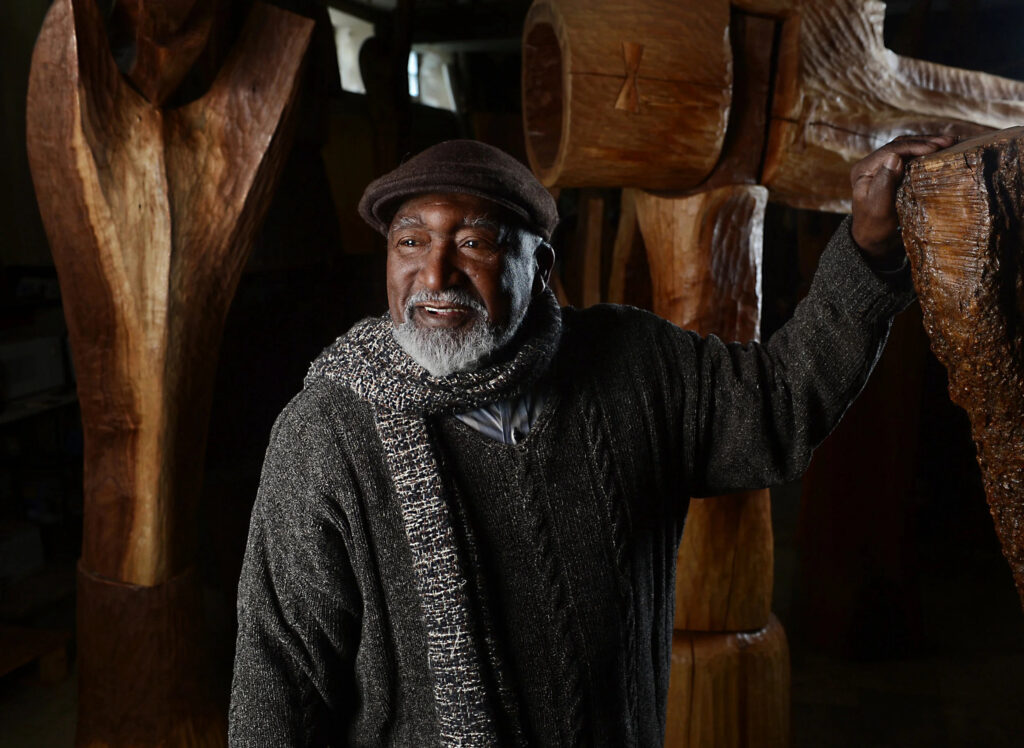
Arriving at his workbench, Thaddeus Mosley never knew precisely what he’d do next. Before him lay stacks of salvaged wood — discarded tree branches, the remains of a trunk. Hunks of felled cherry, walnut and sycamore, Pennsylvania hardwoods that he loved for their color and grain. All taken free from Pittsburgh tree trimmers or the city’s public works department, hauled away by Mr. Mosley in his station wagon.
In someone else’s hands, the stacks were just fuel for a fire. But to Mr. Mosley, a self-taught artist who died March 6 at 99, the wood was as full of possibility as a blank canvas or a block of Carrara marble: raw material for acclaimed sculptures he crafted patiently by hand, using only a mallet, chisel and gouge.
“The log and I decide together what it will become,” said Mr. Mosley, who would use a piece of chalk to draw rough lines on the wood, but never followed a set plan. His pieces were “sculptural improvisations,” akin to the free-flowing jazz he liked to play in his studio.
The results could seem unbound by gravity. Mr. Mosley would join two or three pieces to form abstract sculptures that rose as high as 10 feet in the air, dwarfing their muscular 5-foot-3 creator. They seemed precariously balanced, on the verge of collapse. But that was only a trick of the eye.
“They should look and feel like they’re floating,” Mr. Mosley said, “and the emphasis is up instead of down.”
Mr. Mosley’s own career had an improbable upward trajectory, given how late his star finally rose. For nearly seven decades, he was a beloved figure in and around Pittsburgh, where he exhibited at the Carnegie Museum of Art and took on public commissions, but remained unknown in art-world capitals like Paris and New York.
Perennially short of money, he sculpted with wood in part because it was so readily available. When he needed stone, he found it in demolished buildings; for metal, he turned to scrapyards. To support himself and his six children, he sorted mail for the Postal Service, taking the night shift so that he could spend his days carving.
In interviews, Mr. Mosley said he was happy just to be working in his studio. But in 2018, at age 92, he gained international attention when some of his pieces were featured in the Carnegie International, a long-running North American art show that he had attended ever since the 1950s, around the time he began sculpting.
“It’s like, I guess, the little league baseball player finally becoming a major leaguer,” he said.
Within a year, he was being represented by Karma, an art gallery with locations in New York and Los Angeles. Brisk sales followed (one of his smaller sculptures recently fetched $127,000 at auction) as his pieces appeared in a group show at the Whitney Museum of American Art, were paired with sculptures by Alexander Calder at the Seattle Art Museum, showed at the Musée National Eugène Delacroix in Paris and traveled across the U.S. in a solo show, “Forest,” that stopped in Baltimore, Los Angeles and Dallas.
“It’s the first time in my life I ever had two dollars to rub against each other,” Mr. Mosley told the New York Times in 2023.
“I don’t feel that the work has improved,” he added, “but the situation has tremendously.”
The exhibitions brought fresh attention to pieces that reflected Mr. Mosley’s love of 20th-century sculptors Constantin Brancusi and Isamu Noguchi, as well as his abiding interest in African tribal art, from Chiwara headdresses to life-size Bamum figures.
“Even in the most straightforward pieces, Mosley weaves together heady pairs of opposites: stillness and motion, curves and straight edges, intimacy and grandeur, conscious intention and organic growth,” art critic Will Heinrich wrote in the Times last year, reviewing a Karma show, “Proximity,” that he deemed “spectacular.”
Mr. Mosley’s success was all the more remarkable given that he was a Black artist — a son and grandson of coal miners — who had come of age in a segregated era.
“The world was a lot narrower for us because of our skin color,” he told interviewer David Lewis, adding that “no matter how hard we worked, and no matter how high we scored in our exams, the teachers always found one extraneous consideration after another to steer the prizes to White kids.”
That narrowness showed itself again after Mr. Mosley served in the segregated Navy and, in the late 1940s, enrolled at the University of Pittsburgh. “We don’t get many colored students majoring in English,” the department head told him. “Generally they don’t do very well.”
More than a decade later, while participating in the city’s first Three Rivers Arts Festival, Mr. Mosley received a word of warning. “Don’t stand around your work,” a Black artist advised him. “Because if White people see that you did it, they won’t buy it.”
Mr. Mosley was quick to note that he was not entirely shut out from the art world. After he had his first major solo show, at the Carnegie museum in 1968, gallerists came calling and suggested he move to New York. But he had young children to look after, and no immediate job prospects outside of the Postal Service.
Haunted by memories of his childhood, in which his family struggled to make ends meet after his parents divorced when he was 8, he decided to stay in Pittsburgh. “No way was I going to abandon my kids to have a so-called art career,” he said.
So Mr. Mosley kept at it, carving eight hours a day — 12 on weekends — while spurning power tools and assistants. By the time he got his big break, he had cut down on his studio time only slightly, to five to seven hours a day.
“Mr. Mosley holds up an example that’s so critical for artists of all generations — to keep going,” said Jessica Bell Brown, who curated his “Forest” show and now leads the Institute for Contemporary Art at Virginia Commonwealth University. “Keep pursuing what drives you, what motivates you, what excites you. That passion, that drive and belief in oneself, is one of the greatest gifts that you can have as an artist.”
The fourth of five children, Thaddeus Gilmore Mosley Jr. was born in New Castle, Pennsylvania, on July 23, 1926. His father served as a union organizer at the mines, a role that led company-hired enforcers to terrorize the family, according to Mr. Mosley; by his account, their home was sometimes shot up two or three times a night. His father returned fire from an upstairs window while his mother, a seamstress, guarded the back of the house.
Thad, as he was known, got his college degree in 1950. He went on to work at the Postal Service in addition to freelancing as a writer and photographer, contributing to the Pittsburgh Courier and to national magazines including Ebony and Jet.
In his late 20s, he took up carving, inspired by decorative wooden birds and fish in the windows of Kaufmann’s, a downtown department store. The shop charged $75 a piece for the teak figures. Mr. Mosley decided he could make them himself, and got the equivalent of an art-school education by reading a guidebook, “The Technique of Wood Sculpture,” by artist Chaim Gross. It taught him all he needed to get started.
While still in college, he married Ruth Ray, whom he met at a YMCA dance. They later divorced, and in 1964 he married Yvonne Reed; they had separated by the time she died in 2015. Survivors include his longtime companion, Teruyo Seya; three children from his first marriage, Martel Mosley, Rochelle Sisco and Lorna Mosley; three children from his second, Tereneh Idia, Anire Mosley and Khari Mosley; eight grandchildren; and two great-grandchildren.
His death, at home in Pittsburgh, was announced in a family statement shared by his son Khari, a city council member. Mr. Mosley’s latest exhibition — of small-scale sculptures crafted in glass — remains on view at Karma through March 28.
“People ask me, ‘What are you working on?’” he told ARTnews last year. “I say, ‘I’m working on the same thing, just trying to make it look a little different.’ ”
The post Sculptor Thaddeus Mosley, who found international fame in his 90s, is dead appeared first on Washington Post.