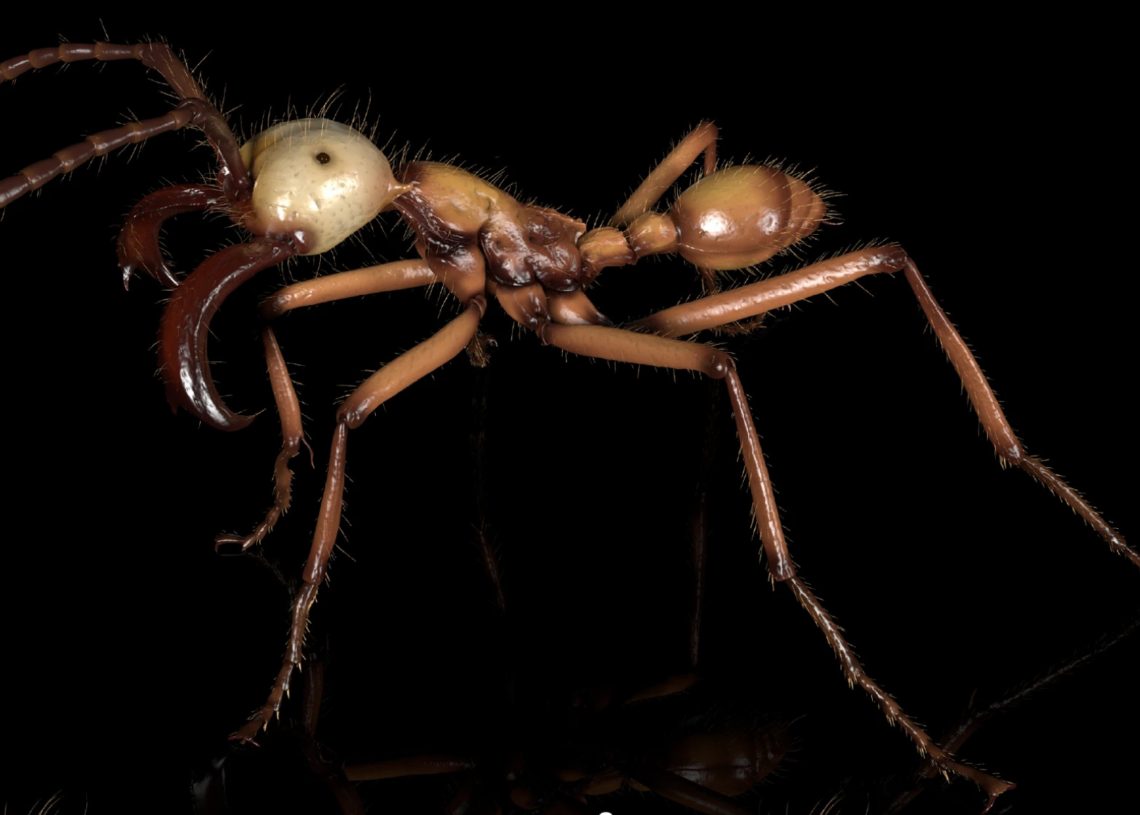
There are a lot of ants. Some estimates put it around 20 quadrillion of them on Earth. That’s why we see them everywhere we go. But how much of them are we really seeing? It’s tough to get a sense of what they really look like when we mostly know them as the little black dots scurrying around in the dirt or in the crumb-filled corners of the kitchen.
According to reporting from The New York Times, scientists have now built one of the most detailed digital collections of ant anatomy ever assembled, creating a sprawling 3D database that could reshape how researchers study not just ants, or even just insects, but all of life.
The project, described in the journal Nature Methods, scanned nearly 2,200 ant specimens gathered from museums and private collections around the world, and all were scanned in southwest Germany.
Turning all of these ants into high-resolution 3D images with the traditional method of using micro-CT scanners would have taken several years. That’s why the team used a synchrotron particle accelerator, which did it all in a week. The synchrotron dramatically sped up the process by blasting the ants with powerful light that can reveal their hard exoskeletons and their delicate inner tissues without having to fuss around with staining the ants to make them readable to the machine.
Hundreds of Ant Species in Painful 3D Detail
To make sure the images were completed as quickly as possible, the researchers worked around the clock in two shifts as a robotic system loaded one specimen after another into the scanner. In the end, the researchers were able to capture the staggering diversity of ants into one big 3D compendium. The scans reveal everything, and in remarkable clarity: exoskeletons, brains, digestive systems, venom glands. Everything.
From the sound of it, the researchers didn’t seem to encounter many problems, with one exception: a lot of the preserved ants curled into awkward poses, making them difficult to scan. On curling them into natural poses would’ve been tedious, time-consuming, and probably damaging to the specimens, so the researchers used artificial intelligence to essentially untangle the knots these preserved ants had crunched themselves into and set them into natural poses.
The researchers imagine this technique having far-reaching consequences across multiple industries, from educators to animators to artists. Of course, the obvious one is scientific research, which is already helping produce scientific insights. Using the scans, the researchers were able to confirm that a mineral-like armored exoskeleton that had been documented in an ant that farms fungus actually appears across several related species.
Researchers hope that this technology can be applied to anything and everything on Earth to build a massive compendium of all life itself. If that transpires, it would mark an incredible feat that started with a bunch of tiny ants.
The post Scientists Scanned 2,000 Ants for a 3D Database, and the Results Are Pretty Creepy appeared first on VICE.