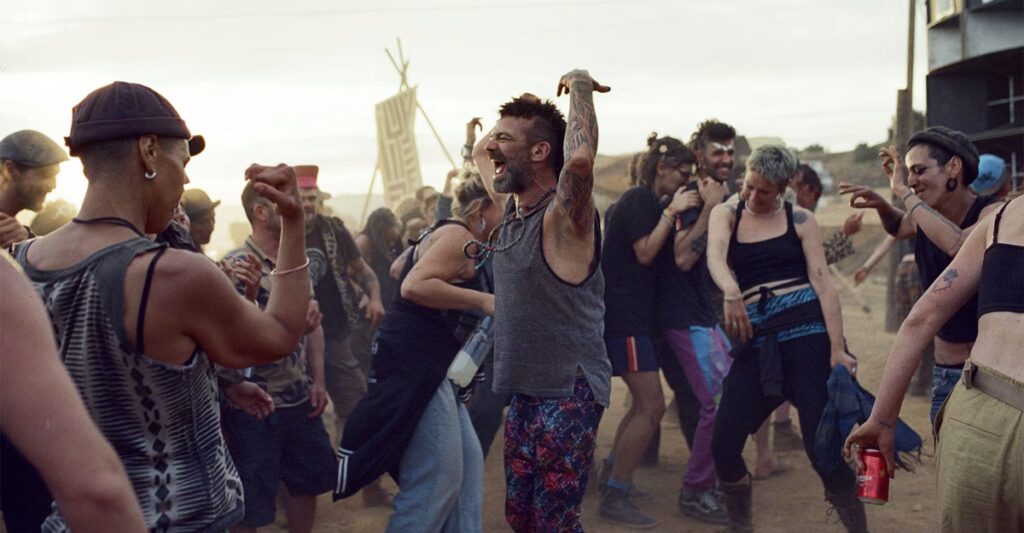
Besides the music, the main appeal of raving is the feeling: of heads jolting to the sound of the beat, and sticky bodies rubbing up against one another as night turns into day. Lost in the groove, dancers escape from modern life—and decades after raving’s emergence in the 1980s, people are still looking for existential meaning at the club. On the outskirts of cities, or under concrete bridges, they slip into their finest nylon-spandex blends, metallic-paper-clip chains, and plastic sunglasses. Whatever ennui the dancers feel, they might, at least, break through it in communion with other disaffected selves.
The possibilities and limitations of raving as an escape are the concern of Sirāt, a film by the French Spanish director Oliver Laxe, which imagines paradise as an illegal rave guarded by towering speakers in the middle of the Moroccan desert. Nominated for Best International Feature Film and Best Sound at the upcoming Academy Awards, Laxe’s movie follows Luis, a middle-aged Spanish father searching for Mar, his missing daughter. He suspects she might be hiding at an open party in the Moroccan desert—“in the south, near Mauritania,” as one reveler describes it—and along with his preteen son, Esteban, he goes to find her.
He isn’t the only one looking for the party. While Luis works to reunite his family, the ravers are chasing what promises to be an epic high. Armed with a gray van ill-equipped for the landscape, Luis follows the ravers—but the journey turns out to be unexpectedly difficult. The group encounters a river too powerful for Luis’s vehicle; when the ravers leave him behind, he erupts in desperation. Luckily, they soon return with a rope, ready to tow him across. It’s a supportive act, one familiar to anyone who has seen dancers looking out for one another on the club floor, mirroring raving culture’s origins in underground spaces built around found communities.
But such gestures count for only so much. In the Muslim tradition, sirāt refers to the narrow bridge connecting Earth to paradise as it passes over hell—a journey cut short because of Luis’s tragic decisions. After the arduous drive, he unintentionally leads the group into a minefield, seemingly a by-product of the territorial conflict between the Moroccan government and Western Sahara’s Polisario Front. In the pursuit of their own happiness, the dancers don’t seem to have learned about the forces shaping the country they are rushing through, and they end up paying a price for their ignorance. Among blaring explosions, it becomes clear that the violence plaguing the world cannot be escaped.
Treating raves as a utopic ideal, as Laxe hints, is impractical. The film’s use of religious imagery—in footage of the Islamic ritual tawaf on TV, in the positioning of speakers at the desert party like Catholic figurines on an altar—charges raving with a higher meaning. But the glancing references to Western Sahara’s decades-old territorial dispute, depicted here as a mere unexpected obstacle in the characters’ quest for a transformative experience, belie a deeper history that is not simply a logistical inconvenience. In real life, it’s not hard to imagine the chic dancers who would eagerly catch a red-eye from Berlin’s buzzy Berghain nightclub to attend what sounds like a fantastical party in the desert, only to be confronted with reality.
[Read: Can the right drugs fix your life?]
For many ravers, breathing the same sweat-soaked air while pressed together feels like a genuine form of connection, unlike the frictionless reality displayed on their everyday screens. But trying to find liberation from a suffocating outside proves futile for the characters of Sirāt, as they learn during their doomed trip. There’s no gospel to be found in raving, only a temporary respite. Despite the divine assistance of stimulants and hallucinogens, looking for paradise in the middle of a desert party is a hopeless path.
Those wannabe converts on Saturday nights are at risk of finding themselves adrift when the lights turn off, the synths power down, and it’s time to leave. As some characters in Sirāt do, they might realize they remain lonely, stuck with their otherwise average lives—and still looking for an escape.
The post Paradise Lost, Found, and Lost Again appeared first on The Atlantic.