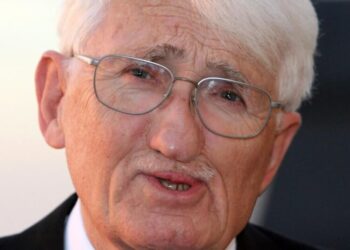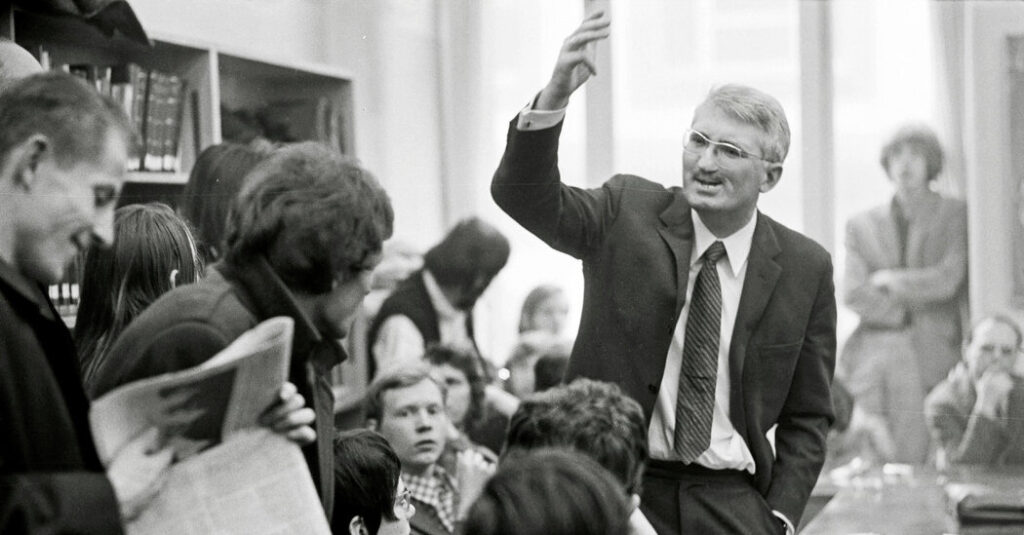
Jürgen Habermas, a philosopher and public intellectual who was one of the most influential and cited thinkers in postwar Germany, died on Saturday in Starnberg, Germany, southwest of Munich. He was 96.
His publisher, Suhrkamp, confirmed the death.
For over half a century and in dozens of books, Mr. Habermas bucked the prevailing trend of postmodern cynicism about truth and reason, offering a staunch defense of Enlightenment ideals and the possibility of individual and societal freedom.
He was best known for introducing in the early 1960s the notion of a “public sphere.” He theorized that democracy emerged and could only continue to exist in a healthy form if there was a space that was outside the control of the state, where deliberation and the exchange of ideas could freely occur. That concept has since swept through a number of academic fields, from political science and history to media studies, spawning thousands of papers and books.
Though a disciple and eventual leader of the famed Frankfurt School of critical social theory, Mr. Habermas had more faith in the promise of modernity than mentors like Theodor Adorno and Max Horkheimer, believing that the Enlightenment was an “unfinished project” that could be corrected through a focus on improved communication.
Starting in the 1970s, he wrote about the “ideal speech situation,” one in which people would come together on equal footing and through a process of rational dialogue arrive at the truth — an idea he expanded on in his major work, “The Theory of Communicative Action” (1981). This sort of consensus-building through conversation — subjecting ideas to, as he frequently put it, an “acid bath of relentless public discourse” — would allow citizens to “exercise collective influence over their social destiny,” he wrote.
If the death and destruction of World War II had soured most thinkers on reason and its power to lead to the common good, Mr. Habermas saw rational communication as a chance to redeem democratic society. “I was always convinced that there is in everyday communicative life, everyday communication, also a kind of push to give reasons, to be more or less reasonable, to give answers to the questions, ‘Why did you say that? Why did you do that?,’” he said in a 2005 interview. “And so that was the motivation to pursue a bit further the issue of the kind of reason that is built-into our everyday language.”
‘Even His Fame Is Famous’
Mr. Habermas was the recipient of many awards, including the prestigious Erasmus Prize in 2013 and the John W. Kluge Prize in 2015. In 2007, when Times Higher Education magazine listed the most cited authors of books in the humanities, Mr. Habermas was ranked seventh, ahead of Freud and Kant. “Jürgen Habermas is not only the world’s most famous living philosopher,” the American philosopher Ronald Dworkin wrote on the occasion of Mr. Habermas’s 80th birthday. “Even his fame is famous.”
Though reading his philosophic writing, often impenetrable in its density, was likened by at least one American intellectual to chewing glass, Mr. Habermas also worked in another register, responding to issues of the moment with countless opinion essays that appeared in German newspapers with great frequency. His abiding concern was the state of democracy and the fear of backsliding into the exclusionary and violent social order he experienced in his youth.
He warned against the rise of nationalism and any attempt to forget or relativize the Holocaust. “There is the obligation incumbent upon us in Germany — even if no one else were to feel it any longer — to keep alive, without distortion and not only in intellectual form, the memory of the sufferings of those who were murdered by German hands,” he wrote.
He also seemed to revel in intellectual fights. His most infamous battle, in the 1980s, became known as the Historikerstreit, or historians’ debate, in which Mr. Habermas attacked right-wing German historians for a revisionism that suggested that the Holocaust was not a uniquely destructive event.
A Figure of Hope
Mr. Habermas was often criticized as naïve, attacked at various moments by members of the postmodern left, who could not abide his belief in universal truths, and those of the neoconservative right, who mistrusted his insistence on compromise and consensus.
His relentless hopefulness about the possibility of human society to talk its way into stable democracy and integration was particularly striking coming from a man whose teenage years were spent in the Hitler Youth. “He was a figure of hope, emerging from the background of a dark history,” Thomas Nagel, the American philosopher, said in an interview for this obituary.
Friedrich Ernst Jürgen Habermas was born on June 18, 1929, in Düsseldorf, Germany, and grew up in Gummersbach, a town about 30 miles east of Cologne. He was the second of three children in a middle-class Protestant family.
He had a cleft palate and throughout his youth had a number of surgeries to correct it, with only partial success. This left him with a speech impediment and a heightened sensitivity, he would later say, to “the medium of linguistic communication without which individual existence would also be impossible.” Bullied as a boy, he was also attuned to those who were excluded from society.
Like many Germans of his generation, he was recruited at the age of 10 into the Hitler Youth, while his father joined the Nazi Party and rose to the rank of major in the Wehrmacht, Nazi Germany’s armed forces. In the autumn of 1944, when he was 15, he received a letter calling him to the Western Front. On the night the military police came to look for him, in February 1945, he happened to be away from home. Allied forces arrived in Germany weeks later, and he was spared military service.
Coming of age in the wake of what would become known as the Holocaust, Mr. Habermas began to form his political and philosophical outlook. The Nuremberg trials made him acutely aware of what he would refer to as the “collectively realized inhumanity” of his fellow Germans. This was, for him, “that first rupture, which still gapes.”
In 1953, at the age of 24 — he was then studying at the University of Bonn, where he would receive his Ph.D. in philosophy the next year — Mr. Habermas took to task Martin Heidegger, at the time Germany’s greatest living philosopher, for not coming to terms with his Nazi past. Mr. Heidegger’s 1935 work, “Introduction to Metaphysics,” had been reissued, leaving in place a reference to the “inner truth and greatness” of the Nazi Party.
“Is it not the foremost duty of thoughtful people to clarify the accountable deeds of the past and to keep the knowledge of them alive?” Mr. Habermas wrote.
From 1956 to 1959, Mr. Habermas worked as Theodor Adorno’s first assistant at the renowned Institute for Social Research at the University of Frankfurt, otherwise known as the Frankfurt School, where neo-Marxist Jewish intellectuals were trying to rebuild their understanding of the world by applying philosophical ideas to social problems.
But Mr. Habermas did not share in what was an understandably fatalistic tone to the critical theory developed by Adorno and Horkheimer. The war had made them skeptical about modernity, and as Mr. Habermas characterized it, they saw capitalism’s mass consumer culture as a “total system of delusion” that quashed individuality.
The Public Sphere
In 1959, Mr. Habermas left the institute and completed his second doctorate at the University of Marburg. His dissertation, which became the 1962 book “The Structural Transformation of the Public Sphere,” was his attempt to offer a more positive vision for how reason and communication could help people escape the delusion. He presented a history of the birth of the “public sphere” in the 18th-century coffee shops of Britain and France, where bourgeois men, aided by the proliferation of newspapers, discussed politics and tried to reach an understanding on issues of common concern. This was a sort of golden age for Mr. Habermas, when such rational communication led to the creation of democratic societies.
“He was a rationalist when it was unfashionable to be one,” Matthew Specter, a professor at the University of California, Berkeley and the author of a 2010 biography of Mr. Habermas, said in an interview. “He developed a more chastened conception of reason — plural, dialogic, fallible — that convinced generations of postwar Europeans that the Enlightenment faith in critique and progress could be made meaningful again after the disasters of 20th-century Fascism and Communism.”
Mr. Habermas succeeded Horkheimer in his chair at Frankfurt University in 1964, effectively leading the Frankfurt School into the next generation. For 10 years, from 1971 to 1981, he was director of the Max Planck Institute in Starnberg, before returning to Frankfurt and teaching there until he retired in 1994. In the last decades of his life, he continued to lecture widely, with long stays in the United States, at Northwestern University and New York University.
He is survived by his wife, Ute Habermas-Wesselhoeft, whom he married in 1955, and two children, Tilmann and Judith Habermas. Another daughter, Rebekka Habermas, a historian and professor of modern history at the University of Göttingen, died in 2023.
‘Ach, Europa’
In his later years, Mr. Habermas was particularly worried about the state of the European Union project, a concern that was reflected in the title of his 2008 book, “Ach, Europa.”
The best counterweight to the destructiveness of both global capitalism and nationalism, he believed, was the sort of integrated democratic union of states that the E.U. was supposed to represent, and he was saddened by what he saw as the erosion of this idea by market and social forces. In numerous headlines in the early 2010s, he was referred to as “the last European.”
Mr. Habermas also turned his attention to the place of religion in the public sphere. Prompted in part by the hostility toward Muslims in Europe, he wrote in a number of books about what he called a “post-secular” society in which he sought to reconcile the atheistic tradition of the Enlightenment with modern religion, and reflexive faith with the institutions of democracy.
It was part of a lifelong ideal that imagined the greatest number of citizens deliberating together about the state of their society. As he wrote in a 2010 guest essay in The New York Times, in which he deplored the renewal of nationalistic tendencies in European politics: “Democracy depends on the belief of the people that there is some scope left for collectively shaping a challenging future.”
The post Jürgen Habermas Dies at 96; One of Postwar Germany’s Most Influential Thinkers appeared first on New York Times.