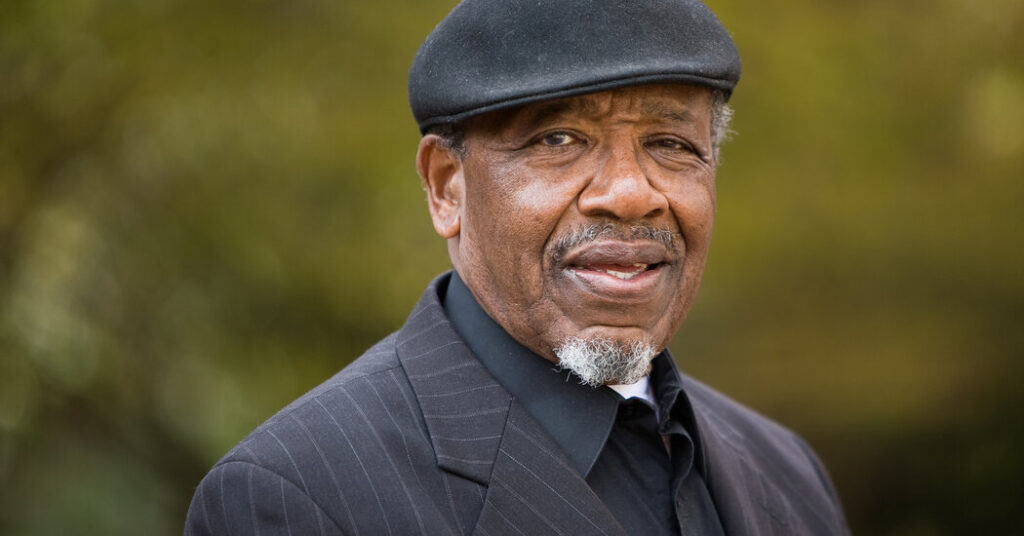
The Rev. John M. Perkins, a Black evangelical leader who created an influential network of community-development ministries fostering social justice and racial reconciliation, and who wrote powerfully of forgiving the white officers who had once brutalized him, died on Friday at his home in Jackson, Miss. He was 95.
His daughter Priscilla Perkins confirmed the death and said he had Alzheimer’s disease and dementia.
Charles Marsh, a professor of religious studies at the University of Virginia who had written about Mr. Perkins, called him “one of the most transformative Black Christian voices in the years after the civil rights struggle.”
Mr. Perkins’s central insight, which he first gained in the 1960s, was that faith leaders could best help impoverished communities by connecting spiritual nourishment — helping people develop a rich interior life with Jesus through the Gospel — to a more programmatic mission of fostering social and economic uplift. It was a faith-based Christian social movement that he called the “whole Gospel.”
Too many churches, in his experience, he said, were devoted more to the spiritual afterlife than to giving hope to the poor that they could improve their everyday lives in practical ways. His desire, he told The Clarion Ledger of Jackson, Miss., was “to lift people out of poverty and to share the word of God.”
“I was for both,” he said. “That was strange. Evangelicals didn’t think that went together.”
Against the backdrop of the civil rights era, Mr. Perkins transformed his Mississippi-based ministry — based in the small town of Mendenhall and later in Jackson, the capital — into an enterprise that included a church, a day care, a health center, a thrift store and programs for youth sports, housing cooperatives, leadership training, legal assistance and adult education.
“People were asking the question, How do we take this precious gospel to the poor without dehumanizing them and without making a free handout?” the Rev. Dolphus Weary, who succeeded Mr. Perkins in running the ministry, said in an interview. “John Perkins gave people the concept of how to do that.”
Over the years — in lectures, books, articles in Christian publications and fund-raising tours — he developed an even more ecumenical vision: of communities of Black and white Christians living and working together in distressed communities. He was effective in recruiting young, left-leaning evangelicals and others from traditions like the Mennonites and the Church of the Brethren.
Bryan Stevenson, a lawyer and human rights advocate who founded the Alabama-based Equal Justice Initiative, said Mr. Perkins left a significant imprint. He not only wanted Black people “to recover from bigotry and make progress — he definitely focused on that,” Mr. Stevenson said, “but he wanted everybody to hear a message of redemption.”
In 1982, Mr. Perkins moved to Pasadena, Calif., intending to retire but soon saw a need to start a new ministry in a blighted, crime-ridden neighborhood there. Soon, helped create two organizations: the Christian Community Health Fellowship, a network of clinics and doctors and other medical professionals to care for the underserved; and the even broader Christian Community Development Association.
The C.C.D.A. involved thousands of individuals and hundreds of churches working at the grass-roots level with organizations like Head Start and Habitat for Humanity to help the poor and the dispossessed — welfare recipients, crack addicts — achieve self-sufficiency through jobs; safe, new homes; and spiritual salvation.
“The highest calling of God is to love your neighbor as you love yourself,” Mr. Perkins told The Baltimore Sun in 1994, speaking of his C.C.D.A. work. The organization, he said, was “styled on the life of Jesus, who had the greatest concern for the weakest of people.”
Picking Cotton, Hauling Hay
John M. Perkins — he said he never knew what the middle initial stood for — was born on June 16, 1930, in New Hebron, Miss., the youngest of six children. The next year, his mother, Maggie (Waller) Perkins, died of pellagra, a chronic vitamin deficiency exacerbated by malnutrition. His father, Jasper Perkins, left the family.
The children were dispersed among relatives. John was raised by his paternal grandmother and his extended family of sharecroppers and bootleggers. He quit school in third grade to work a cotton plantation. By 12, he was making 15 cents a day hauling hay while seeing white workers being paid $2 for the same labor — an injustice that awakened him to racial and economic inequality, he later remembered.
Four years later, his older brother Clyde, just home from Army service in World War II, was shot twice in the stomach by a town marshal for talking back and grabbing the officer’s club after being hit with it. Mr. Perkins recalled holding his brother’s head in the back seat of a car as they raced to a hospital in Jackson — one that would accept Black patients. Clyde was declared dead at the hospital.
For his safety, Mr. Perkins was sent to stay with an uncle in Monrovia, Calif., northeast of Los Angeles. While working at a foundry, he helped lead a strike for higher wages as production demand increased. “I never forgot the potency of united action,” he told The Mississippi Free Press in 2008 in recounting that episode.
After Army service in Japan during the Korean War, he became a janitor at the Shopping Bag food-store chain and so impressed the owner with his work ethic that he was promoted to a department that helped make shopping carts. It was this job, he said, that allowed him to buy a home in Monrovia for his growing family, having married Vera Mae Buckley in 1951.
As he told it, he spent his days forgetting the past and striving for material gain. But one day, burned out, he suddenly found himself emotionally overwhelmed seeing his 4-year-old son, Spencer, smiling beatifically and singing a song about Jesus’s love for children of all colors. He had learned the song at summer Bible school at an evangelist church.
Spencer’s happiness stirred a curiosity in Mr. Perkins, and he began accompanying his son to the church. It was a revelation to him, he said, to see Black and white congregants worshiping together — something inconceivable in Mississippi at the time. He began attending adult Bible study classes.
Even more revelatory to him, he said, was a visit to a nearby prison camp on a mission to convert souls.
He was “horrified,” he said, to see so many Black teenagers incarcerated so close to his suburban haven. As he gave his testimony, he said, he was moved by how they cried when they heard his own story of growing up grindingly poor and feeling empty and embittered until finding communion with God.
“It was the first time in my life,” he told Professor Marsh in a 2009 interview, “that I realized that in sharing the gospel, it was possible that God could transform, and take what I had shared and affect other people’s lives.”
After being ordained a Baptist minister in 1958, Mr. Perkins wrote, he felt called to return to Mississippi, “to identify with my people there, and to help break the cycle of despair — not by encouraging them to leave, but by showing them new life where they were.”
With financial support from the evangelical Calvary Bible Church in Burbank, Calif., he moved to Mendenhall, southeast of Jackson, and started his ministry.
A Beating, and Forgiveness
In an era of civil rights protests throughout the South, Mr. Perkins helped organize a voter-registration drive in 1965 in Simpson County, Miss., where Mendenhall was the county seat, and, during the Christmas season of 1969, helped lead a boycott against local white retailers who refused to hire Black workers.
Early in 1970, he traveled to a jail in neighboring Rankin County to bail out students who were involved in his ministry and who had participated in the boycott; the Mississippi Highway patrol had pulled over their vehicle, ostensibly for reckless driving. Mr. Perkins and two colleagues themselves were jailed after the police said that Mr. Perkins had tried to strike an officer and that shotguns were found in their car. They charged them with inciting riot, resisting arrest and possessing a concealed deadly weapon.
Held in custody, Mr. Perkins said, he was brutalized by a notorious sheriff and his deputies. The officers kicked him in the head, stomach and groin and shoved a bent fork up his nose and down his throat, leaving him in a pool of blood. Nearly beaten to death, he had a heart attack, he said, and lost two-thirds of his stomach in surgery.
In his book “Let Justice Roll Down” (1976), Mr. Perkins described lying on a hospital bed and focusing on Jesus’s suffering and forgiveness. “When I saw what hate had done to them, I couldn’t hate back,” he wrote of the racist officers. “I could only pity them. I didn’t ever want hate to do to me what it had already done to those men.”
The book was widely read in evangelical circles. Over the next decade, Mr. Perkins appeared at the Rev. Billy Graham’s stadium-filling crusades and served on the boards of evangelical organizations. His other books included “A Quiet Revolution: The Christian Response to Human Need, a Strategy for Today” (1976) and “One Blood: Parting Words to the Church on Race and Love” (2018, with Karen Waddles).
In addition to his daughter Priscilla, he is survived by his wife; five other children, Phillip, Derek, Deborah and V. Elizabeth Perkins and Joanie Potter; and many grandchildren and great-grandchildren. Two sons died, Spencer in 1998 and Wayne in 2017.
In later years, Mr. Perkins lived in Jackson and was much in-demand as a speaker.
“I’m not waiting until I get to heaven,” he said at a Baltimore church gathering in 1994. “I’m doing what I can do here on earth. What I’ve got to do in my life, I have to do in time. I’ll be judged by what I do in time.”
The post John M. Perkins Dies at 95; Evangelical Minister Espoused Social Justice appeared first on New York Times.