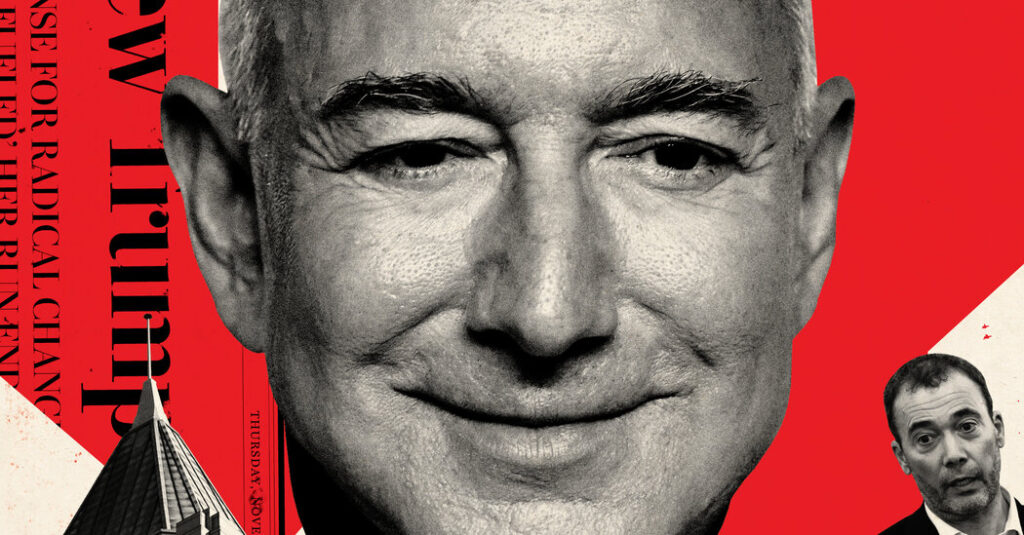
Jeff Bezos called Matt Murray, the executive editor of The Washington Post, in late November to send an urgent message: Please do not quit.
Mr. Murray had known for months that Mr. Bezos, the billionaire founder of Amazon and owner of The Post, was planning widespread layoffs to stem over $100 million in annual losses. But Mr. Murray felt sidelined in the preparations and had recently told the company’s chief executive, Will Lewis, that he was leaving the paper, according to two people with knowledge of the discussions.
Mr. Bezos told Mr. Murray that he wanted him to help shape a newsroom that would be financially sustainable far into the future, the two people said. And Mr. Bezos pitched his strategy: Reduce the newsroom’s budget by half and double the productivity of those who remained, all while protecting some core parts of The Post’s coverage, like investigative journalism. Mr. Murray said he would take on that challenge.
In a single call, Mr. Bezos had set a new course for The Post and upended the power balance between his top news editor, Mr. Murray, and his top business executive, Mr. Lewis.
Mr. Bezos has said repeatedly since he bought the paper in 2013 for $250 million that he wants the company to break even, not to rely on his largess. He initially invested heavily, and the company thrived for many years, with the newsroom doubling in size.
But his call to Mr. Murray shows how Mr. Bezos’ approach changed as the company’s fortunes fell in recent years. Dissatisfied by expanding losses and dwindling readership, Mr. Bezos is demanding that The Post embrace some of the same ideas that brought him riches at Amazon, including a focus on data and efficiency, according to interviews with more than two dozen people with knowledge of his actions at the company, all of whom would speak only on the condition of anonymity.
Mr. Bezos stays out of the paper’s day-to-day operations, as he always has. He has not shown up in the newsroom since 2023. But he has dipped in more forcefully in the past two years, resulting in a series of jarring upheavals in strategy and leadership at one of the country’s most decorated news organizations.
Even as he pushed the company for more accountability, Mr. Bezos had until recently taken little public responsibility himself for the problems under his watch, including the tumultuous tenure of Mr. Lewis, that contributed to an exodus of talent from the newsroom and readership declines. He has insisted that he does not want to sell the company, but also wants to see it perform better.
The newsroom has shrunk by nearly half over the past two years, to about the size it was when he bought it. Mr. Lewis departed days after widespread cuts were made in February. What remains are questions about whether Mr. Bezos’ strategy will stop The Post’s downward spiral or accelerate it.
Some critics of Mr. Bezos’ actions at The Post have accused him of trying to curry favor with President Trump to support his other companies. He is the executive chairman of Amazon, the main source of his $234 billion fortune; owns and is deeply involved in the rocket company Blue Origin; and recently created an A.I. start-up, Project Prometheus, where he is co-chief executive.
Although he has expressed public optimism about Mr. Trump, he has told many people at the paper that his goal is the same as always: for The Post to pay for itself. He has not inserted himself into The Post’s news coverage of the president, according to a dozen people with knowledge of his interactions with the newsroom, and its reporters have aggressively covered Mr. Trump’s campaign and administration.
“Change was necessary to meet our challenges, modernize and advance our overall mission,” The Post said in a statement. “We have an owner who believes that our authoritative journalism is critical to our democracy, and he wants The Washington Post to be successful. We must listen to data from our audience in order to be relevant.”
In early February, a few months after Mr. Bezos persuaded him to stay, Mr. Murray oversaw the cuts they had discussed, laying off roughly 350 of the paper’s 800 journalists. In a meeting with the newsroom, Mr. Murray acknowledged there was “a major cost-savings target that we had to hit.” He then emphasized the importance of “using data intelligently” to inform The Post’s decisions, according to a recording of the meeting obtained by The New York Times.
Jeff D’Onofrio, the company’s chief financial officer, whom Mr. Bezos named as Mr. Lewis’s replacement as chief executive, bluntly described the company’s situation at another meeting that month with a line that could have been pulled from an Amazon slide deck.
“Increased costs and decreases in output,” Mr. D’Onofrio said, according to the recording, “that’s resulted in a doubling of costs for story-units since 2020.”
Leadership Overhauls
Problems at The Post started several years ago, when its audience diminished after expanding during the first Trump administration and the Covid-19 pandemic. It would be more than a year before Mr. Bezos, who was dividing his time among Amazon, Blue Origin and his newfound lavish lifestyle, signaled that he recognized the problem.
He visited the newsroom in January 2023, not long after The Post’s top editor at the time, Sally Buzbee, alerted him to rising concern in the newsroom over the direction of the business, according to two people with knowledge of the discussion. He met with many of the paper’s top journalists, several of whom, like Ms. Buzbee, expressed concerns about Fred Ryan, the company’s longtime chief executive.
A couple of months later, after a round of layoffs and increased public attention on The Post’s business woes, Mr. Bezos joined a video call with Gerry Cardinale, the founder of the investment firm RedBird Capital Partners, and Jeff Zucker, the former chief executive of CNN and one of Mr. Cardinale’s fellow investors. As part of a wide-ranging conversation, the pair took Mr. Bezos’ temperature on selling them a stake in the company, according to three people familiar with the conversation.
Mr. Bezos never showed any interest in selling — but not long after, he made a big change.
In June, Mr. Bezos announced that he was replacing Mr. Ryan with Patty Stonesifer, a longtime Amazon board member and one of Mr. Bezos’ closest advisers. He said she would run the company temporarily while leading the search for a permanent chief executive. After speaking with Post journalists, she also floated the idea of creating a board of advisers for the newspaper. Mr. Bezos rejected the suggestion, according to two people with knowledge of the decision.
The chief executive search soon narrowed to Mr. Lewis, a former publisher of The Wall Street Journal, part of Rupert Murdoch’s media empire, and Josh Steiner, a media and finance executive who previously worked at Bloomberg.
Mr. Lewis was the front-runner, but a cloud hung over him because of his involvement in the cleanup of a years-old phone-hacking scandal at Mr. Murdoch’s British newspapers. Mr. Lewis has denied any wrongdoing, and Ms. Stonesifer concluded he was fit for the job after speaking to journalists and media executives who knew Mr. Lewis and his work, according to two people familiar with the decision. A dinner with Mr. Bezos at his mansion in Washington sealed the deal.
One of Mr. Lewis’s marquee initiatives was to create an experimental “third newsroom” to spur innovation at The Post, a move that required a reshuffling of news leadership. Mr. Lewis pledged to involve Ms. Buzbee in hiring decisions, according to a person with knowledge of their interactions.
But without consulting Ms. Buzbee, the person said, Mr. Lewis chose a former colleague to take her current job and planned to have her manage the so-called third newsroom instead. Mr. Lewis did not comment for this article.
A frustrated Ms. Buzbee talked to Mr. Bezos, who urged her to stay at The Post while also praising Mr. Lewis’s strategic acumen. She left the company not long after.
In her place, Mr. Murray, a former editor in chief of The Wall Street Journal, stepped in.
A Single Opinion
In late September 2024, Mr. Bezos met with the leadership of The Post’s opinion department at his sprawling estate near Miami. With the presidential election on the horizon, he appeared primed to assert himself, as owners typically do on the opinion side in American newspapering.
Mr. Bezos outlined his political and economic beliefs, which boiled down to a mix of libertarian and pro-business policies, according to two people with knowledge of the talks. He also wondered aloud whether the paper should stop endorsing candidates in presidential elections.
Both changes would reverse decades of tradition at the newspaper, whose editorial board had regularly endorsed Democratic candidates. He offered a blunt response when David Shipley, the opinion editor, noted that changing the editorial ideology could turn off some subscribers.
“I don’t care,” he said, according to a person with knowledge of the exchange.
A few weeks later, he ended presidential endorsements, effectively killing a draft editorial that encouraged readers to vote for Vice President Kamala Harris, Mr. Trump’s Democratic opponent.
Despite a reader uproar, including thousands of canceled subscriptions, Mr. Bezos suggested even more changes at a December meeting with The Post’s leadership in New York: Only views in line with his support of personal freedom and free markets would be welcome in the opinion section, which has long published columnists and guest writers with a variety of views.
At another point, he expressed enthusiasm about the commentary published by The Free Press, a news and opinion site founded by the journalists Bari Weiss, Nellie Bowles and Suzy Weiss, and that month had dinner with Bari Weiss and Ms. Bowles in New York at the upscale Indian restaurant Bungalow.
In January, he traveled to Washington and was assigned a seat onstage near Mr. Trump at his inauguration.
Mr. Bezos’ reorientation of the opinion pages became official weeks later. The section, he wrote, would stand “in support and defense of two pillars: personal liberties and free markets.” He added that “viewpoints opposing those pillars will be left to be published by others.”
The fallout from the announcement was immediate. Subscribers again canceled in droves, and some Post Opinion employees resigned. (A Post spokeswoman said the opinion section had recently seen an increase in reader engagement.)
Mr. Shipley resigned. He now works as an editor at The Times.
A Pivotal Call
In early November last year, Mr. Lewis presented Mr. Bezos with a plan to restore The Post to profitability. The proposal came at a huge cost: laying off roughly 200 newsroom employees. Those cuts would be on top of a round of buyouts over the summer that had led to the departure of numerous top-tier reporters and editors.
But Mr. Bezos raised objections to the plan, including that Mr. Lewis’s proposal was not sufficiently grounded in data, according to three people with knowledge of the conversation. He told Mr. Lewis to try again.
The sudden pause took newsroom leaders aback: Editors had just been told that cuts would take place the next week. Mr. Lewis convened a meeting of senior executives and blamed them for the lackluster planning and called for a small group to build data models to satisfy Mr. Bezos, according to two people familiar with the meeting.
That group didn’t include anyone from the newsroom, one of the people said. And tensions mounted over the next few weeks between Mr. Lewis and Mr. Murray, as Mr. Lewis asked for increasingly larger cuts, according to two people familiar with their relationship.
Later in November, Mr. Murray informed Mr. Lewis of his plans to resign.
After Mr. Bezos talked Mr. Murray into staying around Thanksgiving and gave him a major role in the layoff plan, Mr. Murray and his deputies took their cues from Mr. Bezos. They examined customer data to assess which sections generated the most readership and compared that against the cost to produce that coverage.
The math was not easy. Foreign reporting was expensive, for example, but it was essential to keeping The Post competitive on national security, a key beat for The Post. There was no way to hit their target without affecting the scope of the newsroom’s coverage.
In the end, the sports and books departments were folded, and the metro section was gutted. Most international correspondents and editors were laid off, including those in the Middle East, just weeks before the United States and Israel attacked Iran.
More than 60,000 readers canceled their digital subscriptions that week, according to an internal document reviewed by The Times. (A spokeswoman for The Post disputed that figure but declined to provide an alternate number.)
The day after the staff cuts, Mr. Lewis was photographed attending a pre-Super Bowl event in California’s Bay Area. The picture, which circulated on social media, incensed Ms. Stonesifer, who was no longer chief executive but kept ties to Mr. Bezos.
She conveyed her irritation about the photo to a person close to Mr. Bezos, according to a person with knowledge of the exchange. It was not the first time she had raised concerns about Mr. Lewis. Around the time of Ms. Buzbee’s departure, Ms. Stonesifer told Mr. Bezos that she had given up on advising Mr. Lewis because he had ignored her counsel on building a better relationship with the newsroom, two people said.
After more than a year of public criticism of Mr. Lewis, Mr. Bezos’ patience had run out. Two days after the photo circulated, Mr. Lewis resigned with a terse note that thanked Mr. Bezos and no one else.
‘Existential Questions’
In two town halls after the layoffs, Post leaders tried to explain the data behind the cuts.
Mr. D’Onofrio reiterated the message that The Post was losing money and said that since 2020, the number of articles published per reporter had dropped by 36 percent, while total page views for news and opinion had declined by 48 percent, according to recordings of the meetings. He noted that executives discovered in some areas it cost “multiple thousands of dollars to publish a single story.”
Also in the works, he said, is an “audience value score” — a number from 0 to 100 that incorporates the amount of time readers are engaged with an article, the number of times it’s shared, user registrations and subscription starts.
“Basically anything over 70 is extraordinarily good,” Bryan Flaherty, The Post’s managing editor for content strategy, said in one of the meetings.
Mr. Murray acknowledged in one of the town halls that there was “genuine trauma” and “existential questions about our future,” but tried to reassure the staff that Mr. Bezos believed in the mission of The Post.
On Thursday, Mr. Bezos conveyed much the same sentiment to The Post’s leadership in person.
He welcomed a group of top Post journalists and business executives to his Washington mansion to talk about the paper’s future, according to two people who attended the meeting. On display by a coffee station was a busted lock from the Watergate burglary that The Post exposed.
The gathering included two 90-minute sessions with lunch between them. As at Amazon meetings, the sessions started in silence as copies of detailed memos on The Post’s business trajectory and use of data were circulated and read. A vigorous discussion followed, including many questions directed at Mr. Bezos. He confidently answered more during the lunch, of pecan-crusted halibut, sliced steak medium-rare, patatas bravas and sautéed vegetables served on china emblazoned with the newspaper’s “WP” logo.
Mr. Bezos said the company had gotten off track years ago because of inattentive oversight, including from him, and a sluggish response to changes in the media business, according to the people at the meeting. But he reassured the group that he was committed to its future, and said he had spurned seven offers to sell The Post.
Several Post journalists asked Mr. Bezos if he would make a public statement of support for The Post similar to what he had just conveyed to them.
Mr. Bezos said it was a good idea. He told them he would think about it.
Kirsten Noyes contributed research.
Benjamin Mullin reports for The Times on the major companies behind news and entertainment. Contact him securely on Signal at +1 530-961-3223 or at [email protected].
The post How Jeff Bezos Upended The Washington Post appeared first on New York Times.