In Lebanon, the war is raging not only in the streets — it is also in hospitals and clinics.
Medical workers have been killed while treating patients or trying to assist others, underscoring the human cost of the ongoing strikes.
Since March 2, Israeli airstrikes have killed at least 31 health professionals and wounded 51 others, the Lebanese health ministry said on Saturday. Israel has carried out at least 37 attacks against emergency medical workers, the ministry said.
Tedros Adhanom Ghebreyesus, the director general of the World Health Organization, condemned the attacks on health care workers and said it marked “a tragic development in the escalating Middle East crisis.”
The deaths illustrate the conflict’s intensity and the strain on a health system caring for over 2,000 civilians injured since the violence began. Some 826 people have also been killed.
The effects of the conflict were evident on Friday night, when an Israeli airstrike hit a health center in Borj Qalaouiyeh in southern Lebanon, the health ministry said. The strike resulted in nearly the entire medical team, including doctors, paramedics and nurses, being killed. Only one severely injured worker survived, while 12 people were killed, the ministry said. Authorities reported that four more individuals remained missing.
Lebanon’s health ministry described the strike as “criminal conduct” and accused the Israeli government of broader attacks on medical personnel and facilities, including targeting ambulance crews during rescue missions on the front lines.
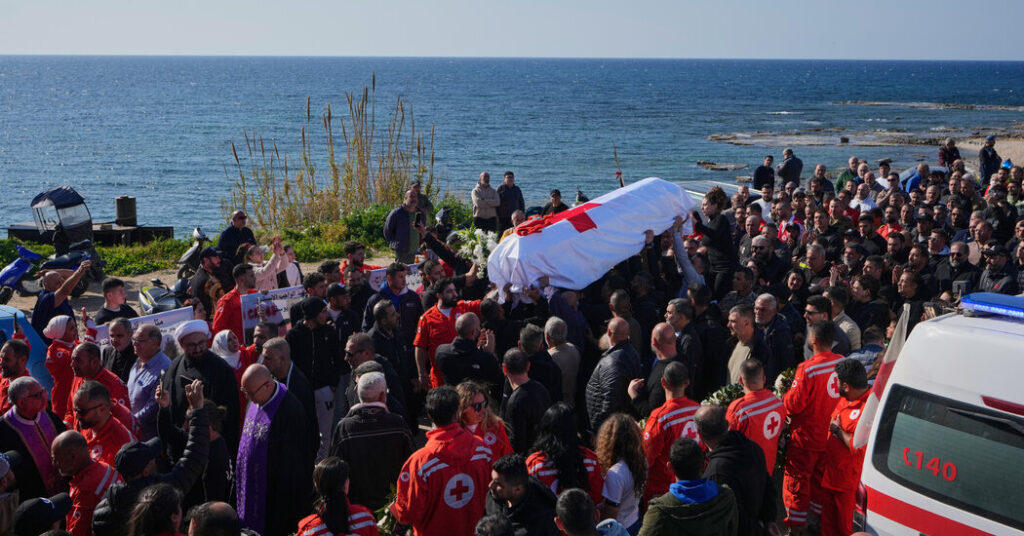
This week, the Lebanese Red Cross reported that one of its volunteers, Youssef Assaf, died from injuries he sustained while assisting victims of an airstrike in southern Lebanon.
In a statement, the Israeli military said that it was aware of reports of a strike in Borj Qalaouiyeh and that the incident was under review.
Israel says it is targeting Hezbollah positions, focusing on infrastructure and facilities used to launch attacks against Israel. Hezbollah, the Iranian-backed proxy group, launched rockets at Israel soon after the United States and Israel began attacking Iran on Feb. 28.
On Saturday, Avichay Adraee, a spokesman for the Israeli military, accused Hezbollah of “extensive military use of ambulances” and medical facilities. He did not specify any location or indicate whether the Borj Qalaouiyeh health center was currently being used by the group.
A senior Hezbollah official, speaking to The New York Times on the condition of anonymity because he was not authorized to comment, dismissed Mr. Adraee’s accusation as false, and said it was meant to undermine people affected by the war.
On Saturday, the Israeli military also said, without offering any evidence, that Hezbollah was moving rockets and other weapons along Lebanon’s coast in civilian trucks.
Lebanon’s medical workers and facilities have previously been attacked. Dozens of health and rescue workers were killed during the 2024 conflict, while hundreds of ambulances and health facilities were damaged.
“The attacks on ambulances, primary care centers, civil defense organizations and medical workers responding to strike sites are extremely alarming,” Ramzi Kaiss, the Lebanon researcher at Human Rights Watch, said in an interview with The New York Times. “Under the laws of war, doctors, nurses and paramedics are protected in all circumstances and must never be attacked.”
Hwaida Saad and Aaron Boxerman contributed reporting.
Abdi Latif Dahir is a Middle East correspondent for The Times, covering Lebanon and Syria. He is based in Beirut.
The post Dozens of Medical Workers Killed as Israel Hits Lebanon appeared first on New York Times.