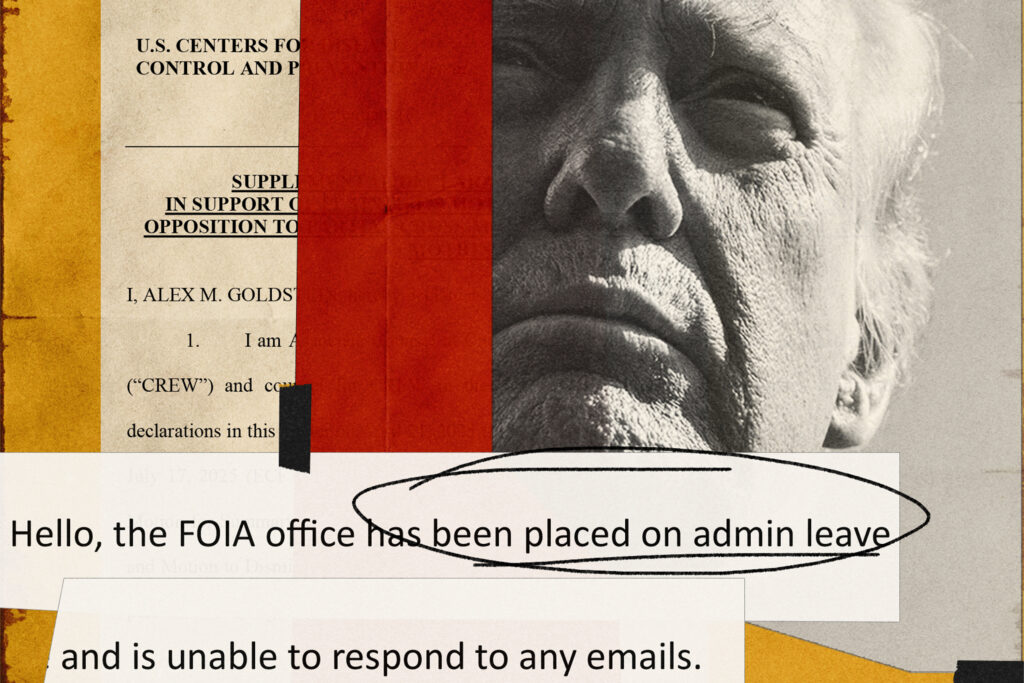
“Hello, the FOIA office has been placed on admin leave and is unable to respond to any emails.”
This was how the Centers for Disease Control and Prevention responded by email this past spring to a Freedom of Information Act request for records about the risk of catching measles in areas with low vaccination rates.
The public health institute’s FOIA office had lost too many staff members to fulfill public record requests — falling victim to President Donald Trump’s executive order to eliminate “waste, bloat, and insularity” in the federal government by significantly reducing its workforce.
As hundreds of thousands of federal employees were fired or chose to leave the government last year, FOIA requesters — myself included — wondered: Would these personnel reductions further undermine the federal government’s already strained ability to follow federal law and disclose public records when requested under FOIA?
The answer, we now know, is a resounding yes. Attorneys for at least 13 agencies and departments have explicitly stated in 26 FOIA lawsuits that the downsizings were the reasons for failures to meet FOIA deadlines, according to a Washington Post review of 339 active FOIA lawsuits.
The true number of requests mired in federal staffing cuts, however, is almost certainly higher: The Post’s count does not include the hundreds of cases in which officials gave no specific reason in court for the delays.
The court records reviewed show that the personnel cuts delayed responses to a range of FOIAs, including requests for information about the death of a person in custody at a federal prison, alleged pro-Hamas activities on U.S. campuses, the Wuhan Institute of Virology and even an investigation of the 1955 death of Emmett Till.
Annual FOIA reports published by government agencies reinforce what agencies have told judges in these cases: Each of the 10 Cabinet-level departments that has published its report for fiscal year 2025 has listed fewer total employees working on FOIA than in fiscal year 2024.
Since Trump retook office 14 months ago, the federal workforce has decreased by more than 300,000 employees through a combination of efforts, including the Reductions in Force initiative, a hiring freeze, deferred resignations, early retirements and Voluntary Separation Incentive Payments.
Enacted in 1966, the Freedom of Information Act is one of the strongest tools available for journalists, academics, researchers and everyday people to hold the government accountable for its decision-making and spending of taxpayer dollars. When successful, FOIA requests have revealed government waste, wrongdoing and potential violations of the Constitution.
A clear picture of how the shrinking workforce has negatively impacted the public’s access to federal records is finally starting to emerge, as the court filings demonstrate.
“Good luck with that they just got rid of the entire privacy team,” wrote an Office of Personnel Management employee in a February 2025 email, responding to a FOIA request from CNN for information about security clearances granted to members of the U.S. DOGE Service.
In April, the Bureau of Prisons told a federal court in the District of Columbia, “Three out of five of the attorneys … left the FOIA office under the deferred resignation program. As a result there is a severe staffing shortage in the BOP FOIA/Privacy Act Unit.” This was the agency’s explanation for why it could process no more than 300 pages of records a month in response to a FOIA request filed by the parents of a man who died at a federal prison in Florida.
In the same month, the Drug Enforcement Administration attempted to justify its slow disclosure of records concerning compensation claims for private property damage caused by the agency: “Currently, the DEA FOIA Unit has two (2) FOIA specialists processing all DEA litigation requests and near 20 overall vacancies cannot be filled due to the federal government hiring freeze.”
In May, a lawyer for the Education Department told a federal court in D.C. that the Reduction in Force initiative had eliminated the lawyer previously working on the litigation. As a result, the current counsel “does not have access to the working files of the prior agency counsel and is currently working to familiarize itself with the production in this case.” She was attempting to explain why court proceedings had stalled over the release of records concerning whether the Education Department had shared personal financial aid information with Meta without the consent of filers.
The Education Department’s latest FOIA report shows a reduction of 59 total employees working on FOIA, or 53 percent, over the previous year. The DEA and the Bureau of Prisons have not yet filed their reports.
Many FOIA offices that blamed delays on staffing reductions were at agencies and divisions targeted by DOGE, including the Department of Health and Human Services, the CDC, the National Institutes of Health, the Food and Drug Administration, the Education Department, the U.S. Agency for International Development, the African Development Foundation, and the U.S. Institute of Peace.
The U.S. Institute of Peace told the federal court for the Northern District of Texas in October that “due to budgetary cuts made by the Department of Government Efficiency,” only one employee was available to produce documents in response to a FOIA request seeking records about the “decision to deny DOGE personnel access to USIP headquarters.”
Even agencies and divisions generally not targeted by the Trump administration for downsizing also told courts they could not meet their deadlines due to cuts in their FOIA offices. These include the Department of Homeland Security, the Federal Bureau of Investigation, the Drug Enforcement Administration, the Federal Bureau of Prisons, U.S. Citizenship and Immigration Services, and U.S. Immigration and Customs Enforcement.
When contacted by The Post, spokespeople for the Bureau of Prisons, HHS, the FBI, the African Development Foundation, and U.S. Citizenship and Immigration Services did not dispute The Post’s findings. The DEA stated it would not comment on personnel or staffing. The other agencies I mention in this column did not respond to my questions about staffing cuts and failures to meet FOIA and court deadlines.
At a Senate Judiciary Committee hearing on the Freedom of Information Act in April, Sen. Dick Durbin (D-Illinois) described the reduction in numbers of FOIA officers as an attempt to “foil FOIA.” I briefed his office on what The Post found in its review, and he sent a statement: “The findings … are deeply troubling, yet not surprising,” he said. “Contrary to his false claims about overseeing the most transparent Administration in history, from the start of his second term President Trump has deliberately weakened the ability of agencies to respond to requests for information by eliminating employees responsible for responding to FOIA requests.”
Of course, not all members of Congress concur with Durbin. At the same Judiciary Committee hearing, Sen. Ashley Moody (R-Florida) said she supported the personnel cuts to FOIA offices because she believed the terminated officers had hidden information about covid-19, immigration and other issues.
“The whole point of the Freedom of Information Act is to make sure that we the people can assess the performance of our government,” Moody said at the hearing. “We now have an administration that says, ‘Okay, we’re going to try and deal with the career embedded people that withheld from we the people.’”
Her office did not respond to my email asking whether she is concerned about slowed FOIA response times.
To be sure, inadequate funding and staffing of FOIA offices was a problem long before last year’s cuts, contributing to delays that have often caused FOIA requests to take years — sometimes decades — to process. A 2024 Government Accountability Office report found that “agencies have most frequently cited challenges related to staffing” as a reason for their FOIA backlogs.
When FOIA offices are working as they should, requests should not end up in court. The law states that requests should be processed at the administrative level within 20 business days, with the option of a 10-day extension for “unusual circumstances.” Agencies are supposed to provide responsive records — or explanations for a denial — before that deadline, no lawyers necessary.
Congress included an emergency provision in the law for situations when agencies violate the requirements of the statute: It allowed requesters to sue in federal court.
Once a suit is filed, judges often set production schedules that create deadlines for how long agencies can take to find, review and release requested records. Court cases can impose transparency on the process; agencies typically have to explain reasons for delays.
Working with my Post colleagues Daranee Balachandar and Beck Snyder, I found jaw-dropping admissions from some agencies about how the FOIA process had broken down.
The nonprofit Citizens for Responsibility and Ethics in Washington, or CREW, filed a FOIA lawsuit in April, seeking records related to the CDC’s decision not to release a report about the relationship between an area’s vaccination rates and the risk of catching measles. The lawsuit included a declaration from “Person Doe,” who stated they were an employee of the CDC FOIA office: “I am submitting this declaration pseudonymously because I fear retaliation.”
The CDC is one of 13 operating divisions of HHS. According to Person Doe, after staff cuts effectively closed the CDC FOIA office, requests were routed to HHS. However, Person Doe continued: “To the best of my knowledge, there are currently no FOIA officers within HHS tasked with or trained on responding to FOIA requests to CDC.”
Indeed, in a separate lawsuitinvolving another stalled HHS request, a lawyer representing the agency told a judge that it had “absorbed responsibility for handling FOIA requests made to CDC” — but was not processing requests in compliance with the law.
Despite the absorption, HHS admitted to the court that it “did not become aware” of a FOIA request filed by Bloomberg News journalist Jason Leopold for records about the CDC’s policy changes related to measles outbreaks until he sued HHS, CDC and other divisions more than three months after he initially filed his request.
“The work FOIA officers do to process records and keep the public informed about government actions is essential,” Leopold told me in an emailed statement. “Without them, FOIA is weakened and the public is left in the dark.”
Emails released to CREW in response to its lawsuit show that, after layoffs, Deputy Chief FOIA Officer William Holzerland wrote in an email that HHS was “operating a skeleton crew” and that “there will be widespread, significant service delays across nearly every HHS … FOIA program as we reorganize.”
In an interview with The Post, Nikhel Sus, senior counsel for CREW, said, “We had never seen such a wholesale gutting of a particular agency’s FOIA office in this way that did not seem to take into account how the agency would comply with the statute going forward.”
Emily Hilliard, press secretary for HHS, did not respond to The Post’s emailed questions about the staffing cuts and FOIA delays but offered a statement: “The prior FOIA process was fragmented and often ineffective at providing timely information to the public. HHS is committed to improving and streamlining the FOIA process, including working with private-sector partners, in alignment with Secretary [Robert F.] Kennedy’s push for radical transparency.”
Fortunately for FOIA requesters, there are signs that judges may be losing patience with agencies that blame staffing cuts for missed deadlines.
In April, D.C. federal judge Randolph Moss rejected in part a request by HHS for more time to provide records to a university researcher about the number of minors that were victims of human trafficking while in the agency’s custody or in the custody of an agency-approved sponsor.
Moss’s order explained: “It is no excuse — and it will be no excuse — for the agencies to assert that they are now unable to respond to Plaintiff’s requests or proposals because they are understaffed. … The Court expects them to comply with their obligations under FOIA and the Court’s orders, and that they may not evade those obligations by dismissing the FOIA staff needed to do so.”
Eleven days after the judge’s admonition, the agency began releasing the records.
Aaron Schaffer, Daranee Balachandar and Beck Snyder contributed to this report.
Do you have a question, comment or FOIA idea? Leave a comment or email me at [email protected].
The post Did Trump cuts slow access to public records? We found 26 cases that say yes. appeared first on Washington Post.