As the price of oil soars to $100 a barrel and countries scramble to limit the fallout of the sudden loss of Middle East fuel, China has two significant advantages over its geopolitical rivals.
Many of its new cars run on electricity. And that electricity is mostly powered by sources at home.
China has spent decades and hundreds of billions of dollars investing in electric vehicles and renewable energy, a long-term strategy that is paying off as other countries grapple with upheavals in the oil market. Beijing has sought to curb its reliance on foreign energy by expanding domestic supply and accelerating the development of alternative power sources, including solar, wind, hydro and nuclear.
Chinese demand for refined oil, gasoline and diesel fell last year, making a second straight annual decline. This has prompted experts to forecast that China’s oil and gas consumption has peaked and that the country is less vulnerable to energy supply disruptions than it once was.
“China has a bit of a buffer and cushion compared to other countries,” said Michal Meidan, head of China energy research at the Oxford Institute for Energy Studies, an independent research group. “The supply outages and price hikes do not significantly impact the running of its economy.”
Oil prices pushed above $100 for the second time in a week amid growing concern that the ongoing fighting will choke traffic in the Strait of Hormuz, the narrow waterway between Iran and Oman that is a vital trading route for oil and natural gas. World leaders agreed to release a record amount of oil from their emergency reserves and President Trump has backed off penalties on some Russian exports, but fears of supply shortages persisted as a growing number of oil and cargo ships became targets.
While China imports half of its seaborne crude from the Middle East, Beijing has enough breathing room to avoid the kinds of extreme measures that some Asian countries have already adopted, such as shifting to a four-day workweek or closing universities to conserve energy.
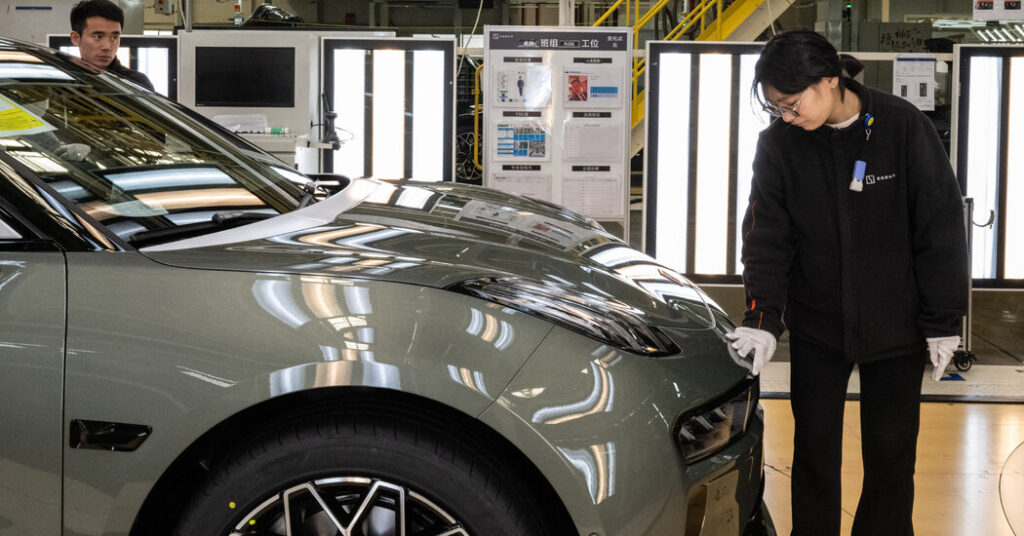
Over the last few years, China has transitioned the world’s largest automobile market from gas-powered cars to electric vehicles faster than any other major global economy. China sold more electric vehicles in 2025 than the rest of the world combined.
Half of the new cars sold in China are electric vehicles or hybrids that run on both electricity and gas. Around one-third of all new heavy-duty trucks are purely electric, according to the latest available data from the China Passenger Car Association.
By comparison, in the United States, around 22 percent of new cars sold in 2025 were hybrid or electric vehicles, according to the U.S. Energy Information Administration. Electric vehicle sales plunged over the last few months of the year after a chunky federal tax credit expired.
A decade ago, China’s leading position in electric cars might have seemed improbable. Sales of gas-guzzling cars were surging and gasoline demand was climbing. But that changed after the government poured $300 billion into a campaign to create homegrown high-tech giants and reduce its foreign dependencies.
From 2016 to 2022, the Chinese government provided more than $5 billion in direct subsidies to automakers to spur the development of electric vehicles, according to government data. BYD received the largest share and last year overtook Tesla as the world’s top electric vehicle seller.
For Beijing, this shift to electric vehicles and renewable energy is rooted in a long-running fixation on addressing China’s energy vulnerabilities.
In the 2000s, Chinese leader Hu Jintao was preoccupied with another narrow passageway through which oil traveled to China: the Strait of Malacca. At the time, the waterway that separated Indonesia and Malaysia from Singapore carried 25 percent of global trade.
“It is no exaggeration to say that whoever controls the Strait of Malacca will also have a stranglehold on the energy route of China,” a Chinese state-owned newspaper wrote in 2004.
At the time, China responded by creating emergency petroleum stockpile facilities and investing in renewable energies. Today, among major Asian economies, China is the least affected by disruptions to oil and gas supplies from the Middle East.
China is the world’s largest buyer of oil and gas and relies on coal for a little more than half of its energy needs. Oil and natural gas make up about a quarter. The rest is powered by nuclear and renewable sources like solar, wind and hydro.
“China’s push for renewable energy is not motivated by the environment but by the need for energy security and also as a driver of growth,” said Mathias Larsen, senior policy fellow at the Grantham Research Institute at the London School of Economics. “Energy security has always been high on the agenda; it has always been a key motive.”
While three-quarters of its oil is imported, it has been building up large strategic reserves. In the first two months of the year, China imported 16 percent more oil than in the same period a year earlier.
Two days after the United States and Israel launched attacks on Iran, the People’s Daily, the official newspaper of the Chinese Communist Party, cheered China’s progress.
“My country has built the world’s largest renewable energy system,” the paper blared on the front page. The article noted that China had the world’s largest electric vehicle charging network.
But even with these efforts, people in China are not entirely shielded from higher oil prices.
Many Chinese homes also still rely on imported gas for heating. Chinese factories need petrochemicals to produce raw materials critical to the world’s supply chains, such as polyester for garments and rubber for tires.
On Monday, as oil prices skyrocketed toward $120, owners of internal combustion engine cars waited in long lines outside gas stations in dozens of Chinese cities. China’s top economic planning agency increased the retail price of oil by five percent, the biggest increase in four years, bringing the price at the pump to an average of $4.20 per gallon.
Not long after the move, one woman in the Chinese coastal province of Zhejiang vented her frustration on RedNote, a Chinese social media app, posting a picture of her white Audi A5 filling up at a gas station.
“What used to be called ‘fill up the tank’ is now called ‘pay for the petrol car,’” she wrote. “Every time I step on the gas, it feels like my heart’s bleeding.”
Alexandra Stevenson is the Shanghai bureau chief for The Times, reporting on China’s economy and society.
The post China’s Edge in an Oil Shock: Electric Cars and Renewables appeared first on New York Times.