Before David Ross had ever stepped foot on a golf course, he had taught himself the swing. He learned the basics of the game at 8 years old by watching “Shell’s Wonderful World of Golf” and whacking balls with a set of used hickory shaft golf clubs in the alley outside his family’s Petworth rowhouse in Northwest Washington.
At 10, he finally got a taste of the green as a junior golfer, and his lessons took him to Washington’s Langston Golf Course — a place he saw as the “mecca for Black golf.”
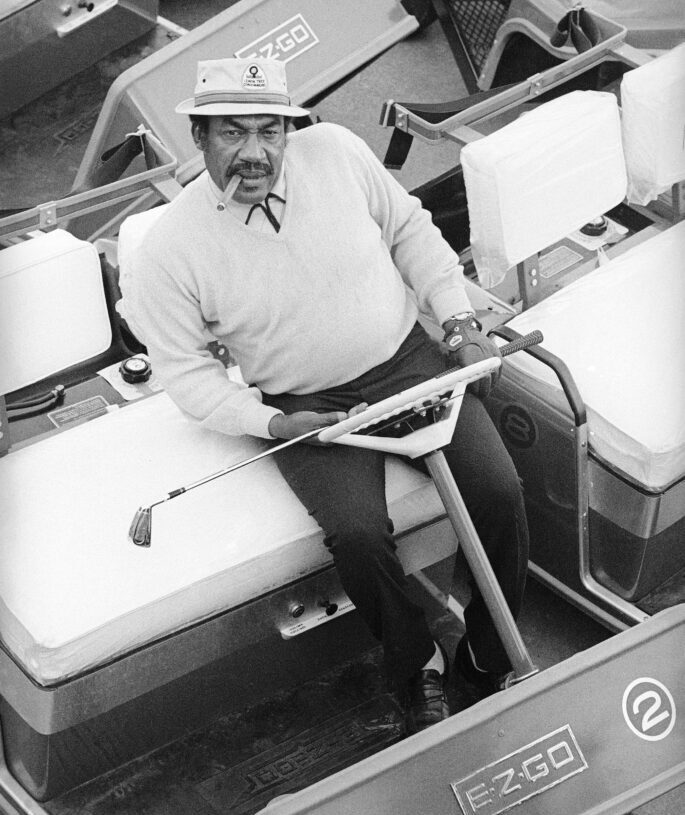
The public, 18-hole course built on the site of a former landfill along the western edge of Kingman Lake was a regular stop for Black pioneers in the sport. Ross once saw Charlie Sifford, the first African American golfer to play on the PGA Tour, compete at Langston. Lee Elder, the first African American to play in the Masters Tournament, handed Ross the second-place trophy and putter he earned at a tournament hosted there.
On any given day, appearances by figures of power and Black celebrity became the topic of conversation among children and elders, who often treated the course as a community gathering spot. Musicians Cab Calloway and Billy Eckstine were regulars. A tree on the third hole was nicknamed after the boxer Joe Louis, because each time he “came to Langston to play golf, he would hit a ball into that tree,” said Ross, who also once witnessed Muhammad Ali jump out of a black Cadillac with his entourage, ready to hit the putting green.
“It was just one of those moments you’ll never forget,” said Ross, now 71 and the spokesperson for the Royal Golf Club, a golfing group for Black men founded in 1933. “The segregation with golf and those kinds of things, we didn’t realize that until we wanted to go to East Potomac or to Rock Creek.”
Tee time for African Americans in the District was restricted to two afternoons a week at a pair of the city’s public, White-only golf courses until 1924, when a sandy nine-hole course — backdropped by the Washington Monument — was built for Black golfers along the Potomac River. The course was eventually closed to make space for the Memorial Bridge. Langston, constructed in 1939, replaced it.
Almost 90 years later, players like Ross, who have continued the legacies of the Black golfing groups that organized for the course’s creation, fear that history may be erased.
Langston Golf Course — along with East Potomac Golf Links and Rock Creek Park Golf, the city’s two other municipal golf courses — is now under the control of the Trump administration, after the Interior Department terminated a 50-year lease last year between the federal government and National Links Trust, the nonprofit organization that has managed the courses since 2020. National Links Trust continues to run the courses for now and said it is seeking talks with the administration on its future.
The White House has shared little publicly about the administration’s vision for the courses, but President Donald Trump told reporters last month that he wants to remake East Potomac into a championship-ready venue — a move that has sparked legal action from local golfers.
“As a private citizen, President Trump built some of the greatest golf courses in the world, and he is now extending his unmatched design skills and excellent eye for detail to D.C.’s public golf courses,” White House spokeswoman Taylor Rogers said in a statement to The Washington Post. “The President and his extraordinary team will redevelop these decrepit golf courses in our nation’s capital to restore glamour and prestige.”
An Interior Department spokesperson said in statement that the president was committed to preserving Washington’s municipal golf community and affordability.
Meanwhile, Langston’s long-term fate is unknown, worrying the golfers who call it a historic home.
“With the stroke of a pen,” Ross said, “he would erase all of our history.”
The fight to play
The first American-born professional golf duo included John Shippen, a D.C. native and the son of a formerly enslaved man in Virginia, and Oscar Bunn, a member of the Shinnecock Indian Nation of Southampton, New York.
Both trained as caddies in their teens at the Shinnecock Hills Golf Club — the nation’s first premier golf course — in the 1890s and competed in the U.S. Open. Shippen played in the tournament five times. His brother, Cyrus Shippen, joined him and Bunn to play at the 1899 U.S. Open before returning to the nation’s capital, where Cyrus taught at Dunbar High School, started a golf team and was an advocate for Black people playing golf.
Before Jim Crow and racial segregation became fixed in many aspects of American society, “two black brothers and their supporters saw in professional golf the exact opposite of what it would become: the stereotype of American exclusion,” wrote Lane Demas, an associate professor of history at Central Michigan University, in his book “Game of Privilege: An African American History of Golf.”
Washington constructed the city’s first two public links between 1914 and 1924 at West and East Potomac parks. In 1921, Lt. Col. Clarence O. Sherrill, who oversaw the Office of Public Buildings and Grounds, granted African Americans limited time to play, but they immediately faced torment from White players.
Black women who attempted to play the courses had their golf balls stolen and thrown around the courses aimlessly, said D.C. native and longtime golfer Paulette Savoy. One time it was so bad, she said, the women received a police escort.
“Wherever they played, they had trouble with people harassing them,” said Savoy, 80.
It was those conditions that led a coalition of Black golfing groups to press the federal government for a stand-alone course for African Americans or the integration of all of the city’s public links.
Petitions circulated by the Citizens’ Golf Club, later the Royal Golf Club, and the Riverside Golf Club prompted the construction of Lincoln Memorial Golf Course — a sandy nine-hole course along the Potomac River, somewhere between West Potomac Park and Interstate 66 — in 1924, according to a National Park Service report.
Over the next decade, the course was made nearly unplayable by the construction of the Arlington Memorial Bridge. The federal government scouted sites across the city for a replacement, while Wake Robin Golf Club — a newly formed golfing group made up of the wives and girlfriends of the Royals — worked with their spouses to send petitions to government officials, including Interior Secretary Harold Ickes.
Ickes approved the construction of a nine-hole course for African Americans on the site of an old landfill in the growing majority-Black neighborhood of Kingman Park in Northeast Washington. Construction of the course by the Works Progress Administration overlapped with another New Deal construction project happening nearby for African Americans. The Langston Terrace Dwellings, named after Virginia’s first Black U.S. congressman, John Mercer Langston, was the first public housing complex built in D.C. and only the second built in the nation.
When the golf course opened on June 11, 1939, it took the name of the nearby housing project. A ceremony and exhibition match between local Black golf champs marked the occasion. Edgar G. Brown, a Civilian Conservation Corps administrator and the husband of Wake Robin member Paris Brown, called the new links — dotted with freshly planted red oak and willow trees, tulip poplars and American elms — “the finest of its kind in the country.”
After their success at lobbying government officials for greater access to public golf in Washington and the completion of a new course, the women of Wake Robin still believed they could win a fight to integrate all of the city’s public links.
On a Sunday in June 1941, Paris joined her husband, three golfing buddies and six U.S. Park Police officers in what Demas called the first “direct-action protest in the world of golf” at East Potomac Park. The group walked onto the green and got through nine holes without much problem, according to Demas. When they reached the 10th hole, the group was met with an audience of reporters, Black supporters and White opposition. At the end, they earned near-perfect scores.
The moment was reported by Black newspapers from Atlanta to Chicago and eventually made its way to Ickes, who agreed to desegregate all of Washington’s park land and facilities.
“I can see no reason why Negroes should not be permitted to play on the golf course,” he wrote. “They are taxpayers, they are citizens, and they have the right to play on public courses on the same basis as whites.”
It took 14 years for that promise to be fulfilled, following years of anti-integration efforts from White segregationists in the city. The Supreme Court’s 1954 decision to integrate the city’s public schools in Bolling v. Sharpe cleared the path to integrate D.C.’s municipal park land.
An uncertain future
Walking into the clubhouse on a recent afternoon, people passed by a set of metal markers fixed on the building’s brick wall in 1991, after the course had expanded to 18 holes and its first nine were added to the National Register of Historic Places. Inside, a TV was set to the Golf Channel. Another cycled through black-and-white photos, capturing an early era of Langston.
As the lunch hour passed, people started to trickle in. An ongoing game of cards played by a pair of older Black men drew vocal spectators. Between breaks in the game, people made their way to the counter, where a half-smoke cost $5 and sweet tea was on tap at Melva’s Kitchen.
A couple placed an order and sat in front of a timeline displayed on the wall, highlighting Lee Elder’s career. After making PGA history in 1975, Elder was looking for a course to host golf camps for children. Langston, which had just been shuttered due to mismanagement and a loss in revenue, caught his eye. After years of negotiations, Elder was awarded the contract to run Langston in 1978, and ran the course into the early ’80s with his wife, Rose Elder. Renovations to the course began immediately under their leadership. New sod was laid, sand traps were refilled, and a driving range was added on the island across the water.
More than 40 years later, there’s no question that work could be done on the course. The drainage could be better. It’s dusty and “old school,” said Savoy. But to her, Langston is still a “vibrant course.”
“And it’s a course that we hope that Trump will respect the history of,” she said.
Since Trump returned to office, his administration has pushed to review or remove content in an effort to expel “improper ideology” from the nation’s public monuments, markers and museums, often targeting mentions of race and slavery. In January, the Smithsonian Institution turned over photographs of labels, placards and other texts on display in its museums, following pressure from the White House. A number of National Park Service sites — including an exhibit on the people enslaved by President George Washington in Philadelphia — have had displays taken down (and in some cases restored) as battles over their removal play out in court.
The White House and the Interior Department did not answer specific questions about whether posted historical content at Langston is under review. In a statement, a spokesperson for National Links Trust called Langston “a cathedral at the intersection of civil rights history and sport” and said the nonprofit has intentionally honored that during its tenure.
When the group took over the historic properties, it pledged to restore and keep them accessible and affordable. Interior officials said the nonprofit failed to complete required capital improvements and lacked a plan to address alleged lease defaults. National Links Trust has disputed the claims, saying it has invested more than $8.5 million in course improvements and complied with the lease while navigating a web of federal permitting requirements.
“Black people have done so much for golf,” said Daryn Dickens, a junior studying history and sports management at Howard University. “We’re going backwards.”
When she was 10, the Alexandria native said there were courses in the Virginia suburb she could have gone to for lessons, but her parents wanted her playing at Langston because of its significance to the community.
“I’m so glad I did that,” said Dickens, 20. All of the kids in her First Tee class were Black, she said. So were the coach and the older gentlemen sitting outside the clubhouse, cheering on the little ones.
Throughout its lifetime, Langston remained a place for the community’s youths as much as it was for the adults. It was Wake Robin members who “taught us young boys” the true etiquette of golf, said Ross. Savoy’s late husband, Ray Savoy, founded the Langston Junior Boys and Girls Golf Club in 1989, offering scholarships and inviting young people from all over the city to learn the game of golf at Langston.
Since the recent shake-up, National Links Trust said it will find new places to offer its First Tee and Jack Vardaman Workforce Development Program, which instructs D.C. high-schoolers on golf course operations through a paid internship and caddie program.
Ross, who now runs Education First Golf Academy, a youth golf program in Wilmington, Delaware, said being at Langston as a kid and talking to men with “real history” felt like a “constant mentorship.”
Whenever he’s in town, he said, he tries to carry on that tradition, offering clothes and items for children in need or words of advice for those who need to hear it. If the course is made less accessible or the administration chooses to clear the history from its living memory, what the children of Langston are set to lose worries Ross the most.
“It would be devastating to the kids that look like me, that’s coming behind me, that will lose that richness,” said Ross, “that legacy.”
The post Black history was made on this golf course. Some fear Trump will erase it. appeared first on Washington Post.