In his wartime appearances before the media, Defense Secretary Pete Hegseth boasts of the death, destruction and retribution that the United States has been bringing to Iran. But as Americans have been learning in the two weeks since the war began, violence has a way of breaking containment.
Within 24 hours of the first strikes on Iran, a man wearing a shirt with the colors of the Iranian flag killed three people and injured more than a dozen others at a bar in Austin, Texas, the authorities said. A week later, two teenagers from Pennsylvania who claimed to be inspired by the Islamic State tried to set off an explosive device at a protest in New York, according to prosecutors.
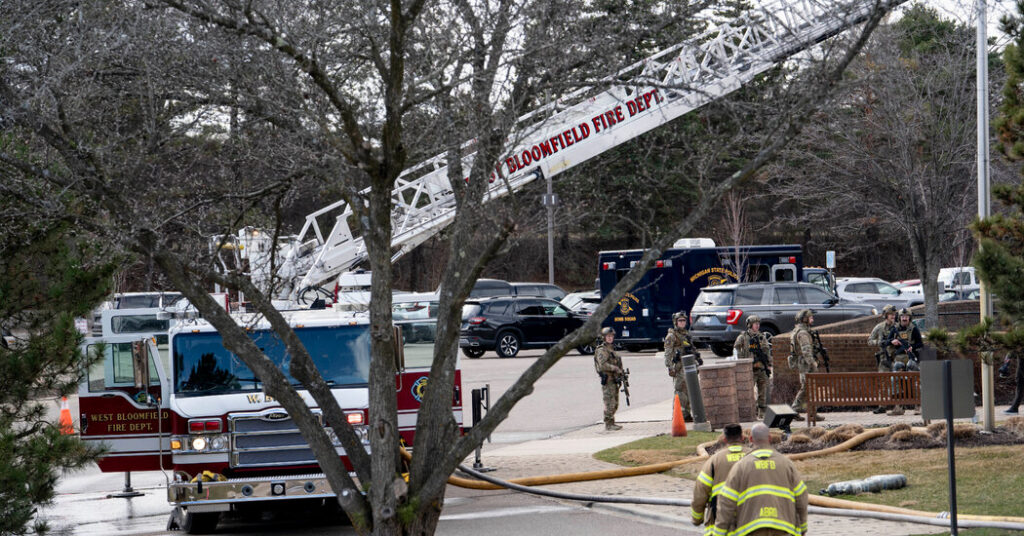
On Thursday, a former National Guard member who had spent several years in prison for providing support for terrorism walked into a classroom of R.O.T.C. cadets in Norfolk, Va., killing the instructor and wounding two students, according to the F.B.I. Less than two hours later, a man in Michigan plowed a car into a synagogue and killed himself during a gunfight with security guards, the police said.
The circumstances of these attacks are different, and the motives are still being investigated. But they have contributed to swelling anxiety and dread in an already violent America.
Since the beginning of the war, which took most Americans by surprise, the police have stepped up patrols on public transit and around synagogues. Law enforcement officials are urging people to report any suspicious activity, as the police did in the days following the Sept. 11 attacks.
And while President Trump has tried to reassure Americans, with his assertion that his administration has had its eye on Iranian “sleeper cells” in the United States, the recent attacks underscore that the dangers are diffuse and that violent attackers can, and often do, come out of nowhere.
“If you don’t know anything about them and no one’s reported them and they’re not a subject of a prior investigation, how are you supposed to find those people?” said Javed Ali, a former senior U.S. counterterrorism official who now teaches at the Gerald R. Ford School of Public Policy at the University of Michigan.
Professor Ali said that if the war continued in Iran, there would be more attacks or attempted attacks from “lone offenders” like the man the authorities said had plowed into the synagogue. A U.S. citizen, the man had learned that four family members in his native Lebanon were killed in recent Israeli airstrikes targeting the Iran-backed militant group Hezbollah, according to an imam in Michigan and a Lebanese official who said he knew the man and his family.
“There’s no common set of factors that drive people,” Professor Ali said.
Whether a coordinated attack directed by Iran is a significant risk for the United States right now is a matter of debate among counterterrorism experts. Some pointed out that since Sept. 11, operations of that scale and impact have not been carried out against the United States, and that federal law enforcement has expanded its capacity to monitor and disrupt plots.
But over the past year, thousands of agents within the Homeland Security and Justice Departments have been shifted from their prior duties to immigration enforcement, a priority of the Trump administration. The department is for now partially shut down, as Senate Democrats demand changes to the administration’s immigration enforcement tactics. Many national security officials have resigned or been fired over the past year, and morale among many of those who remain is low. A 22-year-old with no apparent professional background in national security was appointed to oversee terrorism prevention programs.
Beyond all these disruptions, Alex Plitsas, an expert on terrorism at the Atlantic Council and a former Pentagon official, said that counterterrorism, “both from a funding and priority standpoint, has been moving steadily down the list as we move further away from 9/11.”
Iran, he pointed out, has a history of plots in the United States, including a plan to assassinate Saudi Arabia’s ambassador in 2011 and more recently a murder-for-hire scheme in which Iran was accused of plotting to kill an Iranian dissident in Brooklyn.
“They have become incredibly emboldened in recent years, and it’s clear they have less fear of trying to operate on U.S. soil,” he said. “And if the regime is near collapse and they see an existential threat and the current tactics that they are using for retaliation aren’t working, the fear is that they could escalate to something along those lines.”
But as the last few years have proved, it does not take elite teams of secret agents to sow fear and even death.
Amateur attackers, acting solo, are less likely to kill large numbers of people, and their attacks are more likely to fail. But they are often harder to head off, because while ideology may be one factor, they are often driven by personal and political grievances as well.
Indeed, the stated motives may betray an ignorance of the underlying ideological difference. The Islamic State, which may have served as an inspiration for two of the recent attacks, is hardly an ally of Iran, each aligned with a different branch of Islam. But with the war in the news, a person with a range of grievances may align with Iran “to make a name for himself,” said Daniel Byman, the director of the Warfare, Irregular Threats and Terrorism Program at the Center for Strategic and International Studies.
Robert Pape, a professor of political science at the University of Chicago who has studied political violence for 30 years, argues that focusing too heavily on precise motives is a mistake anyway.
“People want the motive, because once they get the motive, they say, ‘Well, that doesn’t apply to me. I’m safe,’” he said. “That’s not the world of political violence we’re in anymore.”
While a substantial majority of Americans do not approve of political violence, the number who do, from the far right to the far left, has risen in recent years, he said. Grim headlines bear this out: the killing of Charlie Kirk, the killing of a Minnesota lawmaker and her husband, assassination attempts against Donald Trump, the attack on Representative Nancy Pelosi’s husband, and the murder of a health insurance executive, not to speak of the violent images proudly posted online by the administration itself.
Professor Pape said that research showed that rising support for political violence is highly correlated with increasing antisemitism. And, he said, “the more political violence there is in the world, the more it’s related to Israel or the Middle East, the more you could get actors, either coming from the right or the left in America, to do antisemitic attacks. And that is a really dangerous situation.”
Into that already escalating climate of political violence comes the Iran War.
Colin P. Clarke, the executive director of the Soufan Center, an intelligence and security consultancy, is visiting Washington much less frequently these days to share his views on threats, he said.
“This administration doesn’t want to hear from experts,” he said.
He fears that counterterrorism is too focused on previous threats, like the Islamic State, that have significant differences from Iran, and that the ideological seriousness of terror groups sympathetic with Iran may be underestimated. He has discussed all this with other former officials.
“Everybody I talk to — and these are not pearl-clutchers — everybody is worried about it,” he said.
Campbell Robertson reports for The Times on Delaware, the District of Columbia, Kentucky, Maryland, Ohio, Pennsylvania, Virginia and West Virginia.
The post At War With Iran, U.S. Sees More Violence at Home appeared first on New York Times.