If President Trump has yet to agree on why he went to war against Iran, he has at least been a bit clearer on how he wants it to end: with the Tehran regime’s “unconditional surrender,” followed by Trump having a hand in choosing its replacement. “I have to be involved in the appointment,” he said in an interview on March 5, “like with Delcy in Venezuela.”
“Delcy,” of course, was a reference to the American military operation in early January that saw a strike force swoop into Caracas, the Venezuelan capital, to snatch the nation’s president, Nicolás Maduro, and haul him back to the United States in handcuffs. Trump handpicked Maduro’s replacement, Vice President Delcy Rodríguez, to run the country. “What we did in Venezuela,” Trump said when he launched his attack on Iran about two months later, “I think is the perfect, the perfect scenario.”
That is two. And the president has already proposed a third candidate for regime change. “Cuba is gonna fall pretty soon,” Trump announced in a CNN interview a few days into the war with Iran. “We’ve got plenty of time, but Cuba’s ready.”
Regime change isn’t new as a tool in American foreign policy. The 2003 invasion of Iraq, which toppled Saddam Hussein — and initiated an insurgency and a brutal civil war that reshaped the Middle East — has been top of mind for many of the Iran war’s critics. The Reagan administration overthrew the government of Grenada in 1983; his successor George H.W. Bush oversaw the seizing of Panama’s leader, Manuel Noriega, in 1990.
But in his exuberance and his desire to knock down one offending regime after another, the president that Trump most resembles — in this, if in no other way — is Dwight D. Eisenhower. Over two terms, from 1953 to 1961, the former Supreme Allied Commander in Europe tried to take down one government after another around the world. In each case there was a rationale, usually involving Cold War concerns about the spread of communism. But it is clear now that Eisenhower and his men were in a kind of downward spiral, with one coup or assassination leading to the next.
It turns out that once one starts down the path of overthrowing and reconstituting foreign governments, it can get kind of addictive. Even for a disciplined military leader, it can be increasingly difficult to know when and where to stop. But like most addictions, sooner or later — and usually sooner — matters take a nasty turn.
As with Trump’s Venezuela model, things started out well for Eisenhower, refreshingly easy, but then turned bad. Very bad. It was a chain that started with Iran.
Dominoes in Reverse
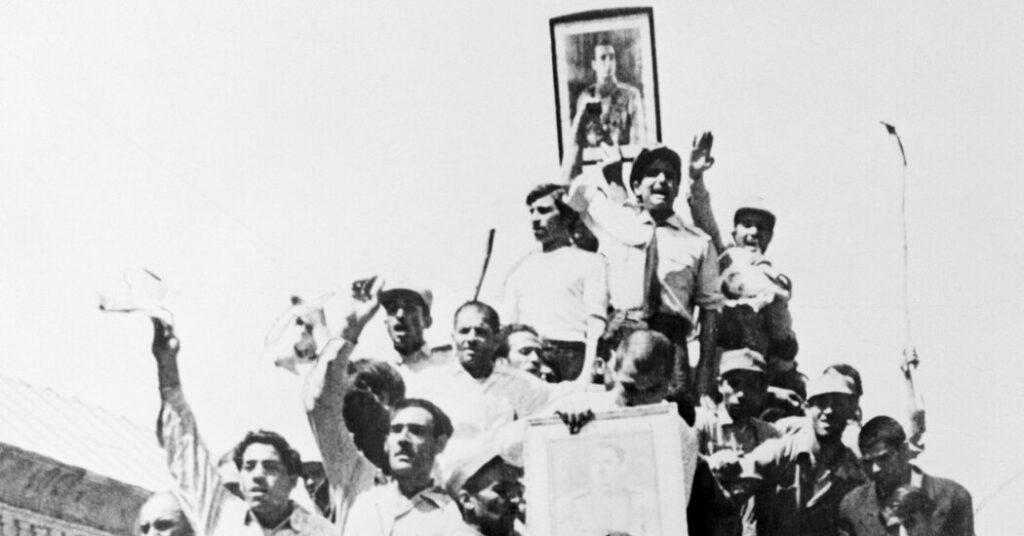
Largely at the instigation of Eisenhower’s secretary of state, John Foster Dulles, in early 1953 the C.I.A. took over a British covert operation to overthrow a populist Iranian prime minister, Mohammad Mossadegh, in favor of the nation’s far more pliant shah, Mohammad Reza Pahlavi. But Operation Ajax, as the plot was known, began to unravel almost as soon as it launched. Tipped to the coup plans, Mossadegh loyalists took to the streets. For two days, a seesaw battle raged in Tehran, with Mossadegh’s supporters gradually appearing to gain the upper hand. But then, in a desperate last bid to save the day, the C.I.A. officer in charge of the operation, Kermit Roosevelt, hired a mob to parade through the capital masquerading as boisterous shah supporters. The bluff worked; Mossadegh and his supporters panicked and melted away, allowing the shah to regain his absolute powers and lead Iran for the next 25 years.
So thrilled were senior Eisenhower administration officials by the unlikely victory that Roosevelt — a relentless adventurer in the mold of his grandfather, Teddy Roosevelt — was brought into the Oval Office to give a blow-by-blow account. Eisenhower recorded in his diary that the report “seemed more like a dime novel than an historical fact.” But he clearly found it compelling; Roosevelt, observing the “catlike grin” of Eisenhower’s secretary of state John Foster Dulles, sensed that the president would be seeking future installments.
Indeed he was. Up next was Guatemala. Its own recently elected president, Jacobo Árbenz Guzmán, had enacted a sweeping land reform bill that enraged Guatemala’s landed aristocracy and upset American business interests. An enterprising former army colonel named Carlos Castillo Armas promised a more pro-American alternative if only someone would fund his private army. Mere days after the successful coup in Iran, Eisenhower signed on to the Guatemalan adventure, and the C.I.A.’s Operation Success was born.
In June 1954, Castillo Armas’s ragtag army of some 400 mercenaries “invaded” Guatemala from four directions, only to stall a few miles from the border, short on supplies and in the face of the much larger Guatemalan army. But a clandestine C.I.A. radio station broadcast a very different story, with the phantom “liberation army” steadily closing on the capital. Once again, the other side blinked, leading to Árbenz’s downfall and the advent of the Castillo Armas dictatorship.
Could it really be this easy? Eisenhower and his men endeavored to find out. Shortly before Operation Success, the president had delivered a speech outlining why the United States needed to take over from the failing French military presence in Southeast Asia, where former colonies now seemed worryingly close to going to communism. “You have a row of dominoes set up,” he offered, “you knock over the first one, and what will happen to the last one is the certainty that it will go over very quickly. So you could have a beginning of a disintegration that would have the most profound influences.”
Eisenhower was describing a potential cause-and-effect of malign Soviet influence across Asia — a daisy chain of regime change from Vietnam into Laos into Burma into Indonesia and so on, as the entire region turned red. But in casting nations as dominoes, the logic cuts both ways. The Eisenhower administration had adopted an ever-expanding definition of what constituted a hostile regime, targeting not only left-leaning leaders but those gaining prominence in the emerging nonaligned movement of countries doing their best to stay out of the Cold War. That was a lot of dominoes. Perhaps with just the right kind of push they could fall in the other direction.
Eisenhower had already seen some success quietly recruiting and backing preferred candidates in foreign elections, with the C.I.A. more or less running Ramon Magsaysay’s 1953 presidential campaign in the Philippines. Building on the seeming success of Iran and Guatemala — his perfect scenarios — he began to turn his attention elsewhere.
Syria for instance. In 1956, it was drawing closer to Egypt and its Arab nationalist president, Gamal Abdel Nasser, and, equally worrying, it had refused to join a regional anti-Soviet military alliance. Perhaps regime change was the solution. The C.I.A. developed a plan with British intelligence, Operation Straggle, to support a coup by more sympathetic forces within the military, but the effort ground to a halt in the face of the Suez crisis. No harm. A year later, Operation Wappen was up and running. This time, the idea was that, encouraged by some $3 million in U.S. bribes, the military would support the elevation of a leader more sympathetic to western interests. But in the event, the key Syrian officers walked into their own intelligence office and handed over the C.I.A.’s money.
There was also the question of President Sukarno of Indonesia. He had fought for Indonesian independence from the Dutch and had become a leading voice of the nonaligned nations, but he was tolerant of the country’s large Communist Party and drifting, in Washington’s view, toward the Soviet sphere. The C.I.A. launched a destabilization campaign that included a pornographic film starring a Sukarno look-alike. When that did not take, the agency escalated, arming and funding dissident military commanders on the outer islands who rose up against the central government in early 1958. The rebellion failed. As in Syria, the intervention had achieved the opposite of its aim: Sukarno emerged stronger; the Indonesian left was emboldened; and American credibility in Southeast Asia was damaged.
It was nonetheless hard to unlearn the happier lessons of earlier dime novel escapades. The C.I.A. found itself involved in intrigues in Jordan, Lebanon, Tibet, Iraq, Laos and more. In the summer of 1960, the Eisenhower administration rounded out its efforts by targeting Patrice Lumumba, the first elected prime minister of newly independent and mineral-rich Congo. Overthrown by C.I.A.-backed commanders in the Congolese army, Lumumba was captured and murdered just three days before Eisenhower ceded the presidency to John F. Kennedy. Even that didn’t close out the target list, however.
Left behind for Kennedy to deal with was another C.I.A. victory-by-bluff scheme, this time against the young Cuban regime of Fidel Castro. And already, advisers were moving into Vietnam.
A Radically New Landscape
The immediate effect of the American regime change spiral was bad enough, but the long term effect was, if anything, even worse. By restoring Mohammad Reza Pahlavi to the Iranian throne in 1953, the C.I.A. had created “the American shah” in the eyes of his countrymen, a tagline that would come to haunt Pahlavi in the 1978-79 revolution that swept him from power. With the shah’s downfall, the United States would lose one of its most important military and economic allies in the world, and color its relations in the Middle East for the next half-century. In the case of Guatemala, it was to be its own people who would most greatly suffer, with Árbenz’s overthrow setting the stage for a decades-long “dirty war” by murderous right-wing dictatorships that would leave an estimated quarter-million Guatemalan civilians dead.
Not all the outright failures brought equal repercussions. The most devastating, obviously, was the 12-man advisory team that Eisenhower sent into Saigon in 1954 to “save Vietnam,” a vanguard ultimately complemented by some three million American soldiers. The Bay of Pigs fiasco helped trigger the Cuban Missile Crisis in 1962, and a half-century of enmity with one of the United States’ closest neighbors.
Eisenhower and the Dulles brothers undertook their regime change campaign following a Cold War era logic, misguidedly believing that any country that wasn’t an unwavering ally of the United States was functionally a Soviet client. In reality, many were post-colonial states struggling to assert their independence and to find their place in a new world order. In a manner it certainly didn’t intend, the Eisenhower administration’s addiction helped reshape that order.
Eisenhower was a decent and principled man, one who came to power when the country he led enjoyed a reservoir of good will probably unmatched in world history thanks to its decisive role in World War II. But taken all together, the geographical spread of governments that his administration sought to overthrow or otherwise subvert suggested an almost purposeful design, as if it set out to alienate the citizenry of most every region and subregion on the planet.
Trump is, of course, a far different kind of president. He has already alienated huge swaths of the world’s population with his unpredictable, punishing tariffs and his erratic, bellicose brand of diplomacy. But with the attack on Iran, he has entered a radically new landscape. The real lesson of Eisenhower’s regime change addiction is that each intervention tends to produce the very crisis that justifies the next, with consequences that reach forward generations. Eisenhower — methodical, cautious, a five-star general who understood the moral cost of force — never found a way to stop. There is little reason to believe Trump will fare better.
The post When a President Gets Addicted to Regime Change appeared first on New York Times.