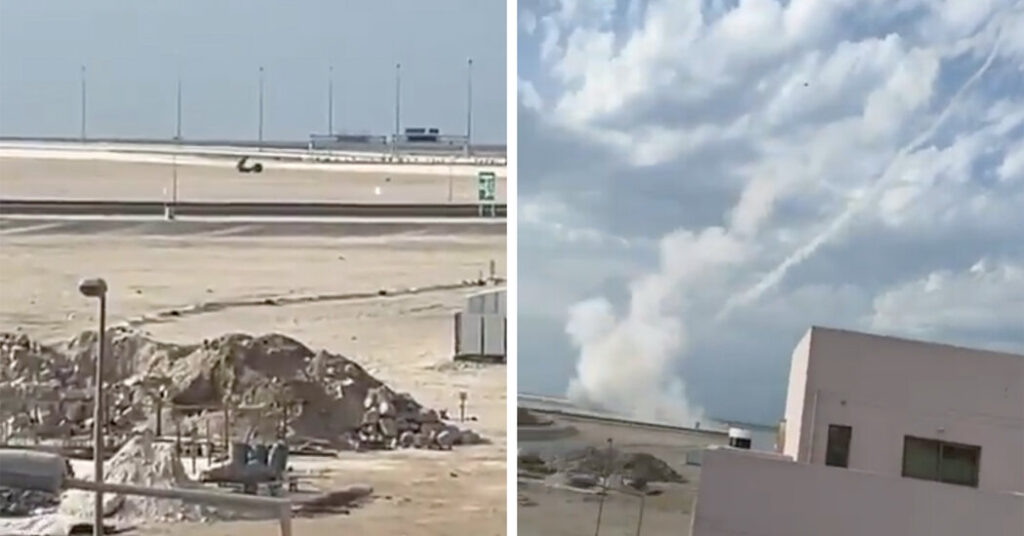
A video verified by The New York Times shows ballistic missiles being launched from Bahrain in the direction of Iran, in what appears to be the first confirmed instance of an attack on the Islamic republic originating from a Persian Gulf country since the war began.
Bahrain is home to the U.S. Navy’s Fifth Fleet. It is unclear from the video alone whether the U.S. or Bahraini military fired the missiles. Defense experts who have reviewed the footage say that at least one of the missiles was fired from American-made equipment.
Iran has launched thousands of missiles and drones at the Gulf countries over the past two weeks, accusing them of allowing their countries to be used as a launchpad for U.S. attacks.
Most of the Gulf countries have denied that and have publicly ruled out allowing their land or airspace to be used for military operations against Iran, even though most of them host U.S. military bases. That is, in part, because their governments fear being dragged further into a war that has already thrown the region into chaos.
The government of Bahrain said in a statement to The Times that its military “has not participated in any offensive operations.”
The kingdom has so far remained silent on whether it would allow the United States to conduct attacks on Iran from its territory. The government did not answer an emailed question about whether the video showed U.S. operations in Bahrain.
Asked on Thursday about the launching of short-range ballistic missiles at Iran from Bahrain, a Pentagon spokeswoman declined to comment.
The video was posted on social media on March 7 and verified by The Times to have been filmed close to a residential area and an airport in northern Bahrain. It shows two missiles being fired into the air, leaving white smoke trails in the sky, and heading northeast over the sea toward Iran.
The first missile’s launcher is obscured by a building, but as a second missile rises into the sky, its trail points to a second launcher that is positioned nearby. That launcher is a U.S.-made M142 HIMARS truck, according to Wes J. Bryant, a national security analyst who served in the U.S. Air Force, and Fabian Hoffmann, a missile specialist at the University of Oslo.
The U.S. military has said it is using HIMARS in its war with Iran. A social media post this week by U.S. Central Command, which oversees American operations in the Middle East, included photos of a HIMARS launcher being used in an unspecified desert location. The post said that the launchers “provide unrivaled deep-strike capability in combat against the Iranian regime.”
Since the United States and Israel began a military assault on Iran earlier this month, Iran has launched more than 100 missiles and 191 drones at Bahrain, according to statements from the Bahraini government.
The vast majority were intercepted, the government says, but on Tuesday, a 29-year-old Bahraini woman was killed in the country’s capital, in what the interior ministry described as “blatant Iranian aggression against a residential building.”
The attacks have also inflicted widespread damage on Bahrain’s civilian infrastructure, including an oil refinery, hotels and a water desalination plant.
“Bahrain has been subjected to an unacceptable series of unprovoked missile and drone attacks from Iran,” the government said in a statement to The Times. Bahrain’s own military “has not participated in any offensive operations,” the government said, but “reserves the right to respond.”
The U.S. State Department approved the sale of four HIMARS — the launchers seen in the video — to Bahrain in August 2025, but deliveries of complex weapon systems typically take years to be completed. There has been no public indication that they have been delivered or integrated into the country’s arsenal.
The American and British militaries are the only foreign forces with a permanent presence in Bahrain, and the British military does not operate HIMARS. That would mean that the HIMARS in the video was likely being used by U.S. military personnel.
At least 12 civilians have been killed across the Gulf countries in Iran’s retaliatory attacks, as well as seven American soldiers and six Gulf military personnel and border guards.
While most Gulf governments have condemned Iran, all have stopped short of publicly joining the war, concerned that their involvement in offensive operations against Iran could spur even more attacks on their territory.
On Thursday, Iran’s newly-appointed supreme leader, Ayatollah Mojtaba Khamenei, appeared to warn Iran’s neighbors in the Middle East to sharply curtail their military cooperation with the United States. “I recommend that they shut down those bases as soon as possible,” he said, “because by now they must have realized that America’s claim of establishing security and peace has been nothing more than a lie.”
The Gulf governments are also conscious of domestic public opinion, which is overwhelmingly anti-Israel and, in many cases, uncomfortable with the American military presence in their countries.
For Bahrain, the calculation about whether to allow attacks from its territory is likely different, analysts say.
The majority of Bahrainis are Twelver Shiite — the same branch of Islam that is Iran’s state religion — yet the country is ruled by a Sunni Muslim royal family, which has long accused Iran of meddling in its internal affairs and stirring dissent.
The marginalization of Bahrain’s Shiites was in part what sparked a pro-democracy uprising in the country a decade ago, which the government violently crushed.
“The kingdom has always perceived the Iranian regime as an existential threat, even before the war,” said Jean-Loup Samaan, a senior research fellow at the National University of Singapore’s Middle East Institute.
Bahrain has also built ties to Israel — Iran’s archenemy — and, together with the United Arab Emirates, agreed to recognize Israel in the U.S.-brokered Abraham Accords in 2020.
And while all of the Gulf countries depend heavily on U.S. military support, Bahrain’s defense apparatus is among the most integrated with the American military. “This means closer alignment on U.S. defense policies,” Mr. Samaan said.
Bahrain’s own military is relatively small; the entire population of the island is roughly 1.6 million people. It is sometimes described by scholars as a force focused mainly on royal family and internal security, rather than external threats.
Some U.S. politicians, including Senator Lindsey Graham, Republican of South Carolina, have urged Gulf countries to join in the war directly. So far, those calls have made little headway.
An official in the Emirates — which, among the Gulf countries, has borne the brunt of the Iranian retaliation — said that his government wants to contain the war, not expand it. He spoke on the condition of anonymity to discuss sensitive diplomacy.
In Bahrain, a decision to allow U.S. missiles to be launched from its territory could also risk exacerbating domestic discontent.
“America’s presence on Bahraini soil is unacceptable,” said Mohammed, a man in his 40s who participated in a protest last week in Bahrain, rallying against the war and mourning the killing of the Iranian supreme leader, Ayatollah Ali Khamenei, in an Israeli airstrike.
“America is a source of wars and crises, and supports criminal and dictatorial regimes in the region,” Mohammed said, asking to be identified only by his first name, fearing government retribution.
Calls for the expulsion of the U.S. military are relatively common at protests in Bahrain.
Eric Schmitt contributed reporting from Washington, D.C., Ismaeel Naar from Dubai, United Arab Emirates and Nazeeha Saeed from Berlin.
Vivian Nereim is the lead reporter for The Times covering the countries of the Arabian Peninsula. She is based in Riyadh, Saudi Arabia.
The post U.S.-made Launcher Fired Missiles From Bahrain Toward Iran, Video Shows appeared first on New York Times.