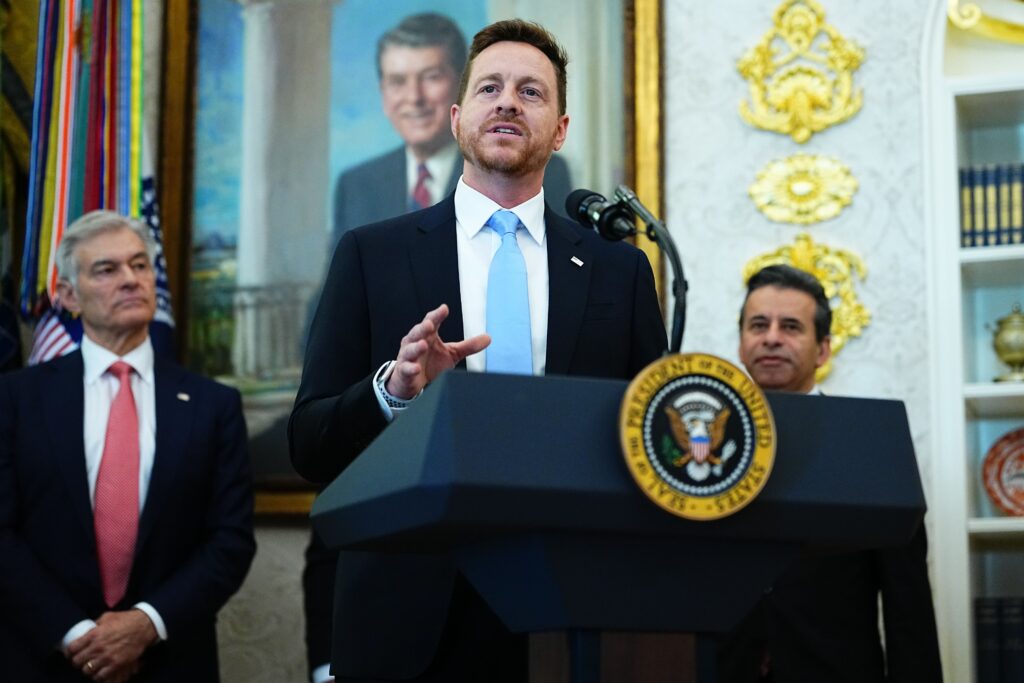
President Donald Trump wants Republicans to run this year on health care wins, such as lowering drug prices and fighting fraud. The White House elevated Chris Klomp to help deliver them.
Klomp, a political unknown before Trump officials tapped him last year to lead the nation’s Medicare program, was promoted last month to chief counselor of the Department of Health and Human Services, giving him control of the $2.6 trillion agency’s sweeping operations. Every HHS division — with such disparate missions as overseeing drug approvals, approving vaccine initiatives and assessing public health risks — now answers to Klomp, 45.
The lone exception at the 65,000-person agency is Health and Human Services Secretary Robert F. Kennedy Jr., whom Trump’s advisers want deployed on the campaign trail this year. He has spent several days on the road since Klomp’s appointment, championing the administration’s new dietary guidelines and efforts to improve the nation’s food supply.
Klomp has cut an unusual path to the senior ranks of the Trump administration — a health-care entrepreneur with significant experience in his field but no past relationship with Trump, Kennedy or another political patron until after the 2024 election. Trump officials created his new position after struggling to keep the health department focused on the messages that the White House wants to see — particularly cutting costs and improving health — and away from abrupt vaccine policy shifts that cause political headaches.
Susie Wiles, the White House chief of staff, told Klomp that she wanted a stabilizing force at HHS as she encouraged him to take the job, according to three people who spoke on the condition of anonymity to describe a private conversation.
Several high-ranking health officials last year resigned or were forced out after clashes over efforts to change vaccine policy, a priority for Kennedy that has not been broadly popular. Polls have shown that most Americans support vaccine mandates for children attending school, and some Republican lawmakers have pushed back on Kennedy’s vaccine agenda.
Meanwhile, the White House has tasked Klomp with reining in the health agencies and aligning their messages, said six people who spoke on the condition of anonymity to discuss internal dynamics. Administration officials had sought Klomp out in recent months for management counsel, such as helping stabilize operations at the Food and Drug Administration after several resignations and policy shifts, and had pitched him on serving as FDA’s chief operating officer before he turned it down.
Since taking on his new role last month, Klomp delayed a planned vaccine announcement out of concern it would lead to more political headaches and overshadow other priorities, shuffled leadership teams and made other moves intended to stabilize the department, said three people who spoke on the condition of anonymity to describe internal operations. He also set up a daily check-in meeting with key leaders across the agencies, while becoming more enmeshed in White House planning, such as accompanying the president and other senior officials on a trip to Kentucky this week to tout the administration’s focus on affordability.
“Incredible guy,” Trump said at Wednesday’s rally, turning to thank Klomp off-stage. “Great job.”
Klomp won Trump’s favor last year after he helped lead the government’s negotiations with drug companies to cut their prices, prompting the president to call him his “favorite Mormon,” or even “the killer Mormon,” according to three people who spoke on the condition of anonymity to describe the president’s personal nicknames. Trump was particularly impressed by Klomp’s public remarks at an Oval Office event to announce Pfizer’s price cuts, the people said, encouraging his deputies to lean on Klomp more.
“’Where’s my Mormon?’” Trump asked in one meeting last year as he searched for Klomp, according to one person who attended. Klomp is a member of the Church of Jesus Christ of Latter-day Saints.
HHS and the White House declined to comment on Trump’s nicknames for Klomp, but officials offered praise for his past work as a prominent health care business leader before joining government and his current role helping lead the health agencies.
“He is moving quickly to impose operational discipline, sharpen our strategic direction, and fortify a renewed sense of mission and accountability,” Kennedy said in a statement, adding that he had asked Klomp to drive “serious reform” inside the agencies.
Klomp is still overseeing the Medicare program, where he has been known to dive into computer code in a bid to solve technical problems. Two career civil servants said he regularly invites federal workers’ feedback and respects their expertise. He has also tangled with lobbyists for Medicare Advantage, the privatized arm of Medicare that Republicans have long supported, after declining to boost payments for the program and threatening to sanction a major health plan.
Several senior officials added to Klomp’s newly broadened purview, including Vinay Prasad, the nation’s vaccine chief, and Ralph Abraham, the top deputy at the Centers for Disease Control and Prevention, subsequently announced their departures from government. Both officials drew headlines for controversies during their tenures — Prasad for efforts to impose strict new requirements on vaccine approvals, and Abraham for remarks suggesting the nation’s escalating measles outbreak and the potential loss of its measles elimination status was the “cost of doing business.”
HHS denied that Klomp played a role in the exits of either official.
In an interview last month, about one week after taking his new job, Klomp declined to detail his role in any specific personnel moves or other decisions. “My job is to ask questions and make sure that we are doing things the right way,” he said.
He said that Trump made the decision to install Jay Bhattacharya, the director of the National Institutes of Health, to serve as the interim head of the CDC, with Klomp praising Bhattacharya as a “stabilizing hand” for the agency. The CDC has not had a full-time director since Susan Monarez was ousted in August after clashing with Kennedy over his planned changes to roll back vaccine policies.
Democrats and outside health advocates say the turmoil reflects deeper problems inside the administration’s health agenda. Sen. Ron Wyden (Oregon) and Rep. Frank Pallone Jr. (New Jersey), the top Democrats on congressional committees overseeing HHS, have opened multiple investigations into the agency’s operations and warned that cuts to federal health spending have created new barriers to care.
Protect Our Care, a liberal-leaning advocacy group, has described the health agencies as a “cesspool of chaos” under Trump.
“We’ve got no indication that anybody in that place has an independent mind that’s willing to stand up to both the secretary and to the president,” said Leslie Dach, the group’s executive director and a former HHS official in the Obama administration. “As a result, people are getting sicker, people’s health is getting worse, and our standing in contributing to the world in terms of drugs and vaccines and discoveries and research has fallen off the cliff.”
Klomp, however, is largely unfamiliar to many Democrats and outside health policy veterans, according to Dach, congressional staff and other liberals.
Klomp founded and sold a health-tech company, Collective Medical, and served as a board member for Maven Clinic, Nomi Health and other health care companies before joining the Trump administration last year. Past business colleagues described him as apolitical, pragmatic and focused on widely shared priorities, such as streamlining health care bureaucracy and lowering costs.
After Trump won back the presidency in November 2024, Klomp was recommended to the incoming White House by Adam Boehler, a senior health official during Trump’s first term who touted Klomp’s business success to the president, and impressed transition officials with his focus on policy rather than politics, said three people who spoke on the condition of anonymity to describe the presidential transition.
Inside the administration, he quickly developed a reputation as a behind-the-scenes fixer. Officials had leaned on Klomp in recent months for management advice, including helping stabilize operations at the Food and Drug Administration after several resignations and policy shifts. At one point, aides urged him to take the FDA’s chief operating officer role, but he declined.
“He was very competent — I could feel it immediately,” said Albert Bourla, the chief executive of Pfizer, who negotiated with Klomp last year during talks that led the company to cut prices on some drugs. “He has this personality that gives you the feeling that you can trust him, and over time, he has proven it.”
Multiple senior officials extolled Klomp’s work in statements to The Post. Mehmet Oz, who runs the Centers for Medicare and Medicaid Services and was Klomp’s boss much of the past year, called him a “generational talent” for his ability to organize and inspire others.
Public health and industry leaders have said some of the agencies’ challenges are of Trump’s and Kennedy’s own making.
Bourla said he hoped Klomp would address issues at the Food and Drug Administration and particularly at the CDC, which he said had become a “problem” after Kennedy’s appointees to the Advisory Committee on Immunization Practices rolled back long-standing vaccine recommendations last year.
Outside physicians and some state governments have since begun conducting their own vaccine safety reviews, saying that CDC guidance can no longer be relied upon.
“CDC was the golden standard for the world,” Bourla said. “Now medical associations are issuing their own recommendations in rejection of the ACIP recommendations. That is not good — that’s terrible.”
Speaking to The Post last month, Klomp said Kennedy’s MAHA agenda and Trump’s “Great Healthcare Plan,” a mix of cost-cutting ideas, provided objectives that would guide his daily work — and a broader focus on the needs of average patients.
“In health care in particular, I do believe that I’m my brother’s keeper, and our job is to do the very best that we can for the people that we serve — the American people,” he said.
The post Trump is counting on his ‘favorite Mormon’ to deliver health care wins appeared first on Washington Post.