The Ukrainian drone operators were in the middle of fierce fighting when a white-haired American arrived at the front and began peppering them with questions. He wanted advice for producing battle drones like the ones Ukraine was then using, Sgt. Oleksandr Karpiuk, the commander of the drone unit, recalled.
“And who are you?” Sergeant Karpiuk said he asked the man. “He says, ‘I’m Eric Schmidt, the former C.E.O. of Google.”
On the advice of Sergeant Karpiuk and others, the tech billionaire shifted gears. Instead of creating a battle drone, he made Merops, an anti-drone system that has become critical to Ukraine’s defenses. The system, developed with the help of Ukrainian fighters, has used its small, cheap interceptor drones to take out thousands of long-range Russian attack drones, saving untold numbers of lives, officials and fighters said.
So effective is the system that the United States is now racing to deliver thousands of Merops interceptors to the Middle East to protect troops against Iranian attack drones, according to three U.S. military officials, who spoke on condition of anonymity to discuss details of the Merops deployment.
The officials said the decision underscored the limitations of existing American air defenses, like sophisticated Patriot missile batteries, which have occasionally allowed slow-moving drones to slip through, causing death and injury. At least six of the American troops killed in the Iran war so far died in attacks involving Iranian drones, the officials said. This week, a French soldier was killed in a drone attack on a military base in Iraqi Kurdistan, the French Defense Ministry said.
One of the American officials said the U.S. military had watched Ukraine “learn these lessons in blood for four years.” But he acknowledged that officials did not take them seriously enough until Iranian drones started killing American troops.
For Ukraine, this interest in its hard-earned knowledge is something like vindication. Its officials, chief among them President Volodymyr Zelensky, have long argued that Ukraine is not just a drain on Western resources, as Trump administration officials often claim. Rather, they insist, Ukraine is the world’s biggest laboratory for the technologies that will shape the future of warfare.
Now, with the Iran war, the world is beginning to see their point.
In addition to the Americans’ use of the Merops system, Ukraine, according to Mr. Zelensky, has sent its own homegrown interceptor drones and a team of specialists to protect a U.S. military base in Jordan.
A Ukrainian company called Skyfall that produces an anti-drone system is in talks with Gulf countries to provide its P1-Sun interceptors, a company representative said on condition of anonymity, citing company policy. Skyfall sells them to the Ukrainian military for about $1,000 each.
“They realize that Ukraine can be helpful, that our expertise is of value, yes, and that we really can help to defend people,” Mr. Zelensky said in a recent interview with The New York Times.
Mr. Schmidt, who is now the chief executive of an aerospace manufacturing company called Relativity Space, was one of the first global innovators to see Ukraine’s potential as an incubator of future military technologies.
When he arrived at the front on that summer day in 2023, Ukrainian fighters were already becoming skilled in the use of drones. The technology had advanced faster than anyone could have fathomed when Russian troops first invaded on the morning of Feb. 24, 2022.
In the first year, the war looked similar to World War II, with colossal tank battles and soldiers dug into muddy trenches, flinging artillery shells back and forth across a narrow no man’s land.
Now, the war looks something like a cross between “Star Wars” and “Mad Max.” Drones rule the skies and, increasingly, the ground and water. On the Ukrainian battlefield, tanks, jets and battleships are more and more obsolete. Innovations move so quickly that the life span of a new technology can sometimes be measured in months.
“I’ve spent lots of time in Ukraine trying to understand the future of war, and I think I understand what’s going to happen,” Mr. Schmidt said at the Munich Security Conference last month. Ships, armored vehicles and aircraft will become increasingly autonomous and powered by artificial intelligence, he said, able to defend themselves as well as attack the enemy.
“This transition is analogous to the transition to the tank a hundred years ago,” he said.
The Iran conflict has put a spotlight on a problem with modern warfare: a dramatic increase in the number of deadly projectiles an enemy can throw at you.
It’s a challenge Ukrainians have contended with for years. After they first pushed Russian troops back from Kyiv in the spring of 2022, there was a period of relative tranquillity in the capital. Ballistic missiles occasionally struck critical infrastructure, but most of the time, life far from the front was eerily normal.
Then, in October 2022, Russia started sending in the Shaheds. Those long-range attack drones, first acquired from Iran, were cheaper than the ballistic, cruise and hypersonic missiles in Russia’s arsenal, and soon Russia’s military industrial complex was dramatically scaling up their production.
The Shaheds brought the horrors of war back to Kyiv and other cities far from the front. The attacks typically come in waves. First, hundreds of Shahed-style drones, together with decoys, are sent to overwhelm air defenses. Then Russia follows up with ballistic missiles and other advanced weapons, which only the most sophisticated systems can stop.
Now it is the Americans and their Gulf allies who face the Shaheds.
American air defenses are designed mainly to protect against fast-moving ballistic missiles. It is not that the Patriots cannot easily pick off the lumbering Shaheds, experts said. It is a question of economics.
The Iranians and Russians build and use far more Shaheds, at $50,000 a piece, than the Americans can Patriots, which cost about $3 million for a single missile. And so, over time, the drones can overwhelm defenses simply by depleting them.
The United States has already fired some 800 Patriot missiles since the Iran war began two weeks ago, more than Ukraine has fired in its entire war, one of the American officials said.
“After several of these waves, the economics of war simply stop working and you begin to feel your lack of defensive missiles more and more,” said Sergeant Karpiuk, the drone unit commander who met Mr. Schmidt at the front. The Americans, he said, “simply didn’t understand that before this war.”
This is where a system like Merops comes in.
A single interceptor drone, launched pneumatically and controlled remotely by a pilot on the ground, costs under $20,000. Its effectiveness has been proven in Ukraine, American and Ukrainian officials said. The system was the first of its kind to be implemented on the battlefield, and it was responsible for around 90 percent of the Shaheds destroyed before other, similar systems came online, the officials said.
One of the reasons the Pentagon has chosen to send Merops to the Middle East, according to one defense official, is that Perennial Autonomy, the company Mr. Schmidt founded to produce the system, “has a great capability for scaling up.” That would take pressure off the Patriots and other defenses that are in shorter supply.
Thousands of the interceptors are expected to be delivered to the Middle East within the next few weeks, the official said. “That’s what we need: volume.”
A spokeswoman for Perennial Autonomy declined to comment.
One challenge for Ukraine is that the Iran war is putting added pressure on arsenals of Patriots, which Kyiv still needs from the West so it can take out Russia’s ballistic missiles. One of the U.S. officials acknowledged that if forced to chose between giving Patriots to America’s forces or Ukraine’s, there would be no debate.
Mr. Zelensky seems to hope that Ukraine’s expertise in drone warfare might give it leverage when it comes to getting more of the weapons it cannot produce at home.
“There is clear interest in Ukraine’s experience in protecting lives,” Mr. Zelensky said in a statement posted to X this week. “Ukraine is ready to respond positively to requests from those who help us protect the lives of Ukrainians and the independence of Ukraine.”
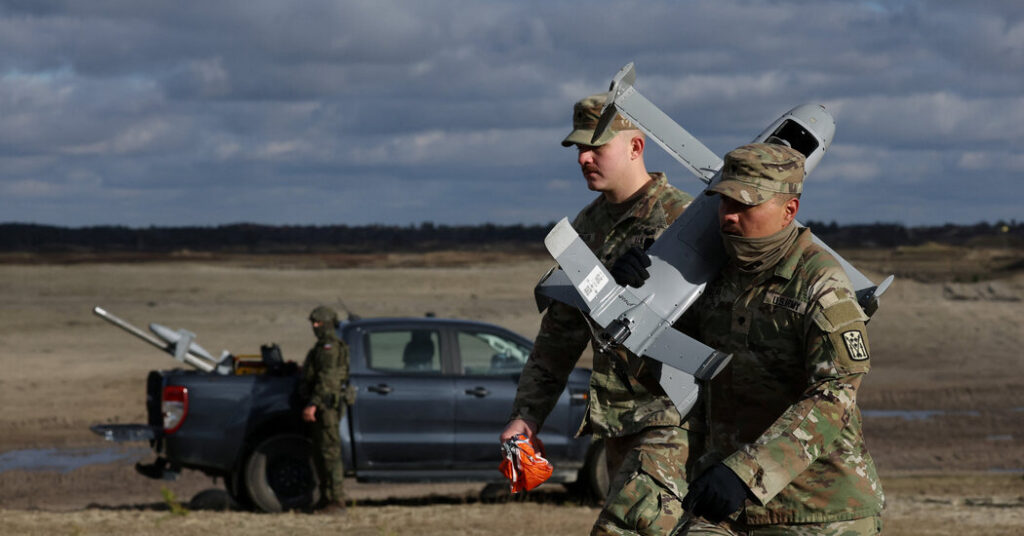
Even before the Iran war, Ukrainian experts had begun training troops from the United States and other allies to use Merops and similar systems, the American officials said. After nearly two dozen Russian drones crossed into Poland in September, Merops was deployed there and in Romania, where Russian drones also sometimes breach the border. In January, U.S. forces began training on the system at the Grafenwoehr Training Area in eastern Bavaria, according to one of the officials.
This is a reversal for Ukraine, which has long relied on Western military assistance in its fight with Russia.
“We have an unfortunate expertise,” said Giorgi Tskhakaia, an adviser to Ukraine’s defense minister. “We did not want to be the best in these spheres where we’re the best, but since we are the best and have the most experience, we are very keen to help and support our partners all over the civilized world.”
Kim Barker contributed reporting from Kyiv.
Michael Schwirtz is the global intelligence correspondent for The Times based in London.
The post To Fight Iran’s Drones, U.S. Taps Ukraine’s Hard-Earned Knowledge appeared first on New York Times.