The U.S. decision to temporarily lift some restrictions on Russian oil has delivered a geopolitical victory to the Kremlin on top of the boon that Russia’s war-strained budget is already receiving from soaring energy prices.
The American move, announced on Thursday, is intended to ease an energy shock that has accompanied the U.S.-Israeli attacks on Iran and at times sent the price of oil soaring over $100 a barrel.
Analysts said they did not believe the suspension of sanctions on Russian oil would substantially ease the worst supply shock to the global market since the 1970s, given that Russia had been able to transport and sell its oil for years despite the restrictions.
“Right now, obviously, the world needs every extra barrel that is available, and I can understand why the White House, under political pressure, would want to check this particular box,” said Pavel Molchanov, an energy analyst at Raymond James. “But it’s not going to make any meaningful difference.”
European countries, which have been at the forefront of imposing sanctions on Russia and are also suffering from higher energy prices, opposed the American move. President Volodymyr Zelensky of Ukraine said during a news conference on Friday that the move “certainly does not help peace,” adding: “This single easing by America alone could give Russia around $10 billion for the war.”
The temporary loosening of the U.S. restrictions, some analysts said, could reduce the discount that Russia has been forced to offer buyers of its oil since the invasion of Ukraine four years ago. Still, the real boon for Russia, they noted, is from higher prices, which the conflict in Iran was prompting before the United States loosened restrictions.
The mood in Moscow was triumphant, after years in which the United States and European countries have tried to starve Russia’s economy of the energy revenues needed for its war machine. Russian officials said the American move showed that Russia could not be dislodged from its central place in global energy markets.
Kirill Dmitriev, President Vladimir V. Putin’s special envoy for foreign investment and economic cooperation, boasted in a post on Telegram that the United States was “effectively acknowledging the obvious: without Russian oil, the global energy market cannot remain stable.”
In a post on social media, Mr. Dmitriev was even more blunt: “EU bureaucrats will soon be forced to recognize this reality, acknowledge their strategic blunders, and atone.”
Mr. Dmitriev met this week in Florida with Steve Witkoff, President Trump’s special envoy, and Jared Kushner, the president’s son-in-law. They discussed energy issues in addition to the peace negotiations that Mr. Witkoff and Mr. Kushner have been leading.
The Kremlin spokesman, Dmitri S. Peskov, told journalists on Friday that the interests of the United States and Russia had aligned in the current environment and welcomed the U.S. move.
“Such measures will help stabilize the market,” Mr. Peskov said. “Without significant volumes of Russian oil, market stabilization is impossible.”
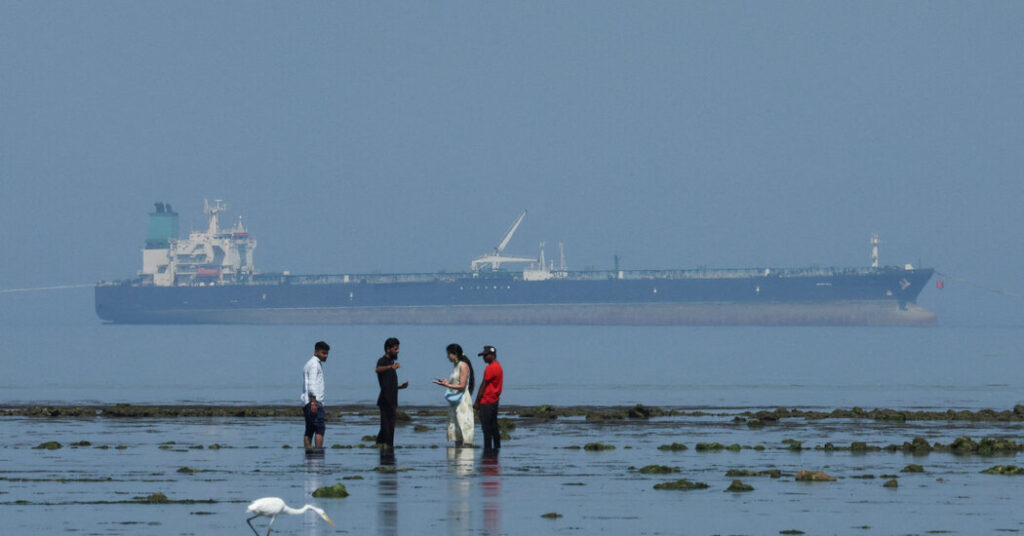
The decision came as the Trump administration scrambled to contain the energy shock that has resulted from production disruptions in Gulf countries and the de facto closure of the Strait of Hormuz, a key transit corridor for oil and gas. The U.S. move was announced by the Treasury Department, which said the exemptions would be in place until April 11 and apply only to Russian oil that was loaded onto tankers on or before Thursday.
Washington previously issued a 30-day waiver to allow India to buy Russian oil, an about-face after the Trump administration pressured New Delhi to cease purchases last year. Indian firms moved rapidly to buy the Russian oil available on the market. David Wech, chief economist at the oil and gas cargo tracking firm Vortexa, said he expected Indian imports of Russian crude to “reach new record highs” from next month, providing the situation in the Middle East continued.
Since Mr. Putin launched his full-scale invasion of Ukraine four years ago, China, Turkey and India have been among Russia’s biggest oil purchasers.
Soaring energy prices and sanctions relief during the conflict with Iran have offered the Kremlin a lifeline at a difficult financial moment.
On Tuesday, the Russian finance ministry reported that its revenues had collapsed by more than 10 percent since the start of the year, with its budget deficit reaching $43 billion, more than 90 percent of what was forecast for all of 2026.
Now, prices have risen and restrictions have vanished on the barrels of its oil currently at sea: around 100 million of them, according to Mr. Dmitriev.
“Russian oil has gone from global pariah to now being extremely sought after, with the discount on Urals crude versus the global Brent benchmark almost disappearing,” Robin Brooks, a senior fellow at the Brookings Institution, wrote in a post on Substack. Urals crude is the blend most often produced by Russia.
Russia’s budget is set to gain more than $1.6 billion per month from each $10 increase in the price of its crude, according to Sergey Vakulenko, a senior fellow at the Carnegie Russia Eurasia Center in Berlin and a former top manager at Gazprom Neft, one of Russia’s largest oil producers.
As of Friday, Russia’s Urals oil benchmark had increased by about $30 per barrel since before the war with Iran, according to Argus Media, a price reporting agency used by the Russian government to calculate its oil extraction taxes. That would mean that the country is receiving more than $150 million extra every day.
President Emmanuel Macron of France said on Wednesday that “the current situation does not justify lifting the sanctions on Russia.”
Chancellor Friedrich Merz of Germany expressed a similar sentiment the day before. “Faced with the choice between sanctions and solidarity, our position is clear: We stand with Ukraine and are prepared to endure such a phase if necessary,” he said.
The oil crunch in the Middle East has the potential to do more than prop up the Russian budget, more than a third of which is being spent on the war in Ukraine. It could also shift the Kremlin’s leverage in the global market, with countries in Asia beginning to view Moscow as a more necessary long-term partner.
For years, China has been reluctant to pursue Moscow’s ambitious plans for a gas pipeline and other projects. But it may now be more amenable, looking to diversify its supplies away from the Middle East in the longer term.
“China may realize that shipments from the Gulf are a problem,” Mr. Vakulenko said.
Ivan Nechepurenko covers Russia, Ukraine, Belarus, the countries of the Caucasus, and Central Asia.
The post Suspended U.S. Sanctions Add a Political Win to Russia’s Economic Gains appeared first on New York Times.