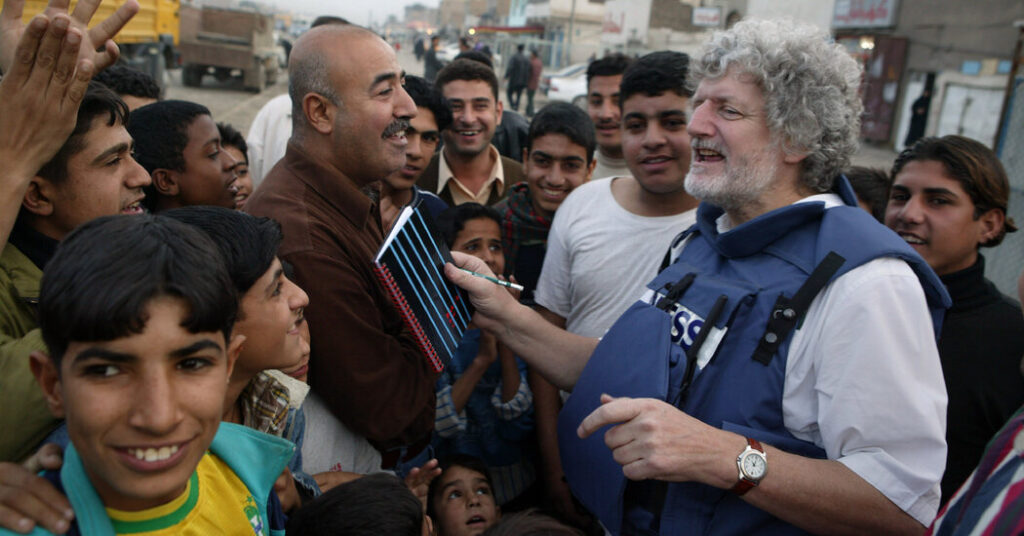
John F. Burns, a longtime foreign correspondent for The New York Times who won two Pulitzer Prizes, died on Thursday. Here is some of his reporting from around the world, selected from among the more than 3,000 articles he wrote over a 40-year career.
A Cellist Honors Sarajevo’s Dead
During the Bosnian war in 1992, Mr. Burns found a cellist for the Sarajevo Opera, still performing amid the rubble.
As the 155-millimeter howitzer shells whistled down on this crumbling city today, exploding thunderously into buildings all around, a disheveled, stubble-bearded man in formal evening attire unfolded a plastic chair in the middle of Vase Miskina Street. He lifted his cello from its case and began playing Albinoni’s Adagio.
There were only two people to hear him, and both fled, dodging from doorway to doorway, before the performance ended.
Each day at 4 p.m., the cellist, Vedran Smailovic, walks to the same spot on the pedestrian mall for a concert in honor of Sarajevo’s dead.
The spot he has chosen is outside the bakery where several high-explosive rounds struck a bread line 12 days ago, killing 22 people and wounding more than 100. If he holds to his plan, there will be 22 performances before his gesture has run its course.
Nelson Mandela’s Walk to Freedom
In 1990, Mr. Burns witnessed a turning point in history: Nelson Mandela’s release from a South African prison.
When Nelson Mandela made his walk to freedom today, he did it with the same simplicity and command of occasion that made him a leader among millions of South African Blacks when his imprisonment began more than 10,000 days ago.
At 4:14 p.m. on a sun-warmed day — 27 years, six months and one week after his arrest on Aug. 5, 1962 — Mr. Mandela stepped from the car that drove him to the last guard post at the Victor Verster Prison.
From there, smiling gently, he passed under a raised barrier and flicked his right hand quickly out from his body in greeting. He then raised his right arm several times in the bolder, Black nationalist salute, his left hand holding the hand of his wife, Winnie, and walked to the point where the prison entrance road abuts the highway running through the undulating wine country of the Western Cape.
It was a walk of perhaps 70 yards, through a corridor of policemen, and as he made it, Mr. Mandela said not a word, at least none that could be heard by any in the crowd of 5,000 Blacks and whites chanting his name. But to those who have come to know Mr. Mandela in the only way that was possible under the total ban that the South African government threw around the Black leader in prison — through his speeches and writings of a generation ago — there was no mistaking the symbolism involved in beginning his life outside jail on foot.
A Reporter’s Odyssey, on a Motorcycle in China
In 1987, Mr. Burns recounted his unauthorized 1,000-mile journey on a motorcycle across the mountains and plains of Central China, which resulted in his expulsion from the country.
We slept in smoky inns, in truck-drivers’ rest houses, in a mountain cave. We bathed in mountain rivers, ate in peasant restaurants and hauled our motorbike onto the flatbed of a truck to drive for hours through a summer storm. Time and again, we laughed with curious villagers who gathered about us as we repaired the bike’s fragile spokes. Whether it was a bed for the night, fuel for the motorbike, or an escorted journey into the hills to see an ancient Buddhist temple, no effort seemed too much for the villagers we met along the way.
The remoteness of many of the mountain villages we passed through was brought home to me when we stopped late one evening in a village in southern Shaanxi. As I crouched by the rear wheel of our cycle to repair some broken spokes, a hand from the crowd began running through my curly hair. “Excuse me,” said the owner of the hand, “with regard to your hair, did you suffer an electric shock?”
An Execution by Stoning in Afghanistan
Mr. Burns, reporting from Afgahnistan in 1996, pieced together the public execution of a couple accused of adultery by the Taliban.
When the Taliban religious movement decided to stone to death a couple caught in adultery, it chose a blazing afternoon in late August.
The suffocating desert heat had pushed temperatures past 100 degrees, but those who were there remember how the townspeople came by the thousands to witness a spectacle not seen in the city of Kandahar for decades.
Long before the condemned couple arrived on the flatbed of a truck, their hands and feet tightly bound, every vantage point around the forecourt of Id Gah Mosque was taken. Still, according to the Muslim traditions of Afghanistan, space was made so that relatives of the condemned pair, including small children, could have a clear view of the type of justice imposed by the Taliban, who now control three-quarters of the country.
A Serbian Fighter’s Path of Brutality
In 1992, Mr. Burns interviewed a Serbian nationalist soldier who described killing civilians “without any apparent emotion, and spoke remorsefully only when he was pressed for his feelings.”
What Borislav Herak remembers most vividly about the sunny morning in late June when he and two companions gunned down 10 members of a Muslim family is the small girl, about 10 years old, who tried to hide behind her grandmother as the three Serbian nationalist soldiers opened fire from a distance of about 10 paces.
“We told them not to be afraid, we wouldn’t do anything to them, they should just stand in front of the wall,” said Mr. Herak, who is 21 years old.
“But it was taken for granted among us that they should be killed. So when somebody said, ‘Shoot,’ I swung around and pulled the trigger, three times, on automatic fire. I remember the little girl with the red dress hiding behind her granny.”
As he tells his rambling story now, in a room with potted plants at the Viktor Buban military prison here, Mr. Herak stands up from his steel chair, shuffles into the open part of the room in his green field jacket and laceless black army boots, and demonstrates how he fired from the hip with his Kalashnikov rifle.
The Execution of Saddam Hussein
Mr. Burns, in a 2007 article reported from Baghdad with James Glanz, Sabrina Tavernise and Marc Santora, described how American commanders and diplomats had fought to stop the execution of Saddam Hussein only six hours before he was hanged.
When American soldiers woke Saddam Hussein in his cell near Baghdad airport at 3:55 a.m. last Saturday, they told him to dress for a journey to Baghdad. He had followed the routine dozens of times before, traveling by helicopter in the predawn darkness to the courtroom where he spent 14 months on trial for his life.
When his cell lights were dimmed on Friday night, Mr. Hussein may have hoped that he would live a few days longer, and perhaps cheat the hangman altogether.
According to Task Force 134, the American military unit responsible for all Iraqi detainees, Mr. Hussein “had heard some of the rumors on the radio about potential execution dates.” But never one to understate his own importance, he had told his lawyers for months that the Americans might spare him in the end, for negotiations to end the insurgency whose daily bombings rattled his cellblock windows.
‘The Defining Event of Ferrari’s Year’
Mr. Burns, who also reported on Formula 1 racing, traveled to Maranello, Italy, in 2013, to preview the Italian Grand Prix.
A distemper was in the air last week in this immaculately manicured town of ocher and soft yellow masonry in Italy’s heartland, home to Ferrari since its fabled racing and production cars began rolling out of a rundown workshop here in the late 1940s. The disquiet is keyed to the imminence on Sunday of the Italian Grand Prix at Monza, 125 miles north of here in a wooded parkland that was once a playground for Italian kings.
The race, the defining event of Ferrari’s year, and the one that the company founder Enzo Ferrari coveted more than any other before he died at 90 a quarter of a century ago, arrives at a time when the summer’s heat has yielded to a gloriously temperate fall, with the grape harvest at local Lambrusco vineyards reported to be as good as any in years.
The Vagabond Cat That Came to Stay
In 2010, Mr. Burns, back home in Cambridge, England, wrote an elegy for Scuzzi, his adopted cat and fiercely independent traveling companion.
He came unannounced out of an Indian monsoon, hauling himself onto our Delhi verandah one morning 16 summers ago — tiny, skeletal, bedraggled, a black-and-white splodge so limp as we lifted him from the polished flagstones that we feared he’d drowned in the sheeting rain.
Even by alley cat standards, he was not much of a kitten, the size of an open hand, unable in those first few hours to stand without falling down. More pitiable, his whiskers had been snipped off, an indignity suffered when he’d petitioned for refuge in a shanty near our home, where children made sport by taunting strays.
Last week, as he reached the end of his adventurer’s life, 5,000 miles and a world away from his beginnings, we comforted each other with those first memories of the cat we came to call Scuzzi — for the scruffy, ragamuffin state in which he arrived as much as for the scrappy, streetwise, step-aside, endlessly talkative character he became.
Michael Levenson covers breaking news for The Times from New York.
The post Read Some of John F. Burns’s Reporting From Around the World appeared first on New York Times.