This article is part of Overlooked, a series of obituaries about remarkable people whose deaths, beginning in 1851, went unreported in The Times.
During an outbreak of polio that ravaged the city of San Diego in 1948, Eleanor Abbott was among those afflicted. She was recuperating in a hospital when she looked around the ward and was distressed to see so many children stricken by the disease, suffering alone.
That was when she began dreaming up a way to transform the dreary clinical surroundings into an enchanted escape.
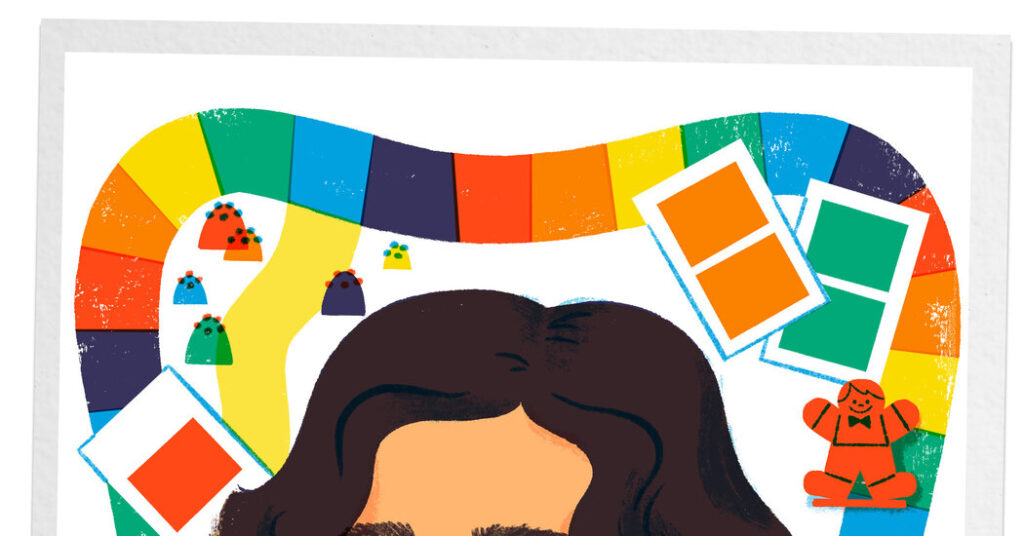
Back at home, she spread butcher paper over her kitchen table and drew a meandering trail. Then she added several sweet stopping points: Peppermint Stick Forest, Gingerbread Plum Tree, Gum Drop Mountain. The path would become one of the most recognizable in board-game history as the rainbow steppingstones of Candy Land.
Abbott returned to the hospital with her prototype and introduced it to the young polio patients. The instructions were simple: Players would choose a colored card and advance their tokens to the matching space on the board. They would skip by a field of Candy Hearts and pass the Crooked Old Peanut Brittle House, trying to avoid the Cherry Pitfall along the way.
The goal was to reach a simple cottage at the end of the path — Home — which held a special significance for the sick children who missed their families. They loved it.
Abbott then took a chance and sent her prototype to Milton Bradley. It was the right moment. At the time, the company was mostly producing school supplies, but was eager to challenge Parker Brothers’ dominance in the board-game market and had been seeking ideas for six games to fill a new line. Candy Land snagged a spot.
Today, more than 60 percent of households with children under 5 own the game, which recently celebrated its 75th anniversary. With more than 50 million copies sold to date, Candy Land is one of the best-selling games of all time.
Eleanor Reynolds Abbott was born on Sept. 9, 1910, in Ontario, Canada, to Eleanor Louise (Reynolds) Abbott and John Weaver Abbott, who had worked together in China as Christian missionaries. Her father taught himself to repair watches and used his skill to support the family.
When Eleanor was 5, the family moved to California, where they lived in San Luis Obispo, Oakland and Monrovia before settling in San Diego.
The most vivid stories of her early life come from accounts in The Monrovia Daily News. Articles about small-town happenings — themed parties and teas that she took part in, her high school club meetings and a short feature on a jewelry and gift store owned by the Abbott family — hint at her spirited nature.
At Monrovia High School, she developed an interest in short story writing, a pursuit she continued after graduation. She learned watch repair from her father. The qualities those activities required — a lively imagination and a propensity for tinkering — would eventually make her a successful board-game designer.
But not much about her quiet existence suggested that she would one day be associated with a whimsical, candy-themed game. At the time she contracted polio, Abbott was repairing watches for Baranov’s jewelry store and sharing a modest apartment with her sister, Betty Ann.
Typically, children in polio wards had few toys to entertain them between grueling daily treatments that included the forced stretching of muscles in rigid limbs. Quarantine protocols meant that they had little contact with their families. The days were long and lonely.
Seeing the joy they felt while playing her game brought Abbott satisfaction.
When Candy Land hit the shelves in 1949, it sold for a dollar. Parents embraced it as a way to entertain their children when schools and parks were closed during polio outbreaks. Because Abbott had designed the game with color-coded cards — eliminating the need to read or count — even the youngest children could play without supervision.
Tim Walsh, the author of “The Playmakers: Amazing Origins of Timeless Toys” (2004), offered another reason the game proved so irresistible: “You can’t underestimate how much kids love candy.”
The artwork on the original board may include a nod to the game’s connection to polio: One of the two children pictured has a thin line running down his leg that resembles a metal brace. While this reading is open to interpretation, it has become part of Candy Land lore.
With the novelty of television advertising, Candy Land took off, earning Abbott generous royalties. She donated much of her money to children affected by polio, and also bought supplies and equipment for San Diego schools.
“This is how I get my great happiness,” she said in “It’s All in the Game” (1960), a biography of Milton Bradley by James J. Shea.
For herself, she bought a purple Willys Jeep, and later a 1972 Mercedes that she called the Red Baron. Despite her reticent manner, she liked to drive fast, and she also enjoyed visiting the shooting range with a neighbor.
Otherwise, she lived modestly. She bought a 900-square-foot house in a working-class San Diego neighborhood, sharing the home with her sister.
Mel Taft, a Milton Bradley executive who visited Abbott, described her in an interview with Walsh as “a great gal” with “no put-on airs, down to earth.”
Despite the considerable income she received from creating Candy Land, Abbott liked to do odd jobs. She worked as a gardener, a babysitter and a dealer of rare coins, creating a drive-up window in her garage that faced an alley.
Evidence of her industriousness and her affinity for children is evident in a letter she wrote to the editor of The San Diego Tribune in 1963. She referred to herself as a “woman do-it-yourselfer” and described how the children in her neighborhood would flock to her home to lend a hand with repair and painting jobs. “I let them help me whenever I feel I can,” she wrote.
Over the years, Abbott tried to create other games, said Larry Karman, whom Abbott babysat when he was a boy. But she remained a one-hit wonder.
Betty Ann’s death in 1987 left her bereft. After updating her will, Abbott died by suicide on Dec. 10, 1988. She was 78.
At the time, she had $1.8 million in the bank, most of it Candy Land royalties. She willed some of the money to friends and acquaintances, but the majority went to Christian organizations.
With the introduction of the polio vaccine in 1955, the disease’s hold on the world began to fade, and so did its connection to Candy Land. But the popularity of Abbott’s game continued to grow. Since then, more than a dozen new editions of the board have been produced, along with many specialty versions.
When Hasbro acquired Milton Bradley in 1984, it rebranded the game with the introduction of a narrative and a roster of quirky characters, including King Kandy, Queen Frostine and Gramma Nutt.
While the art of the early versions reflected a folksy simplicity, recent Candy Land boards feature color-saturated digital art aimed at today’s tech-savvy young players.
In 1999, an insert included with the 50th anniversary edition of Candy Land finally revealed Abbott’s role as the game’s creator. That likely came as a surprise to most players.
“Candy Land is a piece of Americana,” Walsh, the author, said. “People don’t think, ‘Who made this?’ It’s Candy Land. It just is.”
The post Overlooked No More: Eleanor Abbott, the Creator of Candy Land appeared first on New York Times.