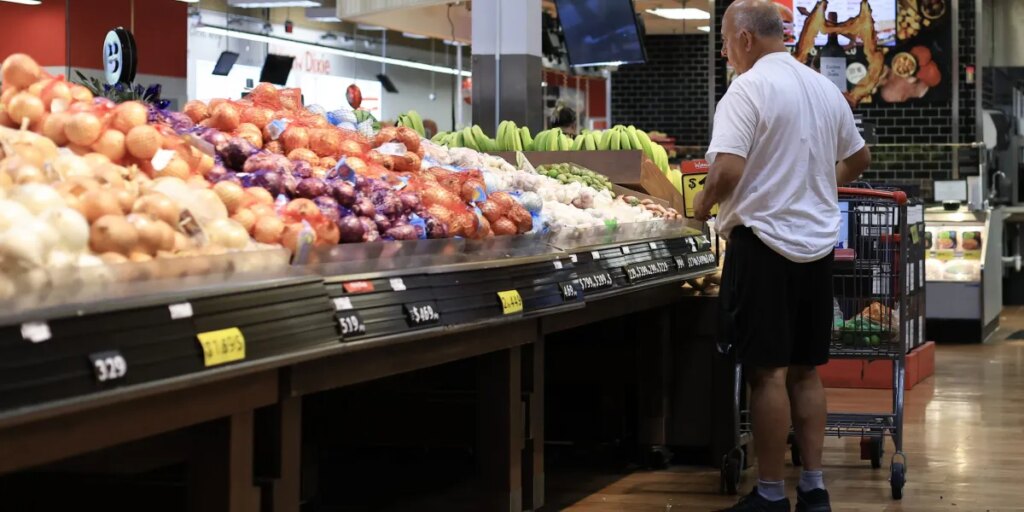
Soaring oil prices won’t just cause you trouble at the tank.
Energy is one of the most critical inputs for the food supply chain, which means the impacts of the war could show up on your grocery receipt. “There’s a very strong correlation between the movement of energy prices and the movement of food prices,” Dr. Ricky Volpe, an agricultural economist and professor of agribusiness at Cal Poly, told Fortune. “We’ve seen oil top $100 a gallon before and that happened to coincide with significant food price inflation.”
The war in Iran is adding another layer of volatility to an already shaky U.S. economy. Goldman Sachs has increased the chance of a recession occurring within 12 months to 25%, up five percentage points. And food affordability has been a top concern for many Americans, with food prices still on the rise despite efforts to cool inflation. Food prices have risen nearly 24% above pre-COVID levels and consumer sentiment remains near historic lows.
An energy-rich supply chain
The longer the war extends, the more drastic the impact on food prices. But if the war does end by the end of the month, as Trump has stated he’s hoping to be the outcome, it’s unlikely you’ll see a spike in grocery prices, according to experts. “If we’re talking just a few weeks, very likely you’re not going to see this show up in your grocery receipts,” Dr. David Ortega, an agricultural economist and professor at Michigan State University, told Fortune. “But if we’re talking a month or more, a few months, then it’s a different story.”
It’s not exactly clear when the war will relent. Trump has offered conflicting messages as to when it could end, telling Axios Wednesday there is “practically nothing left” to target. But Iran has said it’s ready to fight a “long-term war of attrition,” signaling the war could extend beyond the framework Trump has suggested.
However, prices aren’t expected to increase just yet. Ortega said it could take time to see any impact in the short-term. “There’s a lag between when the shock happens and when you see the full effect on your food prices,” he said. “It could be the better part of a full year before we’re seeing the full impact show up at the grocery store.”
Still, the food supply chain is incredibly energy-intensive, with high sums of energy required at each stage of the process. “Energy is required to grow and harvest food, and then to manufacture it, to transport it, and to store it, and then to sell it,” Volpe said. “It compounds down the supply chain, and it’s problematic.”
Shipping—just one stage of the food supply chain requiring a massive amount of energy—includes rates that are largely determined by diesel prices. FedEx Ground and home deliveries, for example, add a fuel surcharge of 24.25% when diesel prices reach $4.54 a gallon. Diesel was above $4.80 as of Sunday.
A blog post Thursday from the Federal Reserve Bank of St. Louis finds high correlation between crude oil prices and the global price of food index. While the post cautions against implying a direct causal relationship, it notes changes in oil prices could signal broader price changes. “Taken together, these two graphs suggest that large and sustained oil price movements have historically coincided with changes in both food prices and broader consumer inflation,” the report reads.
“We’ve seen oil top $100 a gallon before and that happened to coincide with significant food price inflation,” Volpe said. “Most [food companies] operate on very thin margins, so that means that when important sources of costs increase, they have no choice but to pass those along downstream, to consumers.”
The war is also impacting another critical supply chain that feeds into your grocery bill: fertilizers. More than one-third of the global seaborne fertilizer travels through the Strait of Hormuz. Since the start of the war, the price of urea, the nitrogen-rich compound present in most fertilizers, has spiked 35%. That’s made inputs pricier for American farmers. And the price spike is untimely. Farmers are just starting to plant crops for the season, meaning fertilizer is in high demand, including for America’s favorite crop: corn.
“Corn is king in the US,” Volpe said. “If fertilizer disruptions or inflation drives higher corn prices, that is going to be felt everywhere throughout the food supply.”
The post Oil and fertilizer prices are climbing. Your grocery bill may follow appeared first on Fortune.