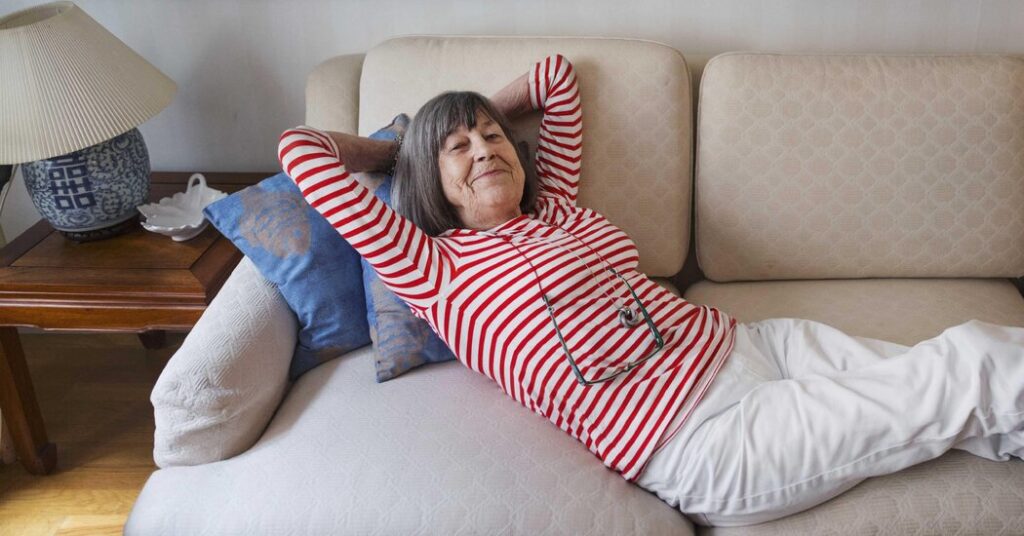
Margareta Magnusson, the artist-turned-author who wrote “The Gentle Art of Swedish Death Cleaning,” a best-selling guide to picking up before heading out, died on Thursday in Gothenburg, Sweden. She was 91.
Her death, at a retirement home, was confirmed by her daughter Jane Magnusson.
Ms. Magnusson was in her 80s when she began writing her book about death cleaning, based on her country’s practice of “dostadning,” or tidying up, “when you think the time is coming closer for you to leave the planet,” as she put it.
To her, death cleaning was about a lot more than death. It meant sharing pieces of your life with others; creating room for new adventures (and objects); and, yes, making sure that someone else won’t be saddled with picking up after you when your time comes.
“No matter how much they love you,” she wrote in the book, “don’t leave this burden to them.”
In less than 130 pages, “Death Cleaning” is both memoir and manual, specific and strategic.
Start your purge with forgotten items in cupboards and the attic, she suggested, rather than emotionally weighty photographs and letters that you may never get through. Books are too hard to sell, so invite people over to rummage around the titles you can do without. Encourage friends to come find treasures (and help you move the heavy stuff). And when you’re passing off your old objects, share the stories of how they came into your life with the new owners.
Ms. Magnusson also addressed the thorny subject of how to initiate a conversation about death cleaning. An adult child, for example, might approach the topic with a parent by asking, “Is there anything we can do together in a slow way so that there won’t be too many things to handle later?” If parents find a way to avoid the conversation, she advised, “then leave them to think and return a few weeks or a few months later and ask again, perhaps in a slightly different way.”
The book was a surprise hit when it was released in 2018. A New York Times best seller, it was published in more than 30 countries and inspired a home improvement series of the same name on the Peacock streaming service that enlisted Amy Poehler as both narrator and an executive producer. The following year, Dictionary.com added the term “death cleaning,” citing the book.
When it came time to cull more difficult items like photographs and letters, Ms. Magnusson wrote of the process, “I often ask myself, Will anyone I know be happier if I save this?”
She continued: “If after a moment of reflection, I can honestly answer no, then it goes into the hungry shredder, always waiting for paper to chew. But before it goes into the shredder, I have had a moment to reflect on the event or feeling, good or bad, and to know that it has been a part of my story and my life.”
Margareta Elisabeth Bothén was born in Gothenburg on Dec. 31, 1934, to Nils Bothén, a gynecologist, and Carin (Lindquist) Bothén, a nurse.
As a child, Margareta liked to climb trees, pick mushrooms and “fish for crabs lying on her stomach on the dock,” her daughter Jane said in an interview for this obituary. “As a teenager and adult, it was all art.”
She studied at Beckmans College of Design in Stockholm, graduating in 1956, and married Lars Magnusson the next year.
The couple had five children. Mr. Magnusson’s various management posts with ESAB, an industrial corporation, moved them all over the world — from Annapolis, Md., to Hong Kong. Ms. Magnusson, who painted, had her first solo show in Gothenburg in 1979 and later exhibited her paintings at galleries in Asia.
The idea for “Death Cleaning” emerged from a conversation that Ms. Magnusson’s daughter Jane had with a friend in the United States who was complaining that he didn’t know what he was going to do with his father’s possessions after he died. Jane replied that she wouldn’t have that problem, because her mother was always “dostadning.”
The friend, who worked in publishing, was intrigued and eventually asked Ms. Magnusson to write the book.
Just as giving away objects becomes an opportunity to share stories with loved ones, Ms. Magnusson wrote in “Death Cleaning,” so does choosing to keep other things. She kept an assortment of shells that she had collected along the Swedish coast as a child, while disposing of most of her children’s baby clothes. But she kept a few pieces that her mother had made, just in case she was “blessed with grandchildren,” she said.
“And when grandchildren failed to arrive, I would take the box down and remind my lazy children of what I wanted,” she wrote. “It worked.”
Though Ms. Magnusson “burned for this cause” of death cleaning, her daughter Jane said, she was not interested in fame. If someone recognized her in public and asked if she was “that death cleaning lady” who always wore striped shirts, she would deny it and turn away.
In addition to her daughter Jane, Ms. Magnusson is survived by another daughter, Ann; three sons, Jan, Tomas and Johan Gaddn; and seven grandchildren.
Ms. Magnusson followed “Death Cleaning” with “The Swedish Art of Aging Exuberantly: Life Wisdom From Someone Who Will (Probably) Die Before You” (2022), a book of essays about what she called the “discoveries I have made about becoming very old.”
It was a coda to her thoughts on death cleaning.
“Remember that the process of death cleaning is ultimately in service to two larger points,” she wrote in the prologue. “To be less afraid of the idea of death, for it comes for all of us, and to remember that after you’ve death cleaned, no matter how ancient you become, there are always new discoveries, new mind-sets through which to see your life and the experiences you have had.”
There are also, she added, “new and familiar pleasures to be had every day — even as the final visit of Mr. (or indeed Miss!) Death approaches.”
Ash Wu contributed reporting.
The post Margareta Magnusson, Who Popularized Swedish Death Cleaning, Dies at 91 appeared first on New York Times.