When the Irish-language rap group Kneecap suddenly found itself with a gaping six-week hole in its schedule last fall, the trio decided to make an album.
They had a lot to write about.
In the previous six months, Kneecap, based in both Belfast and Derry in Northern Ireland, had gone from an underground act rapping about its members’ drug use, to a household name after speaking out onstage and off about Israel’s war in Gaza and the plight of Palestinians.
The group first grabbed the spotlight in April after it displayed anti-Israel messages using the term “genocide” at the Coachella festival. Media scrutiny increased the following month when the British police charged one of its members, Mo Chara, with a terrorism offense for holding a flag of Hezbollah onstage. (He has said a fan tossed it up and he didn’t recognize it; a judge has since dismissed the case.)
As a result, Kneecap lost its United States visa sponsor and had to cancel a planned North American tour that would have included two sold-out 3,000-capacity dates in New York. Its schedule was unexpectedly clear.
Getting into the studio offered a chance for Kneecap’s members to reinvent their public image. They chose to reveal more of themselves.
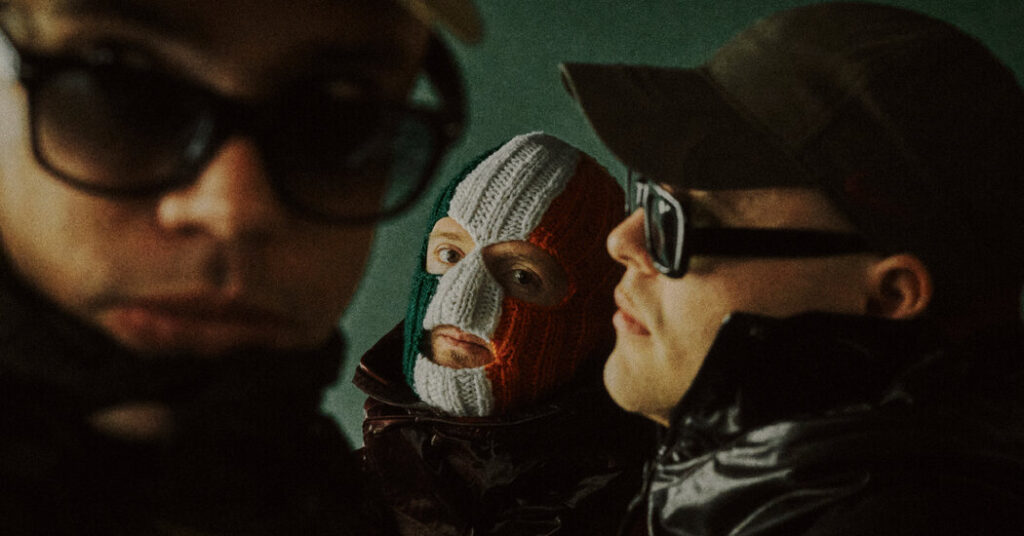
In recent interviews, Liam Óg Ó hAnnaidh (who goes by Mo Chara), Naoise Ó Cairealláin (better known as Móglaí Bap) and JJ Ó Dochartaigh (a.k.a. DJ Próvaí), said that they wanted their new album — “Fenian,” due April 24 — to show they were now more mature, even serious musicians.
“Since everything that’s happened, we couldn’t just be taking about partying all day,” Móglaí Bap, 32, said. “We wanted to show this other side of us.”
That certainly didn’t mean dropping their pro-Palestinian politics. Having solidarity with oppressed people is core to their identity, not a fad, they said. So is causing a little outrage. “We’re Irish, we just love to wind each other up, wind everyone up,” Mo Chara, 28, said.
Some of the new album’s lyrics are pointed — one track accuses “devil Israel” of genocide — but Mo Chara said the only people offended would be “politicians or ultraconservative people who despise our existence.”
“We don’t mind winding those people up,” he added, with a laugh.
During a series of recent interviews in a traditionally Catholic area of Belfast, the trio explained they were not three men jumping on a political bandwagon. They said they were simply the product of this community, a bastion of Irish republicanism — the term for those who want an end to British rule in Northern Ireland.
Those interviews — some over pints of Guinness — took place at the Hawthorn, a tiny pub on a street filled with small rowhouses where Kneecap’s rappers once lived, and the Cultúrlann McAdam Ó Fiaich, a bustling Irish-language cultural center that Móglaí Bap’s father had helped found, where the group first met.
The trio, who had an easy rapport with each other and approaching admirers, were game to discuss painful personal losses and the intense position they’d found themselves in after suddenly being thrust into a contentious spotlight. After our conversations at the bar, they posed for photos with fans (DJ Próvaí, 38, quickly put on his trademark balaclava) and watched horse races on the TV.
Growing up, none of the trio had aspired to be in a rap act. Móglaí Bap played flute and attended his father’s Irish-language stagings of Samuel Beckett plays, to tiny audiences, while DJ Próvaí wrote and covered acoustic pop songs including Jason Mraz’s sappy “I’m Yours.” They said their childhood listening included Irish rebel songs, Elvis and Eminem. (DJ Próvaí said Kneecap had initially wanted to create the same parent-annoying buzz that Eminem once did.)
But politics were ever present. DJ Próvaí and Mo Chara said some of their family members received prison terms for their republican activities; both of the group’s rappers said they learned and spoke Irish as a way to assert their identity.
When Móglaí Bap was about 16, he became more aware of the Palestinian cause when his mother took him on his first solidarity march, and to a local supermarket where she instructed him to help take all the Israeli products off the shelves as part of a protest. Things like that were “natural” for his family, he said, noting they had “a photo of Bobby Sands in the hallway” at home, referring to an Irish Republican Army member who died in prison during a hunger strike.
A shared desire to boost the Irish-language community in Belfast brought the group together — they met at an Irish-language festival that Móglaí Bap had organized. In 2017, the trio released its debut single, “C.E.A.R.T.A.” (“Rights,” in English) partly because they wanted to give young Irish speakers cool music to listen to.
“It’s like when you have this identity, you want people to hear you, you want them to know you exist,” Móglaí Bap said.
Those political passions are clear on “Fenian,” which is named after a word for both ancient Irish warriors and more modern-day revolutionaries that has also sometimes been used as a slur directed at Irish people. The album includes “An Ra” in which the band say an imagined goodbye to British rule (“You civilized us savages and now we’re all grand”). Another track, “Palestine,” features Fawzi, a Palestinian rapper, and lyrics declaring “We won’t stop / Until everyone is free.”
Despite the subject matter, Mo Chara said the act wanted to focus on artistry and “be known as musicians” rather than a reliable source of sound bites.
Throughout its career, the group has often been embroiled in controversy. Mo Chara said its “patient zero” was probably a 2019 incident when Kneecap led a chant of “Brits out” at a concert shortly after Prince William visited Belfast. After a clip of the show appeared online, some local lawmakers said it was unnecessarily divisive. “I miss the playful controversies,” Mo Chara said. They were more fun than terrorism charges, he added.
The recent court case had made him realize he was more introverted than he’d previously thought. “All of this has kind of brought that out — or brought it in,” he said, jokingly. He is still trying to find a way to cope. (The best strategy so far, he said, was traveling with his girlfriend to a tiny island off the coast of Japan where no one cared who he was. “I loved it.”)
Kneecap actually first tried making a new album — their third, a follow-up to 2024’s “Fine Art” — long before last year’s kerfuffles, but Mo Chara found the tracks just didn’t “have any substance.” So they tried again with the producer Dan Carey, best known for working with rock acts including Wet Leg and Fontaines D.C.
The main work on “Fenian” began in September, when Mo Chara was dealing with the terrorism charge, and the band also performed a sold out 12,500-capacity arena show in London.
Dan Lambert, Kneecap’s manager, said in an interview that making the record was “a surreal experience” given the legal case, and it was “unfair” to have asked the trio to go into the studio. But Lambert said he was convinced the pressure would either produce an “absolutely brilliant album or a [expletive] one.”
For Mo Chara, the studio proved an escape from the noise and stress of the court case. The mood during recording swung wildly from emotional highs to deep lows, Móglaí Bap said — “Every day was just this whole challenge” — and the resulting album includes upbeat bouncy pop (“Fenian”) and party tracks inspired by old rave music (“Big Bad Moe”) alongside the political songs.
There is also one starkly emotional track — “Irish Goodbye” — a love letter to Móglaí Bap’s mother, who died by suicide in 2020. Móglaí Bap said writing that song was the first time he’d really processed her death, and became emotional for the only time in the interview. He recalled moments he spent with her as a child, including her dragging him around Belfast’s Botanic Gardens, and her later telling him she loved Kneecap’s music — but he should have a backup plan. “Because she’s a mother like.”
When the group first started, its ambition was just to release one track and secure some free festival tickets, DJ Próvaí said in a tiny classroom in the culture center where Kneecap uploaded its first track to Facebook. Now, its members want to headline Croke Park, Dublin’s 82,300-capacity national sports stadium.
The trio has high hopes for its future in Ireland, but said they also wanted to reach fans in the United States — they just weren’t going to compromise their own views on Israel to help aid a return to the country.
“The thing is America’s so warped,” Móglaí Bap said: “If we get popular enough, even somebody who totally disagrees with us would take us onboard to make money.”
It was a flippant, off-the-cuff comment, like much of Kneecap’s lyrics and stage banter. But the underlying message was clear. This was a group that has no interest in abandoning its convictions.
Alex Marshall is a Times reporter covering European culture. He is based in London.
The post Kneecap Can’t Escape Controversy. It Wants to Be Known for More. appeared first on New York Times.