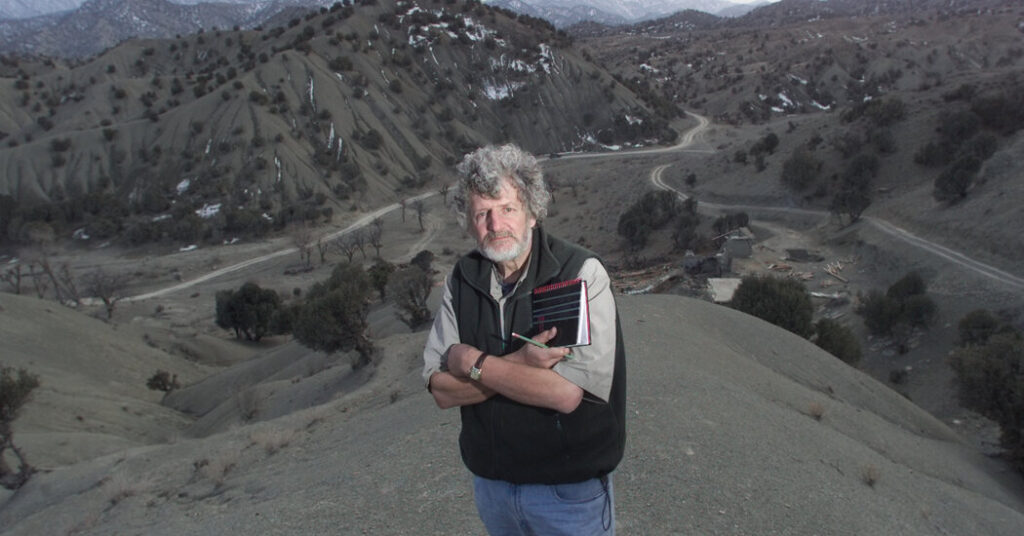
John F. Burns, an acclaimed foreign correspondent whose frontline dispatches for The New York Times from the war zones of Afghanistan and Bosnia secured coveted Pulitzer Prizes, and whose frequent television appearances from Baghdad made him one of America’s best-known journalists covering the chaos and perils of the conflict in Iraq, died on Thursday in a care facility on the outskirts of Cambridge, England. He was 81.
The cause was pneumonia, his stepson, Jamie Scott-Long, said. Mr. Burns lived in Cambridge.
In a 40-year career at The Times, Mr. Burns reported from a remarkable array of bureaus, including those in South Africa, the Soviet Union, Canada, Bosnia and Herzegovina, India, Afghanistan, Pakistan, Iraq and London. He interspersed his spells on the road with periods of study at prestigious universities, including Harvard and Cambridge, where he lived for several stretches during and after his decades with The Times.
With his signature mop of tousled curls framing aquiline, bearded features, Mr. Burns was once described in an internal memo at the newspaper as the “consummate Foreign Desk fireman” — a term denoting rapid deployments to the world’s trouble spots and fast work once there.
He apparently did not object to that assessment. From 2003 to 2015, he bore the rarefied title of chief foreign correspondent.
In his writing, Mr. Burns displayed a deft ability to capture the sweep of history along with the telling detail of the present. A 1992 article, for instance, began with a description of a cellist, Vedran Smailovic, playing Albinoni’s Adagio in G Minor under artillery fire in the ruined streets of Sarajevo, the besieged capital of Bosnia and Herzegovina, to commemorate the city’s dead.
The article went on to take note of the city’s cosmopolitan history, dating to its founding in the 15th century. By 1992, Mr. Burns wrote, it was “a wasteland of blasted mosques, churches and museums; of fire-gutted office towers, hotels and sports stadiums, and of hospitals, music schools and libraries punctured by rockets, mortars and artillery shells.”
He often wrote late at night, as deadlines approached in the faraway newsroom in New York. When the former Soviet leader Leonid I. Brezhnev died in 1982, the news broke in the late morning in Moscow, eight hours ahead of New York, enabling The Times to publish 140,000 copies of that day’s paper splashing news of Mr. Brezhnev’s demise.
A complicated and discursive figure, whose anecdotes were relayed with a raconteur’s panache, Mr. Burns was a frequent source of controversy with the authorities in countries that hosted him, among some of his colleagues and with editors awaiting his late-night responses to their suggested rephrasings.
He tilted passionately against what he saw as the slavish commitment to ideologies bred by dictatorships of any hue and acknowledged that — “not infrequently” — he had been among those journalists saved by editors from “the excesses of their passion with the cruel but necessary judgment of the blue pencil.”
For his editors, “John Burns was most himself when invisible — the full force of his talent and personality revealed in his matchless dispatches from around the world, and even more in his signature memos,” Susan Chira, a former foreign editor of The Times, wrote in 2015 on the occasion of his retirement. “These were peerless works of artistry, eloquence and guile — making a case for the front page, painting a scene of the reporting rigors he was undergoing, explaining why he could not and should not do something his editors had requested, apologizing for the invariable lateness of the elegant prose hurtling toward New York as deadlines came and went.”
Arrested in China
Assigned to China in the 1980s, some years after he joined The Times from the Toronto Globe and Mail in 1975, Mr. Burns embarked on an unauthorized 1,000-mile motorcycle journey into the hinterland, where foreigners were not permitted to travel. He was arrested, charged with espionage — a charge that he ridiculed and which was later dropped — and deported.
He was the head of The Times’s Baghdad bureau following the invasion of Iraq in 2003, and his tenure there inspired a long article in Vanity Fair that spoke of personal rivalries, dysfunction and divisions. Friend and foe alike framed their views of him with equal passion.
For decades, Mr. Burns was accompanied by Jane Scott-Long, his second wife, who achieved a reputation in her own right for her command of logistics and innovation in the creation and running of The Times’s war-zone bureaus. In Baghdad, she was credited with turning a run-down, insecure reporting operation into a safe haven protected by military-style blast walls and a small army of bodyguards; it came equipped with comforts like a dipping pool and a state-of-the-art coffee-making machine.
“If they had a Pulitzer Prize for enabling great journalism,’’ Bill Keller, a former executive editor of The Times, said of Ms. Scott-Long, “Jane would be my first nominee.”
She died in 2017, and in his later years Mr. Burns seemed to friends to become increasingly reclusive — a transformation from the previously gregarious and outgoing manner evident in a 1980 photograph of him flanked by armed men during the transition period that led to Zimbabwe’s independence. Other snapshots showed him waving to reporters with a casual insouciance as he was escorted by a Chinese security agent; and, in debonair mode, posing with colleagues on Moscow’s Red Square, sporting a Burberry-like belted raincoat, once the correspondent’s must-have sartorial emblem of status and success.
Like others of his generation, Mr. Burns flourished in a pre-internet era, when reporters overseas enjoyed the luxury of time-zone differentials that encouraged a more considered writing and chronicling of events. But even later, with the ascendancy of digital news — and throughout his final assignment for The Times in London, before he stepped down in 2015 — Mr. Burns continued to compose his dispatches in his distinctive manner, blending the tribulations of the present with the lessons of the past.
It was perhaps fitting that his last story as a staff correspondent was an account of the reburial of the bones of King Richard III, discovered beneath a parking lot in the Midlands city of Leicester and transferred to a tomb in an Anglican cathedral — a metaphor for the sweep of the centuries propelling the news of the day.
A Worldly Family
John Fisher Burns was born on Oct. 4, 1944, in the English city of Nottingham, where his South African father, Robert John Barrow Burns, was a high-ranking officer and pilot in the Royal Air Force. His mother, Dorothy (Fisher) Burns, was a wartime nurse and later accompanied her husband to a variety of postwar military assignments in West Germany and other countries.
John was educated at English boarding schools, including the prestigious Stowe School, before his family moved to Canada, where he studied political science and economics at McGill University in Montreal. His first work in journalism was in Toronto, for The Globe and Mail, which assigned him to the Chinese capital then known as Peking (now Beijing) in 1971. In 1972, he married Jane Pequegnat, whom he later divorced. He joined The Times in 1975, as a reporter on the metropolitan desk in New York.
In 1976, the year of the Soweto riots, when Black schoolchildren took to the streets to protest the use of Afrikaans as the language of instruction in the nation’s segregated schools under apartheid, Mr. Burns became head of The Times bureau in Johannesburg. From South Africa, he traveled frequently to pre-independence Zimbabwe, covering a conflict fought mainly in the country’s remote bushlands. It was there that he met Ms. Scott-Long, whose son, Toby, became Mr. Burns’s stepson.
In addition to Mr. Scott-long, he is survived by his two children with Ms. Scott-Long, Jamie and Emily Scott-Long; and two sisters, Caroline and Bridget. A third sister, Elizabeth, died last year.
While in South Africa, Mr. Burns interviewed Steve Biko, the leader of the Black consciousness movement, whose beliefs, he predicted, would significantly influence the country’s future. Later, he covered Mr. Biko’s death in police custody. He returned to South Africa in 1990 to cover Nelson Mandela’s release from prison, “at 4:14 p.m. on a sun-warmed day — 27 years, six months and one week after his arrest on Aug. 5, 1962,” he wrote.
From 1981 to 1984, Mr. Burns was the Moscow bureau chief, followed by postings in China, from 1984 to 1987, and Toronto, from 1987 to 1991.
With the fall of the Berlin Wall in 1989 and the subsequent collapse of the Soviet Union, the geopolitical landscape was transformed, forcing correspondents to operate in a less predictable and potentially more chaotic and perilous world than they had during the Cold War, when Washington and Moscow strove, though not always successfully, to keep their surrogates in check.
While based in the Balkans in the early 1990s, Mr. Burns won the first of his two Pulitzer Prizes, for his reporting in 1993 on the Bosnian conflict, which produced some of Europe’s worst ethnic bloodletting since World War II. As The Times’s Bureau chief in New Delhi from 1994 to 1998, he won his second Pulitzer, for reporting from Afghanistan in 1997. The citation lauded “his courageous and insightful coverage of the harrowing regime imposed on Afghanistan by the Taliban.”
Mr. Burns also won two George Polk Awards, in 1996, for his coverage of Afghanistan, and in 1978, sharing it with two other Times reporters for their coverage of Africa.
In the events leading up to and shaping the world after the attacks of Sept. 11, Mr. Burns became the newspaper’s first Islamic affairs correspondent, notably covering the October 2000 assault on the U.S.S. Cole in Yemen. He went on to coordinate coverage and report on the war in Afghanistan from Kabul and Islamabad, in Pakistan, in the early 2000s.
Into Iraq
In 2003, the forces of history once again reshaped the landscape of global power, when the United States and Britain invaded Iraq, ousting Saddam Hussein and propelling the region into mayhem. Mr. Burns, who had been among the correspondents covering Iraq’s invasion of Kuwait in 1990 and who had been assigned there intermittently for several years, returned to Baghdad and served as bureau chief there from 2004 to 2007.
As much as he cherished his position at The Times, Mr. Burns was consumed by the organization’s inner workings and convulsions, its politics and personalities, and he cleaved to what he saw as the highest aspirations of modern journalism, which he felt were under assault by the transient trends of the moment.
As he left the staff of The Times in 2015, he addressed the question of the norms that had governed his reporting of events over so many years, quoting a former executive editor, A.M. Rosenthal, as saying that the essence of the paper’s journalism should be “keeping the paper straight.”
“The commitment to fairness and balance and to shunning conventional truths when our reporting leads us in unexpected directions has been our gold standard — and one that I, like other reporters, undoubtedly failed on occasions when my passions, and the passions of those around me, ran at their highest,” Mr. Burns wrote.
He took issue with journalists of a newer generation, who professed what he considered a messianic calling that diluted the commitment to even-handedness.
“In our time, it has become common for young reporters to give as their moral code, indeed as their reason for choosing the profession, that they aim to create a better world,” Mr. Burns wrote. “It is a handsome thing, but one that can foster a missionary complex — a hubris, even — that can favor a blindness to inconvenient facts to the advantage of others.”
After a long career as a foreign correspondent for The New York Times based in Africa, the Middle East and Europe, Alan Cowell became a freelance contributor in 2015, based in London.
The post John F. Burns, Prize-winning Foreign Correspondent for The Times, Dies at 81 appeared first on New York Times.