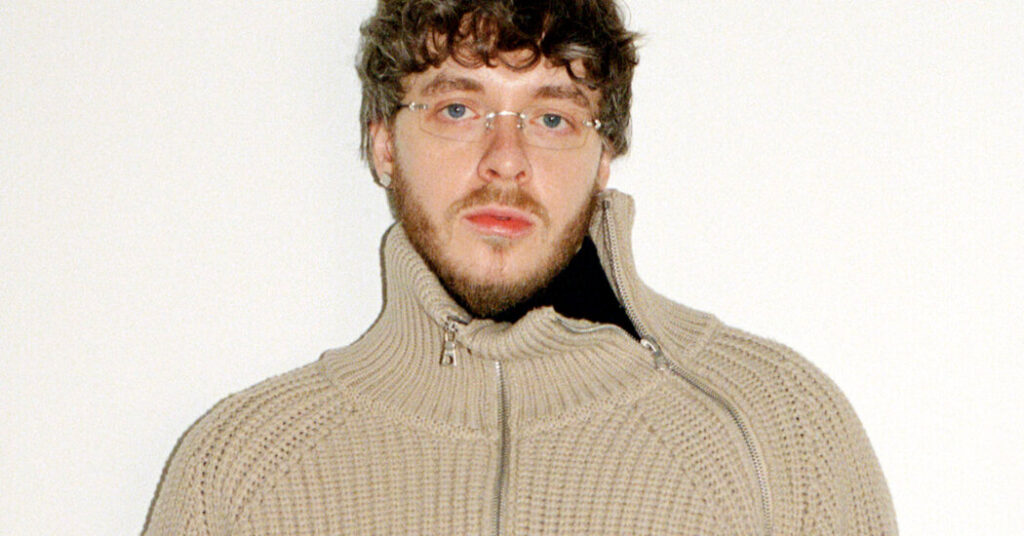
In 2022, Jack Harlow topped the Billboard Hot 100 for three weeks with “First Class,” a reimagination of Fergie’s “Glamorous” that catapulted him from emerging rap hitmaker to promising pop headliner. A year later, “Lovin on Me,” another playful pop-rap hit built around a melodic sample, went to No. 1 for even longer.
A template was solidifying, which was when Harlow began to get itchy.
A Louisville, Ky., native who was discovered in Atlanta, he moved to New York in January 2025 for fresh inspiration. In between CitiBiking and trips to museums, independent movie theaters and bookstores, Harlow began working on his fourth album, but found the sessions rough going.
“It didn’t feel like, ‘Oh, he’s doing that?’ It felt like, cool, this is patented,” Harlow said on a new episode of Popcast, The New York Times culture show. Frustrated, he decided to scrap everything and start anew: “I think you get to a point where as much as you’re trying to find your voice, you’re also hoping to escape yourself.”
What that ultimately meant was a true musical pivot — trading rapping for singing (or something like it), hip-hop for R&B (or something like it). The resulting album, “Monica,” released Friday, is the product of months of pared-back, live-band sessions at Electric Lady Studios in downtown Manhattan, the place where neo-soul was born. In that lineage, it’s a warmer, more intimate release for Harlow, full of nods to the organic R&B of the 1990s, and also underground hip-hop outfits like Slum Village, who were inheriting the earthen sultriness of the rap collective Native Tongues.
The album, driven by soft guitars and Harlow’s coos, was executive produced by Aksel Arvid (known for his ’90s-nodding work with PinkPantheress), with a band of jazz and soul mainstays like Robert Glasper, Cory Henry and Jermaine Paul. Like-minded friends including Ravyn Lenae, Omar Apollo and Mustafa added guest vocals.
Going smaller and more sensual — with lyrics devoted to eager come-ons and gentle letdowns — is a sly twist from Harlow, who acknowledged that many of his white rap contemporaries had retreated toward rock and country. By opting to put his commercial prospects aside and commit to a more niche pocket of Black music, he is hoping to set his career apart while becoming truer to himself.
“Ideally you want a unique arc, an arc that is all your own,” Harlow, 28, said in an interview that encompassed the unsatisfying sides of fame and the comforts of music that can be enjoyed passively. These are edited excerpts from the conversation, which can be watched in full or listened to below.
JON CARAMANICA There are people who retreat from a version of themselves out of fear and then there are people who alter a version themselves with a purpose and direction. I’m struck by how end-goal focused this album is — it doesn’t feel like running from something, it feels like heading confidently to something.
JACK HARLOW I’d been recording a project for two years after [the 2023 album] “Jackman,” and it wasn’t exciting me. I took a few weeks off, because I was getting to the point where I was dreading going to the studio. And I thought about, what do I actually want to do? What would intrigue me? It just struck me that I would want to do something a little more egoless. As I’m getting older, I’m having more trouble reconciling being braggadocious on record. And it’s a pillar of rap. Part of the reason I love rap music is the braggadocio of it. But I spent some time thinking, How can I lean away from that?
And then just sonically what I was listening to — I love softer, more melodic stuff. More than anything, I think I made this out of, “What do I want to hear?” So we had a lot of rules.
CARAMANICA What were the rules?
HARLOW No braggadocio in the writing.
CARAMANICA So when you say egoless, that’s what you mean?
HARLOW Yeah, I had a convo last year with [the singer] Elmiene about what makes Stevie Wonder’s music age so well. It’s all infused with love, all he’s talking about is love, he’s never talking about himself and how great he is. Which is not a groundbreaking realization, but he helped me understand ego can sometimes make music age poorly. Obviously there’s exceptions. There’s plenty of rap songs where people are talking [expletive] that are aging like fine wine.
But for me, I just became interested in saying, OK, what if I’m a little less self-indulgent, especially because I know that’s a little closer to the person I like to be, you know? I go by my government name. My entire career path has been me trying to get closer and closer to capturing who I actually am.
So the ego thing was huge, and then, no cursing — not for any purity reasons, just to challenge the writing. So there was no crutches. No digital instruments, except drums. Everything else had to be live. And then, no rapping was probably the last.
JOE COSCARELLI Jon and I have been going back and forth about this — I say there’s no rap on this. I think you’re singing.
CARAMANICA And I think that there is melodic rapping on this album.
HARLOW Right, and as long as it was melodic — everything had to have melody is, I guess, the best way to put it. But in shorthand, we were saying no rapping.
COSCARELLI You can’t talk to Jack Harlow without talking about race.
HARLOW I would hope not.
COSCARELLI We’ve had a version of this conversation over the years with Post Malone, Jelly Roll, MGK, Yung Lean, Eminem: White rappers are afforded more freedom to change their genre at will, true or false?
HARLOW I might have to think about that. What do you think?
COSCARELLI Definitely. I think there is something about being a white rapper that first puts the chip on your shoulder. And then you prove yourself, you become accepted, and then you have the privilege, the ability to say, “I rapped my ass off. I’m not gonna do that anymore, at least for now.” People take you seriously if you do that. If a Black rapper wants to do something completely sonically adventurous, it can often be treated as a whim, or something to be ignored, or a joke.
CARAMANICA I also think of it through the lens of reception and landing places. Country music, for example, has become a safe landing place for former white rappers. But talk about what I feel is the radical twist of what you have chosen.
COSCARELLI Right, you didn’t retreat into a whiter genre, in fact, arguably you went deeper …
HARLOW I got Blacker.
COSCARELLI Was that conscious? A little twist on the typical move that white rappers make?
HARLOW It certainly made what I already wanted to do even more appealing, absolutely. I love Black music. I love the sound of Black music. And, of course, I’m hyper-aware of the politics of today, that safer landing spot that a lot of my white contemporaries have found.
I’m not gonna pretend, with what you’re talking about, that I was like, huh, I guess you’re right! I knew that there were multiple things appealing about this route, but I also came to the decision, I’m proud to say, off of what feels good in my ear.
CARAMANICA How do you think of yourself as a singer versus as a rapper?
HARLOW I still think of myself as a rapper. Even after making something melodic, I would love for people to refer to me as a rapper first. And I think I’m limited as a singer. Part of my approach was, let me see where in my register and what notes I can hit sweetly and let’s lean into those. Some of the biggest feedback I’ve gotten is constructive criticism: Maybe you could put a little more power behind it. There’s a little monotony. But the intent of this album wasn’t to prove to people I could sing, it was to make music that sounded really good to me.
I just want it to be pleasant. I really don’t like erratic music. I don’t love loud music. I like soft music, I like smooth music. I wanted to add something to my discography that could be enjoyed passively.
COSCARELLI So you’re OK with this playing in a coffee shop?
HARLOW I would hope it does. This is the lowest I’ve ever let myself be in the mix. I wanted to be more impressionist instead of a hi-def photograph of: Check Jack out.
CARAMANICA With “First Class” and then “Lovin on Me,” you had hits that threatened to — and it sounds like maybe did — destabilize you a little bit. Can you talk about going through that?
HARLOW I always wanted hits. I wanted hits before I had them even more than I do now, I think. I love the idea of having a song that impacts everyone, still. I love songs that are accessible and even to this day, as I make stuff that maybe feels more niche to people, accessibility is subconscious for me. I don’t like making things that don’t invite people to whatever party I’m throwing.
I think things just got so big that maybe there was some nuance that I originally felt like I could get across that it didn’t feel like I was getting across in the same way. Trimming a lot of the fat off made me feel like OK, well, maybe I don’t need to get everything about myself across at once. But maybe piece by piece I can get one nuance at a time across. I’ve come to terms with waiting to be understood.
I’ve taken note of some of the artists that came out in the early 2010s that it feels like the full breadth of who they are is being totally understood and celebrated now. I think of Tyler, the Creator, I think Drake, I think of Kendrick — these guys over time have earned their opportunity to make what they’re making now through 10 years of grinding and adding little pieces to the arc.
CARAMANICA You were on a very Drake path for a while, not just as a friend but as a kind of lodestar of how to move.
HARLOW Yes, School of Drake, absolutely.
CARAMANICA Tell me about letting go, if you are indeed letting go, or moving away from that approach.
HARLOW As I’ve gotten older, I’ve become more concerned with finding my voice. I’m much more averse to mimicry or anything that feels derivative than I was in the past. I think I was so determined to achieve a certain thing and land in a certain place, maybe the spot I wanted to land in my head wasn’t as nuanced as it is now. I’m looking to carve out my own island and I’m less concerned with how immediately big I can make that island.
I would like to think that in my 30s, I’ll be an even better artist. Early in my career, I was split between, Do I wanna be a celebrity or artist? I have now chosen artist in a way that I wasn’t sure about early on. I thought I could do both, but I realized that not everybody can do both at the exact same moment.
CARAMANICA When we spoke in 2022, you were saying, I think I can be one of the top guys, and obviously that’s not exactly what we’re doing now. That bluster is part of the original charm of Jack Harlow. Do you have fond memories of that bluster?
HARLOW I spent time pondering that exact topic so much the last few years, and I definitely question how much of that bluster I’m able to access. But I also know that there are different seasons in your career that call for different things. And I think I’m just embracing the season I’m in. I do not rule that type of music out at all, but I’d like to do it at a higher level.
Cinematography by Andrew Amine.
Joe Coscarelli is a culture reporter for The Times and a co-host of the Times podcast “Popcast.”
The post Jack Harlow Was a Chart-Topping Rapper. He Doesn’t Want to Brag Anymore. appeared first on New York Times.