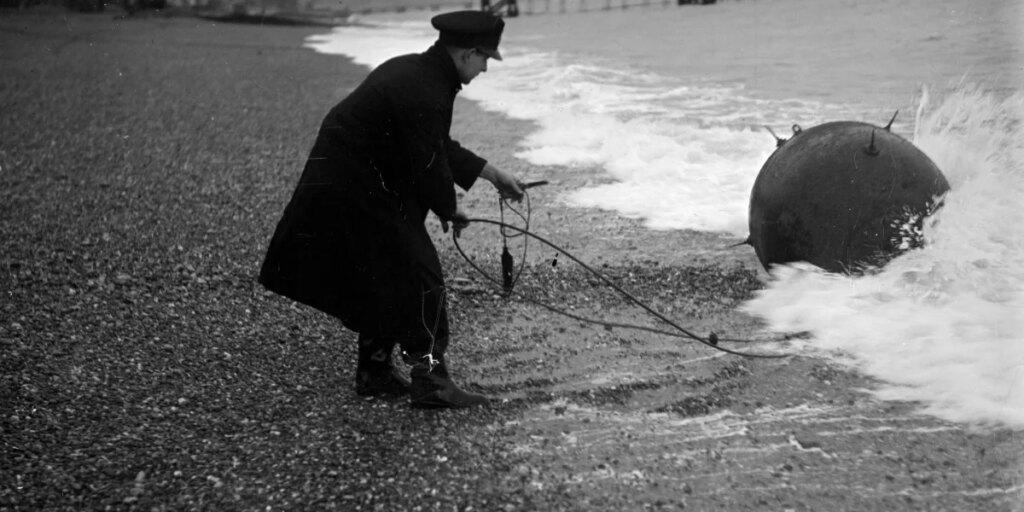
Sea mines are “simple, uncool weapons,” Scott Savitz, a naval marine warfare expert at RAND who was stationed in Bahrain in 2001, told Fortune. They predate World War I and haven’t advanced much since; they look like the spiky metal balls you’d imagine from the movies, small enough to slip neatly into a fishing boat and packed with TNT and ammonium nitrate.
But when they go off, they can snap ships straight in half, Savitz said. They have a “much greater effect, typically, than a missile,” and can inflict millions of dollars worth of damage for just a few thousand bucks a pop. And they’re pretty effective too: naval mines have caused 77% of all U.S. Navy ship casualties since 1950, per the Strauss Center at the University of Texas.
As the 13th day of the Iran conflict draws to a close and with no end in sight, Iran is looking towards old tech to elevate its position in a war that has so far been dominated by hypersonic missiles. The sea mine isn’t flashy, but right now it could be Iran’s most dangerous weapon in the military conflict against the United States.
Some U.S. intelligence officials told CNN that Iran has begun laying mines in the Strait of Hormuz, the chokepoint that carries a fifth of the world’s oil and is currently the subject of the standoff between Iran and the U.S. Iran has attacked several oil tanker ships in and around the Strait in recent days, including two Iraqi oil tankers in the Persian Gulf that left one crew member dead. Nearly a quarter billion barrels per day of crude has been stranded in the Gulf since the war began nearly two weeks ago, commodity expert Rory Johnston has estimated. Crude oil prices have spiked, at the time of writing hovering just under $100 a barrel, and gas is up 20% due to the blockage. Across the Pacific, the situation is more dire: Pakistan has closed schools and mandated 4-day-work weeks; India is closing restaurants and hotels across the country to preserve oil for cooking; and Thailand has asked government bureaucrats to forego the elevator.
The Strait of Hormuz isn’t actually “closed” by Iran, Savitz said. “It’s the decision of individual users whether or not they are willing to bear the risk. If they can raise the risk, or the perceived risk, to a level such that commercial traffic decides that they will not go through that strait, then that’s sufficient.”
The current risk level in the Strait has already scared off most major marine war insurers, who have pulled their coverage of ships in the Strait. Freight rates have soared to record highs, and a very large crude carrier heading from the strait to China can earn half a million in revenue a day. Yet, if true that Iran has laid mines in the Strait, that would turn a temporary blockade into something even harder to undo.
The psychological warfare of the sea mine
Sea mines are so powerful, in part, because they have “disproportionate psychological effects,” designed to prey on the fear of the unknown. The mines are nearly invisible at every stage and are incredibly difficult to detect—unlike missiles, where sailors can use heat signatures or trails picked up by radars. But for a mine, all that needs to happen is a vessel pulls up, shoves one overboard, and moves on. “There’s a splash in the water,” Savitz said. “Ships are dropping things in the water all the time.”
There’s even more psychological warfare at play. Some mines are programmed to ignore the first ship that passes, detonating only on the fifth, just so that the mine-clearing team goes through safely and the tanker behind it takes the hit.
Ship operators often fall into one of two traps: they either say, “’Well, I can’t see it, so I’m just going to ignore it’ and blindly find themselves in trouble,” Savitz explained, “Or they say, ‘Well, the waters might be mined,’ and they overreact and are unwilling to assume any risk from mines, even as they’re assuming other types of risk.”
Some of the worst incidents have been due to the latter mistake. During the tanker war of the ’80s, Iran and Iraq attacked 450 ships in the Persian gulf, and their most devastating weapon was the mine. In 1988, ten Navy sailors were severely injured on the USS Samuel Roberts after hitting an Iranian M-08 mine designed exactly 80 years earlier. “All three of the US warships that were damaged by mines in 1988 and 1991 did not know they were in a minefield when it happened,” Savitz said. The U.S. responded with Operation Praying Mantis, the largest American naval surface battle since World War II, sinking half of Iran’s operational navy in a single afternoon. The repairs cost $90 million, all for a weapon approximated to be worth $1,500.
The U.S. has had decades to prepare since the disaster. Yet, “The U.S. has been underinvesting in mine warfare for many decades,” Savitz said. The Navy decommissioned its last dedicated minesweepers in the Persian Gulf last September. Their replacements were supposed to be the littoral combat ship—a program Savitz called “a disaster,” because they built tiny metal ships that could set off the mines as opposed to the traditional wood and fiberglass minesweepers.
More so, mines are too boring to compete for budget. “A hypersonic missile is exciting and gets attention. Mines don’t.” The last time a U.S. warship was damaged by a mine was in 1991.
Hormuz escalation
The question is if the conflict in the strait will escalate that far. Savitz is cautiously optimistic. “Yes, we will be able to get it open,” he said. The U.S. has divers, unmanned systems, allied minesweepers from Europe—even Navy dolphins trained to detect mines, he said. But the timeline depends entirely on what else is happening around them. Mine countermeasures forces move slowly, in predictable patterns, through waters that may also be covered by Iranian missiles, explosive boats, and drones. “Can we suppress those threats well enough that mine countermeasures forces can operate without undue hindrance?” Savitz said. “That’s the challenge.”
And even under ideal conditions, clearing mines is agonizingly slow. Savitz estimated the cost ratio between laying and clearing at “between one and three orders of magnitude”—essentially, up to a thousand times more expensive to remove a mine than to deploy one.
“A hasty clearance”—opening just one single narrow lane for tankers to push through—could happen in days, Savitz said. Getting the strait to a safety level where tanker operators are willing to accept the risk could take weeks. But to fully remove and sweep the entire waterway, where tankers feel fully confident nothing is left, could take far longer; or could never come. There are still World War II mines in the Baltic Sea and the Pacific because they aren’t fully cleaned up.
Eventually, the calculus will shift. During the Tanker War, ships ran through minefields anyway. About 1% took a hit, Savitz said, “but the risk was deemed to be justified by the reward.”
The post Iran’s dumbest weapon is now holding the global economy hostage appeared first on Fortune.