A slew of announcements this week provided further evidence of a widening divide in the auto industry between traditional companies that are backtracking on electric vehicles and start-ups pushing ahead with models that cost less and charge faster.
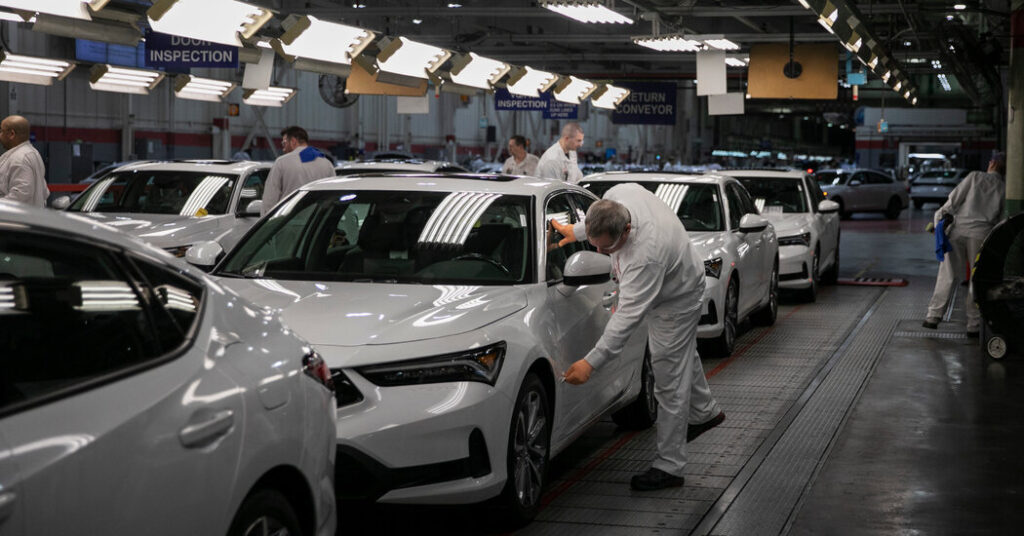
Honda said Thursday that it would scrap plans for three electric models it had planned to produce in the United States and that it would record its first annual loss since it listed its stock publicly in 1957.
The Japanese carmaker joined Ford Motor, General Motors and Stellantis, the maker of Chrysler and Jeep vehicles, in taking multibillion-dollar hits to their profits as they delayed or canceled plans for electric vehicles and reckoned with the cost of investments in factories that would not pay off.
At the same time, Rivian and Lucid, U.S.-based carmakers that sell only electric vehicles, provided details about models that would be priced under $50,000 and threaten to steal customers from established rivals. Current Rivian and Lucid vehicles start at more than $70,000, placing them out of reach for many buyers.
Sales of electric vehicles in the United States have slumped after Republicans in Congress and President Trump killed incentives for E.V.s and gutted clean air standards, prompting many carmakers to cancel or delay plans for electric models. The administration has encouraged carmakers to sell more big pickups and sport utility vehicles.
“In the U.S., the expansion of the E.V. market has slowed down due to several factors, including the easing of fossil fuel regulations and revisions to E.V. incentives,” Honda, which has a large manufacturing operation near Columbus, Ohio, said in a statement.
The policy changes could be good for the carmakers’ bottom lines during the next few years. Pickups and sport utility vehicles tend to be more profitable than smaller cars, while most automakers lose money on electric vehicles.
But the established carmakers risk falling behind as electric vehicles become cheaper to buy and more practical. War with Iran and rising gasoline prices could also make electric vehicles more attractive. Battery-powered cars usually cost thousands of dollars more to buy than cars that run on fossil fuels, but much less to operate. Electricity is usually cheaper per mile than gasoline and less prone to big swings in price.
There has been an uptick in the number of shoppers considering electric vehicles since the United States and Israel started their bombing campaign, Edmunds, a car-shopping site, said this week.
“Sharp increases at the pump have historically influenced how drivers think about their next vehicle,” Jessica Caldwell, Edmunds’s head of insights, said in a report.
Not all established carmakers are pulling back from electric vehicles. Toyota, Subaru, BMW, Volkswagen and Hyundai are among those that are introducing more types of electric vehicles, often at lower prices. Sales of electric vehicles continue to grow briskly in Europe and in many countries in Asia, including the Middle East, and Africa.
Rivian and Lucid illustrate how advances in technology are making electric vehicles easier to own.
At a presentation for investors in New York on Thursday, Lucid executives provided details of the Cosmos, a new four-door vehicle that will sell for less than $50,000. The vehicle, with a design somewhere between a sport utility vehicle and a station wagon, will be able to add 200 miles of driving range in 14 minutes, the company said. It will also feature sports car performance, able to accelerate to 60 m.p.h. in under four seconds. Lucid said Thursday that it planned to add more than 40 sales outlets this year in the United States, Europe and the Middle East.
Lucid, based in Newark, Calif., plans to begin producing the Cosmos this year in Saudi Arabia and begin selling it in 2027. Later, the company will produce the car at a factory in Arizona where it already manufactures the Air, a luxury sedan, and the Gravity, a sport utility vehicle. Lucid is majority-owned by the Saudi Public Investment Fund.
Also this week, Rivian, which sells electric pickups and sport utility vehicles made in Illinois, began allowing customers to place detailed orders for its new R2, a midsize S.U.V. Initially, the company is offering only a $58,000 performance version. A standard version will go on sale next year for $48,500, according to Rivian’s website.
Rivian, based in Irvine, Calif., and Lucid both lose money, and they still need to prove to many investors that they can survive long enough to become profitable.
Honda said it expected the cost of switching direction on electric vehicles to total 2.5 trillion yen, or $15.7 billion, this year and in years to come. The company’s net loss for the fiscal year that ends this month could be as much as ¥630 billion, Honda said.
The “extremely challenging earnings situation,” Honda said, has been “compounded by a decline in the profitability of gasoline and hybrid models due to the impact of newly imposed tariffs.”
Jack Ewing covers the auto industry for The Times, with an emphasis on electric vehicles.
The post Honda Scraps Plans for E.V.s While Start-Ups Forge Ahead appeared first on New York Times.