When the music started and the teacher began to sway, the students mimicked the motion. When swaying morphed into a bounce, the students copied that, too — as they did each new move introduced. Any child watching would have a name for this game: Follow the leader.
These students were adults, though, professional dancers who gathered last month to take a workshop with the French choreographer Leïla Ka. She was in New York to present her work “Maldonne” as part of the Dance Reflections festival, sponsored by Van Cleef & Arpels.
As in its previous iteration in 2023, the monthlong festival has taken over most of the city’s dance-friendly theaters. (The festival runs through Sunday.) New this time is a full slate of workshops — all at the Joyce Theater’s New York Center for Creativity and Dance in the East Village — in which the artists share their methods and choreography.
While workshops are common features of international dance festivals, the scale of this series — like everything else about Dance Reflections — is unusually large for New York. It extends the festival’s objective to promote what it calls “transmission and education,” helping to demystify work that might seem esoteric. New Yorkers learn more about the mostly European artists; the artists learn more about New Yorkers.
“This is exactly what I always wanted to do,” said Serge Laurent, the Van Cleef & Arpels director of dance and culture programs. “Working in contemporary dance, sometimes it is not easy to connect with the audience. But even if once in your lifetime you attend a dance workshop, that is probably the best way to get connected and understand better.”
“People do a lot of watching,” he continued. “We watch dancers like a projection of what we would like to be. But with this practice, people reappropriate their own bodies.”
There are classes for professional dancers, but also for nonprofessionals and even children. The differences among those categories are smaller than you might assume.
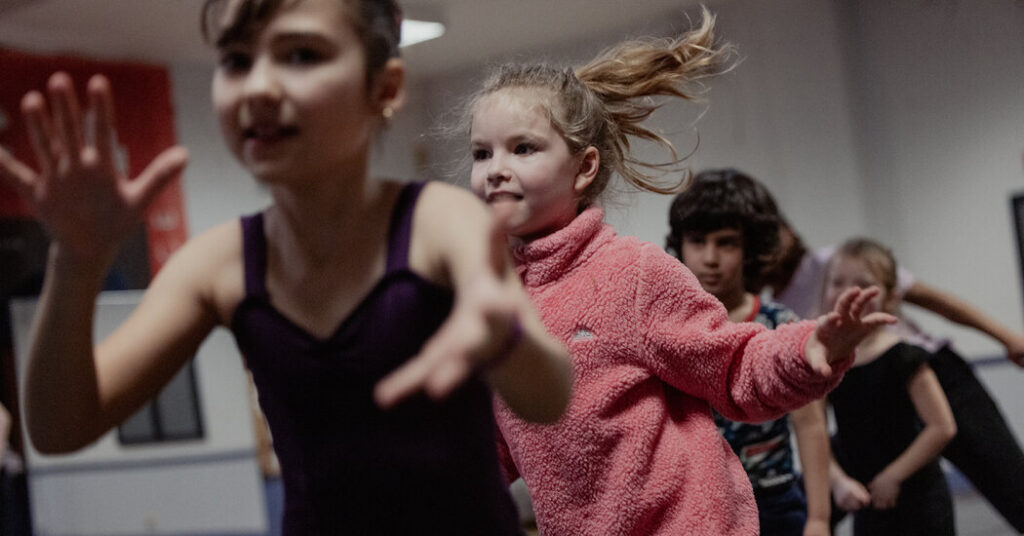
In her class for children, Jamie Scott of the Trisha Brown Dance Company guided young students through several exercises. In one, they lined up, took a step forward, then returned to the line. Next, they took two steps forward, then three and four and so on, but no matter how many steps they took, they still had to race back to the line in the same amount of time. When the number of steps passed eight or nine, the screaming grew loud.
“It got harder and harder, but funner and funner,” Audrey Batinsey-Martin, 6, said after the class.
In another exercise, the students assembled an accumulating sequence of movements: A, A+B, A+B+C. Or they each took a turn as the leader while everyone else copied their motions — like Ka’s warm-up but with kids in charge.
These were games that could easily transfer to a playground, but the rules had all been devised by Brown, a master choreographer who died in 2017. She used these same rules and games in dances like her masterpiece “Set and Reset” (1983), which the company performed in the current festival.
“I was nervous about whether it would work,” Scott said. “But the kids got so creative. Sometimes with adults, there’s a self-consciousness, but the children didn’t have that obstacle.”
Scott showed the children video footage of Brown’s work, and they caught the connections to the class activities. Their reactions were similar to those of the journalists invited to take a class with members of Lyon Opera Ballet. Let in on the fairly simple secrets behind the snaking steps that had mesmerized them when the company performed Christos Papadopoulos’s “Mycelium” at the festival, the adults made noises of gleeful wonder. Understanding the mechanics only increased their appreciation.
Ka didn’t offer a children’s class, but she taught one for nonprofessionals. It differed from her class for pros only a little, mainly in the complexity of the section she selected from “Maldonne,” a work that physicalizes the oppression and liberation of women using repetitive rhythmic gestures. (At one point, Ka urged her students to regard the audience with a “killer look,” a directive that could apply to most works at this year’s festival.)
“The moves come from emotions everyone can feel,” Ka said. “With professionals, we can ask for more sharpness and speed, but most of what we ask for is the same.” The essential part, in other words, is available to all.
For Nacera Belaza, teaching her methods to nonprofessionals is in some ways easier. “Being a professional has many positive points, but also many negative ones,” she said. “When you practice something, you get more aware but also more familiar, so that you lose the feeling that it is happening for the first time.”
“The reaction of a professional is ‘How can I do that?,” she added. “The reaction of a beginner is ‘How can I experience that?’”
Belaza never studied dance formally, and when she teaches, she tries to replicate in miniature what she calls her own quest for freedom, treating her body as a blank page, an empty vessel, with the aim of transcending her own physical and mental limitations.
The goal is to “set the body free from the head,” she told one class. This involves exercises in embodied imagination: envisioning yourself with two fronts by standing back-to-back with a partner, or seeing, hearing and feeling a circle inside yourself and surrendering to its motion. These exercises prepare a dancer for the perpetual spinning and eddying-in-a-whirlpool effects of the work Belaza brought to the festival, “La Nuée.”
Teaching this kind of approach is tricky. Belaza spoke to the students about dismantling inner programming, about releasing control, about getting in tune with something more powerful than their own decisions. “It takes a lot of practice,” she said.
Belaza invited dancers in her company to join the first timers, more for them to learn from the students than the other way around. Sharing her methods in a workshop, she said, helps her in her choreographic practice.
“A student in the workshop told me there was a moment when they started to hear a different sound, a collective vibration,” she said. “This is what I’m interested in — to reveal this frequency.”
“I work the same with children,” Belaza added. Her Dance Reflections classes made it easy to imagine how that might go. Trying to coax her adult students out of their self-consciousness, she told them to “remember the child.”
The 6-year-old Audrey Batinsey-Martin had another idea for how to facilitate such learning: “We teach the grown-ups.”
The post Grasping Esoteric Dance? It’s Child’s Play appeared first on New York Times.