Individual income taxes accounted for more than half of the total revenue collected by the U.S. government in 2025. At a total of $2.6 trillion, they make up the largest share of government revenue. But income tax hasn’t always played a key role in tax revenue. In fact, it wasn’t even introduced as a concept until about 100 years into the country’s history after President Abraham Lincoln signed the very first federal income tax—a 3% flat tax on incomes exceeding $800—to fund the Civil War. Just as income tax didn’t always exist, it also may not last forever.
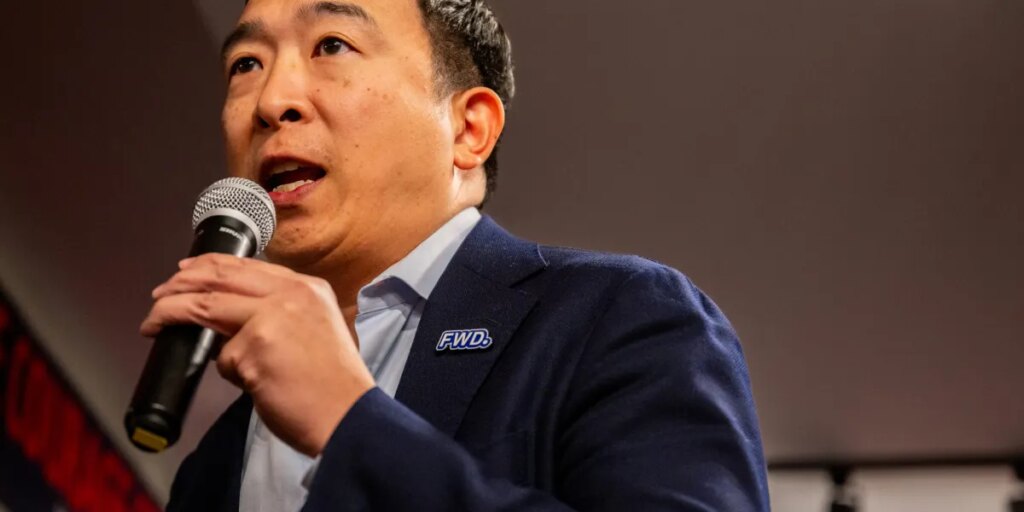
That’s if ex-presidential candidate and CEO of Noble Mobile Andrew Yang gets his way. In an interview on CNBC’s Squawk Box, Yang said it’s time for the U.S. to drop taxes on labor, in favor of taxes on AI. He argued that taxation is a tool used to discourage certain behaviors, and with human employment under threat, the government should stop penalizing the hiring of people.
“We’re going to be in a position where we want to shore up labor in every quarter, in every organization and environment,” he said. “We should actually try to stop taxing labor,” and instead, start taxing AI.
Yang isn’t the first to float the idea of dropping taxes on labor. It’s a cause that’s caught the attention of billionaires and politicians alike. Sen. Cory Booker (D-NJ) recently introduced a bill that would eliminate income tax on the first $75,000 of earnings. Khosla Ventures founder and billionaire Vinod Khosla said in a recent interview with Fortune Editor-in-Chief Alyson Shontell that presidential candidates should run on a platform to remove income tax for those making less than $100,000.
However, those making $100,000 or less only contributed to about 15% of the total income tax revenue last year, according to the think tank Bipartisan Policy Center. Business leaders and AI entrepreneurs predict AI will soon take over many jobs in the white-collar workforce, potentially raising unemployment to 20% (according to Anthropic CEO Dario Amodei). Microsoft AI chief Mustafa Suleyman thinks most white-collar work could be replaced within 18 months. And Yang has recently made a similar prediction. His warnings come from his own observations of the AI industry.
“I just came from an AI conference out west, and holy cow!” he said, just after agreeing to the host’s question reconfirming his stance to shift the tax to AI. “They said to me that what we’re going to see in the next six months outstrips what we’ve seen in the last ten years, because the rate of change is on a hockey stick and heading up.”
While the labor market has been persistent in recent months, it’s shown signs of wavering, with unemployment ticking up to 4.4% last month, and employers posting 91,000 job losses. And several major tech companies have attributed mass layoffs to AI. Jack Dorsey’s Block last month cut nearly half of its workforce citing productivity gains from AI. And earlier this week, Australian-American tech firm Atlassian cut 10% of its global workforce. (Although Sam Altman of OpenAI has warned some companies are “AI washing” or blaming layoffs on AI when, in reality, they’re thanks to another cause).
Beyond the AI era: a tax system for humanoid robots
Despite Yang’s thoughts to shift the tax scheme from laborers to AI companies, some tech leaders think taxing AI is unfeasible. But some think the labor threat isn’t coming from the chatbots, but rather the robots, and that the U.S. should actually plan to tax the labor humanoid robots could perform.
AI-powered tech firm AskHumans founder Zak Kidd is proposing a tax on tasks, where businesses are levied a fee for every specific activity performed by a humanoid robot that replaces a human worker. AskHumans has been used by The World Bank, Fidelity, and The Ned, according to Kidd, who said he is actively pitching governors around the country on his task tax idea. This “tax to task” model is designed to replace the government tax revenue lost when an employer decides to swap a human employee for a mechanical system.
“What we want to do is actually levy a tax on each of those activities that’s paid back to the state to replace that fiscal gap,” Kidd told Fortune, referring to tasks robots may one day be able to perform that will replace human labor.
Kidd uses a hotel like Marriott to illustrate his proposal, noting that replacing a $28-per-hour human housekeeper with a $2-per-hour robot results in a significant loss of tax revenue. But even with a slight tax on the business, the costs incurred would still total less than the human worker.
Unlike Yang, Kidd thinks taxing AI raises too many logistical questions because, as more companies integrate AI into workflows, it’s harder to denote where the AI stops and the human interpretation starts. He thinks that while AI threatens white-collar work, robots could come for physical labor.
“I see AI as an augmentation of knowledge work,” he said. “But I see robotics, humanoid robotics as a replacement for manual work.”
The post Ex-presidential candidate Andrew Yang says it’s time to ‘stop taxing labor’ and make AI foot the bill instead appeared first on Fortune.