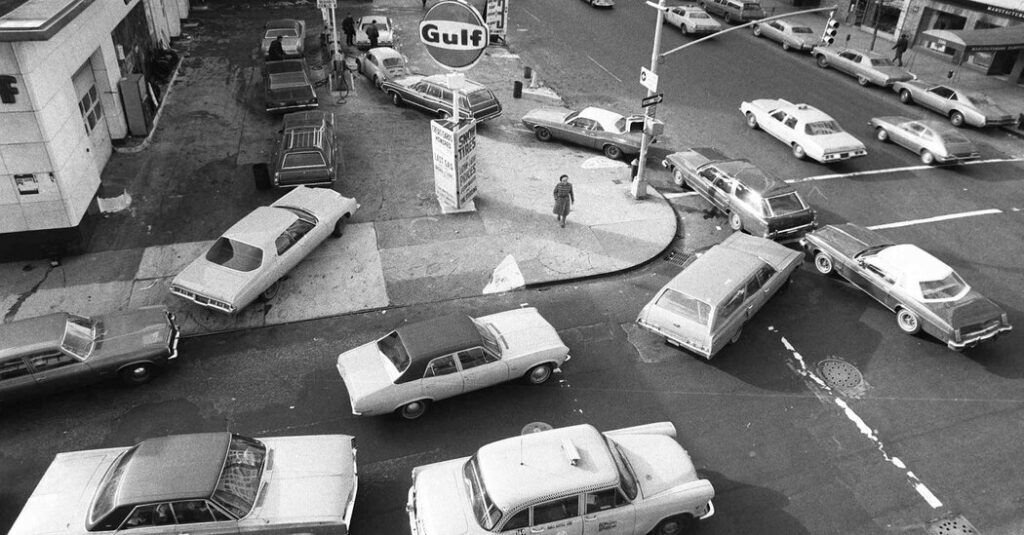
In October 1973, oil-producing countries in the Middle East imposed an oil embargo, among other measures, on the United States and other countries that had supported Israel during the Yom Kippur war.
Gasoline prices skyrocketed, and President Richard M. Nixon took emergency measures to limit consumption. Gas stations rationed supplies, leading to long lines, complaints of price gouging, and what The New York Times called “chaotic” situations. In Europe, some countries banned driving on Sundays, and Japan, heavily dependent on oil imports, declared a state of emergency.
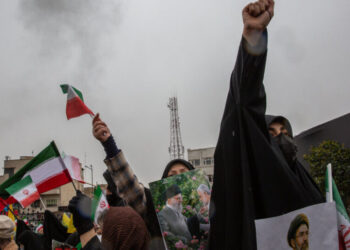
This month, after the United States and Israel attacked Iran, the Iranians began counterattacks on energy shipping and infrastructure. That has led to what experts are calling the worst disruption to oil supplies in history.
Certainly, oil and gasoline prices are soaring. But there’s no sign yet that American drivers will have to line up for fuel or that the government will have to enact new policies like the ones Mr. Nixon’s administration did to to try and keep fuel distributed around the country. In a November 1973 speech, he called for Americans to take steps to “include reductions in home heating, reductions in driving speeds, elimination of unnecessary lighting.”
So what makes this one worse?
Many of the hallmarks of the 1973 shock were a result of poor domestic policy decisions, and the hit to supply is far greater now, said Bob McNally, president of Rapidan Energy Group, a research firm. Policies like rationing set off panic buying, creating shortages instead of easing the problem.
The 1973 embargoed oil accounted for about 7 percent of global oil consumption, and targeted only a handful of nations. That meant the United States could still buy some oil from other countries.
Now, closer to 20 percent of the world’s supply is threatened, and the disruption is caused by a war that has no end in sight. The United States, Israel and Iran are all dug in, and daily threats to oil production, refining and storage mean that even when ships can sail again the supply might not come back quickly.
The conflict has the potential to cause a lasting inflationary cycle, as rising prices for everything from diesel to fertilizer are passed on. That could add pressure on a world economy that is already contending with President Trump’s trade war.
“I think we’re having a slowly building recognition of the enormity of this disruption,” Mr. McNally said.
The Trump administration has taken some steps to alleviate the pressure — promising to release oil reserves and lifting sanctions on Russian oil exports — but they’re not having a notable impact on oil prices. And Mr. Trump has dismissed concerns over the jump in fuel costs.
“I don’t have any concern about it,” he said in an interview with Reuters earlier this month. “They’ll drop very rapidly when this is over, and if they rise, they rise, but this is far more important than having gasoline prices go up a little bit.”
The world has changed in some ways that will soften the blow. Improvements in energy efficiency and large oil stockpiles around the world serve as a buffer, and alternative energy sources mean oil is less important to the global economy than it was in the 1970s. The United States does not rely on the Middle East for oil, but other economies, notably in Asia, do and are now competitors for oil on the global market. So even if the closing of the Strait of Hormuz won’t lead to lines for gasoline in the United States, the longer the conflict lasts, the more difficult the ramifications are to predict.
“We are talking about shielding from price increases,” Clay Seigle, a senior fellow at the Center for Strategic and International Studies, said. “That’s separate from a physical shortage risk, which I think will be experienced in other markets that get most of their oil from this region.”
On Thursday, the research firm S&P Global Energy said that the war had reduced supplies of oil and refined products from the Persian Gulf by around 17 million barrels a day, equal to most of the region’s previous exports.
“No other historical episode comes close,” the firm wrote, warning that prices could hit record highs if supplies remain cut off.
The International Energy Agency also described the current situation as “the largest supply disruption in the history of the global oil market.”
“In the absence of a rapid resumption of shipping flows, supply losses are set to increase,” the I.E.A. said.
International crude futures were hovering around $100 a barrel on Friday, rising significantly since the start of the war. Gasoline prices in the United States have jumped 22 percent, to an average of $3.63 a gallon. Prices of natural gas, jet fuel and diesel are all climbing even faster.
The 1973 embargo also included curbs on Canada, and Japan, as well as price increases and production cuts. Supply from the oil producers fell by about 4 million barrels a day, according to the Center for Strategic and International Studies. By January 1974, oil prices had nearly quadrupled from before the start of the embargo in October.
And even though the embargo ended in March 1974 after diplomatic negotiations, the economic damage — rising unemployment, faster inflation and a recession — lasted for years.
There were other jolts too: In early 1979, the Iranian Revolution led to another significant drop in crude oil production. That, as well as government price regulations, caused a gasoline shortage in the United States and renewed long lines at the pump. The price regulations were not successful, and prices rose anyway.
The most recent extreme shake-up to oil markets occurred in 2022 after Russia invaded Ukraine. Gas prices hit record highs, inflation spiked to the highest level in decades and Europe was particularly hard hit as it tried to wean itself off Russian supplies.
Those past crises have led to a number of changes in they way fuel is consumed around the world. Cars are far more fuel-efficient, buildings are better insulated and some industries have transitioned away from a direct dependence on oil thanks to alternative energy sources like solar power.
And one direct result of the 1973 embargo was the creation of the U.S. Strategic Petroleum Reserve. Established in 1975, it now has a storage capacity of 714 million barrels. The I.E.A. says emergency reserves among its 32 members stand at 1.2 billion barrels. China, which isn’t a member of the I.E.A., has another 1.2 billion barrels of reserves.
“One of the lessons from the 1970s, of course, is everybody needs to have emergency stockpiles for exactly the kind of crisis we have today,” said Pavel Molchanov, an analyst at Raymond James.
This week, the I.E.A. members agreed to release 400 million barrels of oil from those strategic reserves, the most ever and the first coordinated release since Russia’s full-scale invasion of Ukraine in 2022. The U.S. will release 172 million of those barrels over four months, beginning next week, the department said.
But the reserves don’t contain refined products like gasoline or jet fuel, Mr. Seigle said. “If we start to experience pricing pressure on those products,” he said, “a release in crude oil isn’t going to directly address that.”
The 1973 embargo also led the United States toward energy independence. It is now the world’s largest oil producer.
Fast-growing economies like India and China have become huge consumers of energy in recent decades. Although countries have moved toward more renewable energies, global consumption of oil nearly doubled from 1973 to 2024, to more than 100 million barrels a day, according to the Energy Institute.
The reserves may offer only a temporary cushion, and even if the Strait of Hormuz opens relatively soon, oil prices could remain high.
“If the strait opens, the world will still have the question: How long is it going to be open for?” said Phillip Braun, a finance professor at Northwestern University.
“There’s still a lot of uncertainty about what might happen,” he said. “Even if it opens up for a while, I still think the price of oil is going to go up.”
Rebecca F. Elliott contributed reporting.
Emmett Lindner is a business reporter for The Times.
The post Echoes of the ’70s in What’s Now the Largest Oil Shock Ever appeared first on New York Times.