We live in stressful times, and that doesn’t stop even when we escape to the movies. You might notice it after you leave the cinema, when a fellow moviegoer exclaims “That was so stressful,” or a critic praises a movie’s “panic-attack aesthetic.” Several of this year’s Oscar-nominated films, from “Marty Supreme” to “If I Had Legs I’d Kick You,” epitomize what we might call anxiety cinema: They’re designed to invoke neither fear nor joy in the viewer but a kind of delirious, ulcerous unrest.
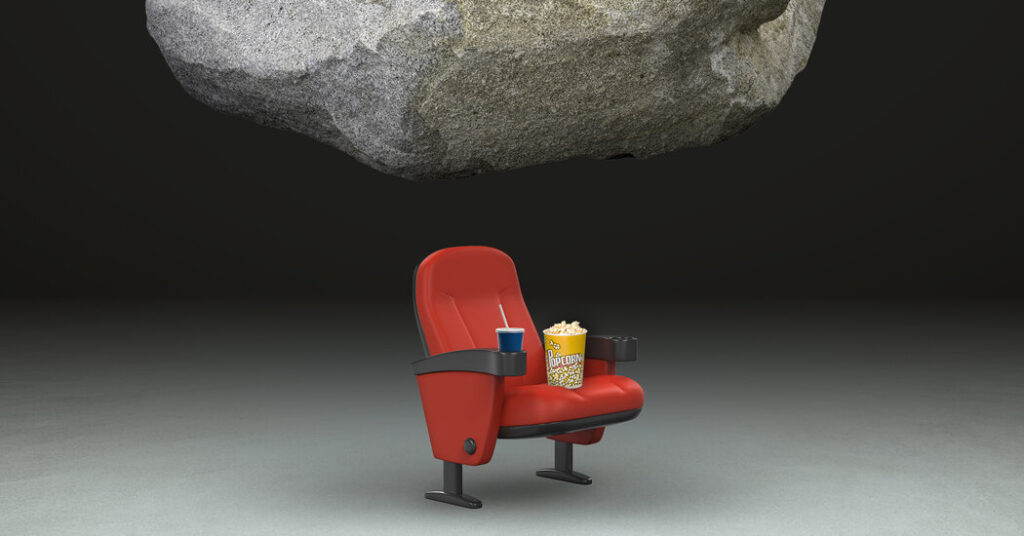
In these films, the world is hostile and claustrophobic. The desperate characters unravel before our eyes, making terrible choices and then trying, and often failing, to outrun the consequences. The films use distressing musical scores and jarring cinematography to evoke the feeling that the ceiling is about to cave in on the people we’re watching — as it does literally in both “Marty Supreme” and “If I Had Legs I’d Kick You” — and, by extension, on us.
I have lived with anxiety for most of my life, so I often wonder why I love these jittery movies. Then I realized: It’s like wondering why sad people listen to sad songs. Anxious people flock to anxious films, and lots of people are feeling anxious. America is in fight-or-flight mode, with a thousand threats and crises materializing every day. Now we’re seeking out that feeling as entertainment, too.
I think these movies offer a perverse kind of comfort, or at least blunt recognition. They capture and metabolize the sense of distrust and destabilization that has been lingering in the air for years. They often confront grim, taboo subjects that mainstream films are inclined to avoid — such as early pandemic life, as in “Eddington,” from the director Ari Aster — and dial up the absurdities to such a degree that we can laugh at the spiraling nightmare. As an audience, we’re yearning for some sort of catharsis, and having a simulated panic attack in a theater full of strangers is as close as we can get — and feels more appealing than having a real panic attack alone.
Paul Thomas Anderson’s film “One Battle After Another,” nominated this year for an Oscar for best picture, includes an absolutely harrowing 25-minute stretch in which the lapsed revolutionary Bob Ferguson (Leonardo DiCaprio) tries desperately to contact his old comrades, a sequence full of dizzying cinematography paired with a plinking piano motif. The director Mary Bronstein’s maternal meltdown “If I Had Legs I’d Kick You” stars Rose Byrne as a mother who unravels in real time while dealing with a flooded apartment and a chronically ill child. “Marty Supreme,” from the anxiety-cinema maestro Josh Safdie, grips viewers in a swirl of frenetic pacing and perpetual calamity as an aspiring table-tennis champ (Timothée Chalamet) tries to outrun the consequences of his own ill-considered schemes. These are the heroes of our times.
Mr. Safdie, along with his former collaborator and younger brother Benny Safdie, have emerged as the auteurs of anxiety cinema. Their 2019 film “Uncut Gems,” focused on a crazed gambling addict (Adam Sandler), is foundational, hailed as “so stressful it should come with a panic attack warning.” Its signature mood has since become critical shorthand for this particular jangling experience, such as in 2021’s “Shiva Baby,” about a young woman trapped at a claustrophobic post-funeral gathering, which was labeled a “queer millennial ‘Uncut Gems,’” and “If I Had Legs,” which the elder Safdie co-produced and has been called “‘Uncut Gems’ for moms.”
Anxiety is not new at the cinema — it’s a staple element of films from the noir movies of the ’40s and ’50s to the paranoid political thrillers of the ’70s. In 1939, during a lecture to a group of Yale drama students, Alfred Hitchcock offered this advice to his young listeners: “Make the audience suffer as much as possible.”
But what distinguishes this current wave of anxious cinema from its predecessors is that these films are not anchored by debonair heroes, like Robert Redford or Cary Grant, who coolly navigate the chaos. Their protagonists are damaged and neurotic, panicked and sweaty. And these modern movies aren’t about spy chases or deeply rooted conspiracies; they’re about everyday scenarios. They use a heightened style to infuse these mundane situations with an almost unbearable level of stress. They resonate with us because they evoke the daily dread of life in a society where everything feels increasingly like a scam, a hoax, a grift or a threat.
If there’s a spiritual ancestor to these films, it’s “After Hours,” directed by Martin Scorsese. In that cult classic, from 1985, a young man’s night out in SoHo goes nightmarishly awry. It drew mixed reviews at the time but now stands as the Rosetta Stone to this school of filmmaking: the escalating paranoia, the perverse camera angles, the surreal sense of cosmic punishment.
Mr. Scorsese has said he saw “After Hours” as an exercise in style, employing Hitchcockian shots and alarming close-ups “just to build up paranoia and anxiety.” He was dealing with his own troubles at the time, particularly the loss of financing for his passion project “The Last Temptation of Christ.” So he poured his frustrations into “After Hours” and took a sadistic zeal in the misfortunes of its emasculated hero, played by Griffin Dunne — processing his own misery by putting his character through the wringer.
Maybe films like these have resurfaced as we all process our own misery, and seek out new wringers to put ourselves through. Mr. Dunne later recalled how “The anxiety of the movie struck all of us as hilariously funny.” He could hear Mr. Scorsese “out of the corner of my ear during takes, saying, ‘Oh God, that’s awful.’ … And he would keep laughing.”
That same pitch-black humor is in the movies crowding our theaters. Several of them are up for Oscars on Sunday. What drives them is a feeling that’s central to the spirit of anxiety cinema and to this moment: the sense of a world so menacingly out of control that all you can do is laugh through the dread.
Zach Schonfeld is a cultural critic, a former senior writer at Newsweek and the author of “How Coppola Became Cage,” a biography of Nicolas Cage.
Source photographs by Kampee Patisena, Nerthuz, Devonyu and webking/Getty Images.
The Times is committed to publishing a diversity of letters to the editor. We’d like to hear what you think about this or any of our articles. Here are some tips. And here’s our email: [email protected].
Follow the New York Times Opinion section on Facebook, Instagram, TikTok, Bluesky, WhatsApp and Threads.
The post Does This Movie Make You Anxious? appeared first on New York Times.