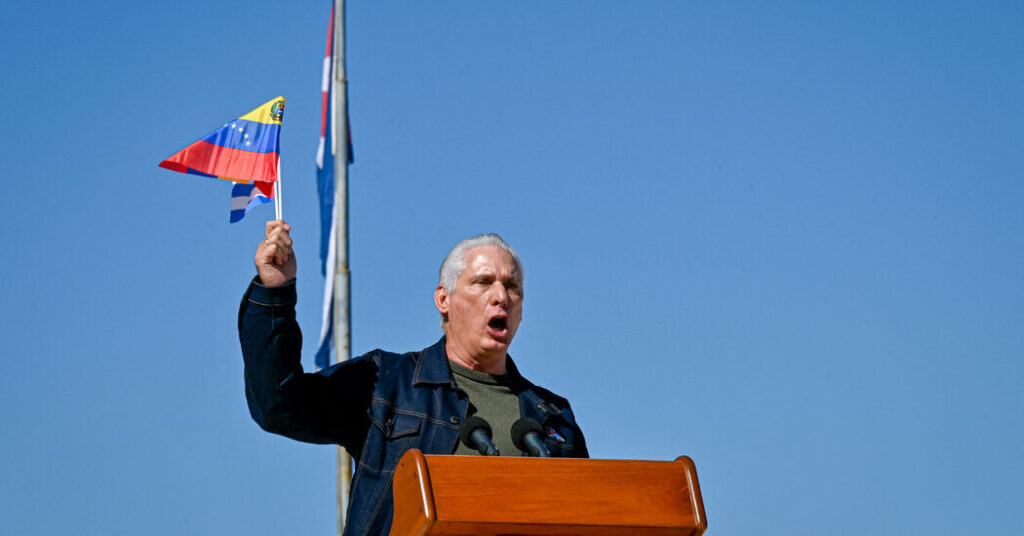
With oil running out and the nation increasingly plunging into chronic darkness, President Miguel Díaz-Canel of Cuba on Friday announced that his government had been engaging in talks with the Trump administration.
While word of the discussions had already leaked in the U.S. news media, it was the first time the Cuban government acknowledged it.
The announcement was widely seen as a last-ditch effort by a hobbled regime to stay in power as the Trump administration ratchets up pressure on the 67-year-old Communist state.
Mr. Díaz-Canel, in a speech broadcast on Cuban state media, said “these talks have been aimed at finding solutions, through dialogue, to the bilateral differences between our two nations. International factors, he said, have facilitated these exchanges.”
Mr. Díaz-Canel said the talks are also needed in part “to determine the willingness of both sides to take concrete actions for the benefit of the people of both countries.”
The Cuban leader also warned that talks would likely take a long time to yield any results.
“Agendas are built, negotiations and conversations take place, and agreements are reached — things we are still far from because we are in the initial phases of this process,’’ Mr. Díaz-Canel said.
The Cuban government has been in dire straits since President Trump attacked Venezuela in January, arrested its president, took control of its state oil industry and blocked fuel shipment to Cuba. Venezuela had been Cuba’s top supplier of oil and Mr. Díaz-Canel said his country had not received any Venezuelan oil in three months.
After the Venezuela operation, Mr. Trump threatened severe tariffs on any country that provided Cuba with oil. The Cuban government was forced to curtail public transportation, elective surgeries and other services that depended on diesel fuel.
With Cuba dependent on foreign oil for 60 percent of its fuel supply, experts have estimated that the Cuban government would run out of fuel this month.
Mr. Trump has repeatedly said the Cuban government would collapse on its own.
Late last week at a White House event, Mr. Trump suggested a Cuba deal was imminent. “As we achieve a historic transformation in Venezuela, we’re also looking forward to the great change that will soon be coming to Cuba,” Mr. Trump said Saturday.
“Cuba’s at the end of the line,” he added. “They have no money. They have no oil.”
Standing next to the soccer superstar Lionel Messi to celebrate the 2025 Major League Soccer Championship, Mr. Trump was joined by the co-owner of the Inter Miami soccer team, Jorge Mas, the son of a prominent Cuban exile leader, Jorge Mas Canosa.
“You’re going to go back, and you won’t need my approval,” Mr. Trump said to Mr. Mas, indicating an easing of travel restrictions to the island.
He concluded by saying about Cuba: “They want to make a deal so badly. You have no idea.”
Any meaningful deal with the Cuban government, experts say, would have to include the release of all political prisoners, an end to the criminalization of dissent, permitting independent political organizing, the legalization of political parties other than the Communist party and a restoration of basic civil liberties, including freedom of speech and the press.
The Cuban government announced Thursday that it was planning to soon release 51 prisoners.
“The main question for me is whether and what political, social and civic changes will also be included in any deal,” said Ted Henken, a Cuba scholar at Baruch College.
Frances Robles is a Times reporter covering Latin America and the Caribbean. She has reported on the region for more than 25 years.
The post Cuban President Acknowledges Talks with the Trump Administration appeared first on New York Times.