Prime Minister Mark Carney of Canada unveiled a multibillion-dollar plan on Thursday to significantly build up the country’s military capacity in the Arctic, including establishing new bases in a region where the country has had to rely on the United States to ensure its defense.
The announcement follows President Trump’s repeated calls for Canada’s annexation and his musings about acquiring Greenland, Canada’s Arctic neighbor.
Mr. Carney is not the first Canadian prime minister with grand plans for improving the security and asserting Canada’s sovereignty over its enormous yet largely unpopulated Arctic region. But his proposal is more comprehensive and extensive than past efforts.
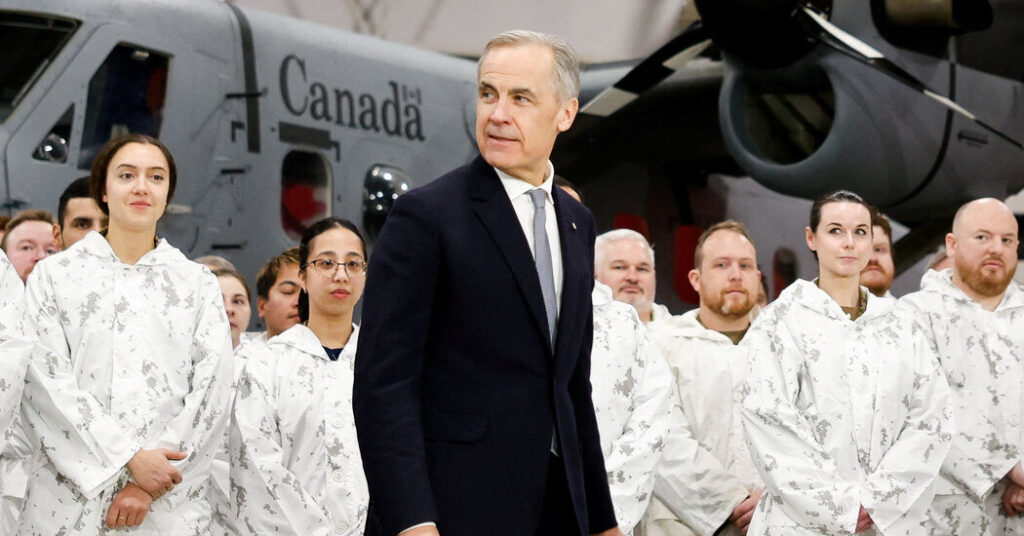
“With this plan, we are taking control of our future,” Mr. Carney said, speaking in an airplane hanger in the city of Yellowknife surrounded by troops. “We will no longer rely on others to defend our Arctic security or to fuel our economy. We are taking full responsibility for defending our sovereignty.”
Mr. Carney said that past efforts “lacked the scale of ambition and the depth of strategy worthy of this vast region and its people.”
The cornerstone of the new effort will be spending 32 billion Canadian dollars, about $23.5 billion, to build three military bases in the northern territories, including one in Yellowknife, and making improvements at an existing base in Labrador. Two “operational support nodes” — essentially service stations for military aircraft and troops — will also be built for another 2.67 billion Canadian dollars. The government will spend 294 million dollars on improving two Arctic airports to allow the landing of larger aircraft, civilian and military.
“The primary purpose of all this spending is to show Donald Trump that Canada can take care of security in its own Arctic, so that the U.S. doesn’t need to,” said Michael Byers who studies Arctic sovereignty and Canadian defense policy at the University of British Columbia.
Professor Byers added that “in other circumstances, permanently stationing more than a few hundred troops in the Canadian Arctic would not make sense. It’s too vast, cold, and sparsely populated.”
He said that it would be more effective and less expensive to set up a special northern rapid reaction force in southern Canada that could be swiftly sent north.
David Perry, president of the Canadian Global Affairs Institute, a defense and international affairs research group, said that “these are massive, not seen in several generations investments.”
Trump Administration: Live Updates
Updated
- Trump removes sanctions on Russia to help oil flow amid Iran conflict.
- Cuba pledges to release 51 prisoners amid pressure from Washington.
- The executive and judicial branches are sparring over control of federal courthouses.
A senior government official, who spoke on the condition of anonymity because of public service rules, said the new bases and supply stations would allow Canada to maintain a constant presence of a sizable number of troops and aircraft in the north, rather than just dispatching them for occasional training exercises. The official said that work on some of the projects had already started and that the government had called for bids on the others.
The entire project is expected to take at least a decade to complete.
The expanded military presence follows Canada’s decision to spend 6.5 billion Canadian dollars on an Australian radar system to monitor Arctic airspace. During a visit to Australia last week, Mr. Carney attended a demonstration of that system by the Royal Australian Air Force.
Canada, the United States and Finland are also working jointly to build icebreakers for use in the Arctic, a program that preceded Mr. Trump’s return to office.
The Arctic military project is part of Mr. Carney’s plan to rapidly expand Canada’s military spending to NATO’s voluntary minimum of 2 percent of gross domestic product. Last year, Mr. Trump repeatedly characterized Canada and most other NATO members as freeloaders.
Most of the projects announced on Thursday come under 87 billion Canadian dollars set aside for modernizing Canada’s operations within NORAD, the joint Canada-United States continental air defense command.
Long before Mr. Trump took an interest in Greenland, calls for improving Canada’s Arctic security had been growing. Global warming has raised the prospect that the Northwest Passage might become a viable shortcut for shipping from Asia to Europe. There has been growing interest in the Arctic mineral resources, particularly of critical minerals, although some analysts question the commercial viability of operating in the isolated region and its hostile environment.
Two all-season road projects and a hydro electric system expansion are being fast-tracked, Mr. Carney said, to prepare for new mining operations, to improve electrical service in the region and get ready for the troops who will be stationed at the new bases.
Mr. Carney stopped in Yellowknife on his way to Norway, where he will travel to the far north to watch a winter training exercise by about 25,000 troops from NATO member nations including the United States.
This weekend, he will join the prime ministers of Denmark, Norway, Sweden, Finland and Iceland for a nordic nations summit meeting.
Ian Austen reports on Canada for The Times. A Windsor, Ontario, native now based in Ottawa, he has reported on the country for two decades. He can be reached at [email protected].
The post Canada to Expand Military Presence in Arctic, Following Trump Threats appeared first on New York Times.