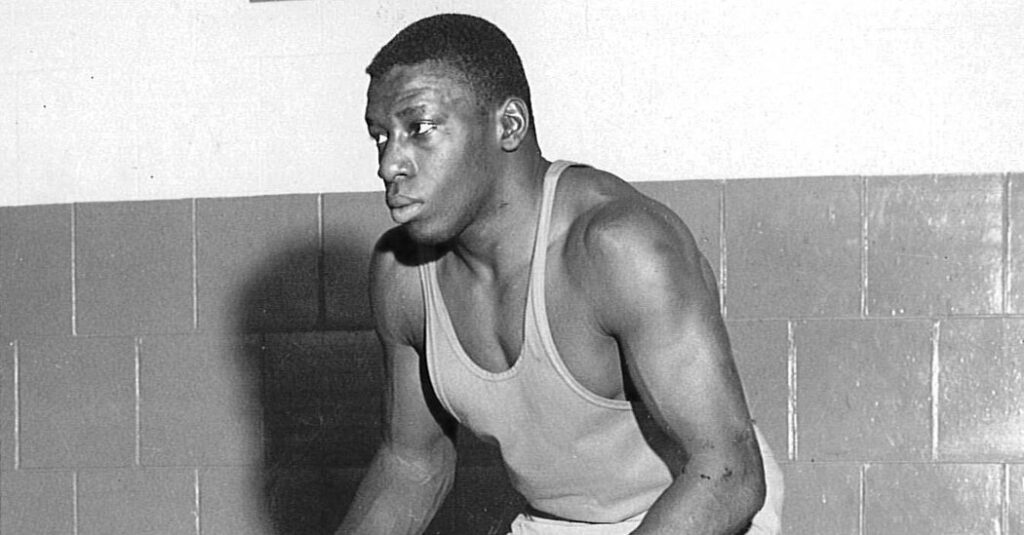
Bobby Douglas, who in 1964 was one of the first three African Americans to compete in wrestling at the Olympics and who later became the first Black head coach of a major college wrestling team and the only coach to guide an undefeated wrestler to four N.C.A.A. titles, died on Feb. 23 in Ames, Iowa. He was 83.
His death was announced by U.S.A. Wrestling, the sport’s national governing body. No cause or other details were provided.
Known as a brilliant technician, Douglas forged a groundbreaking career as he rose from a childhood marked by poverty and tragedy to become the first African American wrestling team captain (in 1968) and head coach (1992) at the Olympic level.
In 1973, he became the first Black head coach of a major-college wrestling team, at the University of California, Santa Barbara, and he guided Arizona State to an N.C.A.A. title in 1988.
As a competitor, coach and author, he had a significant impact on diversifying a sport once dominated by white Americans and Eastern Europeans.
At the 1988 Summer Olympics in Seoul, with Douglas coaching in his corner, Kenny Monday, an American, became the first Black athlete to win a gold medal in wrestling. With Douglas in his corner again, Monday won gold at the 1989 world championships.
Douglas “explained to me the significance of being the first and how important that was,” Monday, now the head wrestling coach at Morgan State University in Baltimore, said in an interview. “It took my mind and passion to another level.”
As a competitor, Douglas finished fourth as a featherweight in the freestyle wrestling competition at the 1964 Summer Olympics in Tokyo, where his Black teammates Charles Tribble and Robert Pickens were also trailblazing entrants. Douglas then served as captain of the freestyle wrestling team at the turbulent 1968 Summer Games in Mexico City.
Making what he later described as an agonizing decision, he disagreed with the sociologist Harry Edwards’ call for Black athletes to boycott the 1968 Games to protest racial inequality in the United States. The boycott did not occur but various protests did, most emphatically the black-gloved salutes on the medal stand by the American sprinters Tommie Smith and John Carlos.
“I want to prove that I can do more by competing than by sitting on the sidelines and yelling ‘Black power,’” Douglas told The New York Times the day before the Games began.
As a coach, Douglas helped shape the unblemished career of Cael Sanderson at Iowa State from 1999 to 2002. Sanderson is widely considered the greatest college wrestler of all time. He is the only Division I wrestler to have won four N.C.A.A. titles while never losing a match, building a record of 159-0. Douglas also coached Sanderson to an Olympic gold medal at the 2004 Summer Games in Athens.
Sanderson, now the head coach at Penn State, once described Douglas as “the Bruce Lee of wrestling,” peerless with setups and finishes in taking down opponents, expert with upper-body positioning and in clinches.
Speaking to reporters after Douglas’s death, Sanderson said: “I always thought technically he was 10 years ahead of the competition. He was just a great man and a great coach. I never really saw him be upset in a match or get upset with somebody. He always treated people with love and respect.”
Robert Edward Douglas was born on March 27, 1942, in Bellaire, Ohio, along the Ohio River south of Wheeling, W.Va.
According to a 1992 profile in Sports Illustrated, his father, Eddie Douglas, an itinerant boxer and mineworker, was in prison for theft when Bobby was born. His mother, Belove Davis, had been left an invalid after having her pelvis crushed in an automobile accident. As a young boy, Bobby performed errands for numbers runners.
One night, Douglas said, a man broke into their apartment and raped and stabbed his mother. She never fully recovered, so he was sent to live with his maternal grandparents, Maggie and Anthony Davis, in nearby Blaine, Ohio.
Douglas was small and often bullied, so his grandfather, a coal miner, taught him wrestling moves for self-protection. On Sundays, after church, Douglas and other Black, Russian and Polish sons of miners wrestled outdoors on the grass.
His grandfather also told him a story that, according to Sports Illustrated, Douglas confirmed as an adult: His family descended from the Nuba peoples of Sudan, in northeast Africa, who covered themselves in ash and wrestled for honor and spiritual growth. Douglas became something of a historian of wrestling, noting in interviews and speeches that Plato had been a wrestler. So had George Washington and Abraham Lincoln.
It was a sport, he said, where “dynamic, combative, disciplined people can find a safe haven.”
At high school in nearby Bridgeport, Ohio, Douglas met a man who, like his grandfather, he would credit with saving and molding him: a wrestling coach named George Kovalick. In 1959, Douglas used his signature speed and movement to win a state championship in the 112-pound category.
He followed Kovalick to West Liberty State College (now West Liberty University) in West Virginia and, in 1962, won a National Association of Intercollegiate Athletics title in the 130-pound category. Ambitious for an Olympic medal, he transferred to Oklahoma State, a wrestling powerhouse, but in 1964 finished just off the podium in Tokyo.
Douglas won a silver medal at the world championships in 1966; received a bachelor’s degree in health, physical education and recreation from Oklahoma State in 1967; and entered the 1968 Olympics as the freestyle team captain and a gold medal favorite.
His chances of winning, though, ended in his first match, when he suffered injuries to his ribs and Achilles’ tendon. In 1970, he won a bronze medal at the world championships, then retired with a lifetime record of 303-17-7.
After a year at U.C. Santa Barbara, he coached at Arizona State from 1974 to 1992 and received his master’s degree in secondary education there in 1980. He then coached at Iowa State until 2006. He was inducted into the National Wrestling Hall of Fame in 1987.
He is survived by his wife, Jackie (Davidson) Douglas, whom he married in 1966, and a son, Robert Douglas Jr.
At the 1992 Games in Barcelona, with Douglas as the first African American head coach of the U.S. Olympic freestyle team, his wrestlers brought home six medals, including three golds — one of them won by Kevin Jackson, who became the second Black wrestler, after Kenny Monday, to stand on top of the medal podium.
“Bobby Douglas was really a key person that shared our history with me,” Jackson said in a 2020 interview with the digital platform Trackwrestling. “He reminded me constantly that Kenny was the first and that I could possibly be the second. He would also say things like, ‘Your family’s going to hang their hat on gold medals, especially Olympic gold medals.’”
Jeré Longman is a Times reporter on the Obituaries desk who writes the occasional sports-related story.
The post Bobby Douglas, Pathbreaking Olympic Wrestler, Dies at 83 appeared first on New York Times.