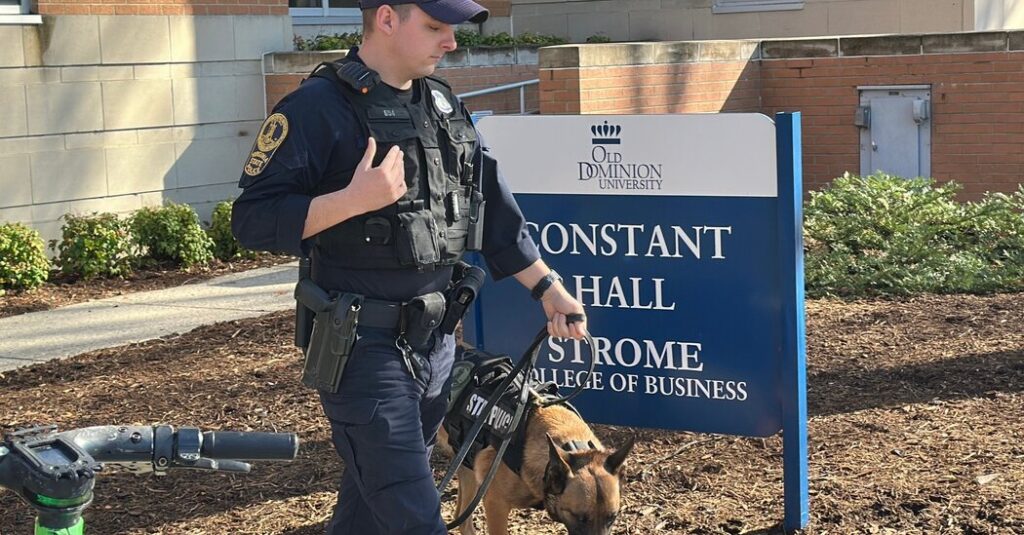
Lt. Col. Brandon Shah had flown hundreds of hours of combat missions as an Army attack helicopter pilot in Iraq and Afghanistan, and after years in war zones, he had turned to teaching the next generation of military officers in the safe, green quads of his alma mater, Old Dominion University in Virginia, far from any conflicts.
On Thursday, a gunman stormed into his classroom shouting “Allahu Akbar!” and shot the combat pilot dead. Two R.O.T.C. students were also wounded, according to the F.B.I. Other students in the class quickly subdued and killed the shooter, whom the authorities identified as 36-year-old Mohammad Bailor Jalloh — a military veteran and Old Dominion student with a long, troubled past.
Now, portraits are emerging of the two lives that collided in that classroom: one of a beloved officer and father who survived multiple deployments and was decorated for valor, only to be killed at home; the other of a former U.S. soldier who was radicalized by online extremists, was sent to prison on federal terrorism charges, and was freed after years in lockdown, apparently still set on bloodshed.
When Mr. Jalloh walked into the classroom, he asked twice if it was a Reserve Officer Training Corps class before pulling the trigger, according to documents filed in federal court on Friday. Then he started shooting.
Mr. Jalloh’s involvement with terrorism started at least 10 years before he opened fire on Thursday. He was part of a wave of more than 200 convictions of American extremists who were inspired by the Islamic State that peaked in 2015. The average prison sentence in the cases that resulted in convictions was 12 years. Now, many are getting out.
The federal prison system has made little effort to break down the radicalized beliefs in those inmates before their release, according to Alex Hitchens, a lecturer at King’s College London, who studies radicalization and wrote a book about the wave of cases, including Mr. Jalloh’s.
“We’ve been worried about this moment for some time,” Mr. Hitchens said in an interview. “There didn’t seem to be much of a plan for when these guys got out.”
Colonel Shah had seen his time at Old Dominion as a needed break from danger, according to a cousin, Rizwan Shah, who also served as an Army helicopter pilot, and who mentored his younger cousin.
“He had spent a lot of time overseas in dangerous places, or in high-tempo assignments,” Rizwan Shah said. “Old Dominion was his chance to take a knee and spend more time with his family.”
Brandon Shah was born in Virginia to a Pakistani father and American mother. He enlisted in the Virginia National Guard in 2003 as an aircraft support soldier, earned a degree from Old Dominion in 2007, then became an Army officer and flew Apache attack helicopters in Iraq and Afghanistan. He was awarded the Bronze Star twice, as well as the air medal for heroic actions during combat, and he went on to command multiple helicopter units.
He was married and has a son in elementary school. His cousin said the pilot was looking forward to higher command positions.
“He really gave his all and took on a lot of tough assignments,” Rizwan Shah said. Though the cousins were close, constant deployments meant they were rarely in the same ZIP code. They often spoke by phone about the challenges of command, or how to handle the loss of a fellow soldier.
Since the shooting, he said, messages of love and support from soldiers who served with Colonel Shah have come from all over the globe.
“He was the best of us, a great father, a great husband, a great leader,” Rizwan Shah said. “His loss is greater loss than just one man.”
Mr. Jalloh also served in the Virginia National Guard, and he started attending Old Dominion just a few months after Colonel Shah graduated. He was born in Sierra Leone but moved with his family to Virginia and became a U.S. citizen. He served one enlistment in the Guard from 2009 to 2015. At Old Dominion he studied geography intermittently from 2007 to 2013, according to a university spokesman.
By the end of his National Guard career, he was spending more and more time online, consuming radical Islamic content, including that of Anwar al-Awlaki, an American-Yemeni cleric killed by a U.S. drone strike in 2011, according to a 2016 federal court filing.
Once out of the National Guard, he returned to Sierra Leone in 2015 — a trip he later told the F.B.I. was an attempt by his father to “sort him out” from his radical beliefs, the filing said. In Africa, it said, he tried to join a convoy of Islamic State militants bound for Libya, but was ultimately unsuccessful and returned to the United States.
Back in Virginia, he connected with Islamic State operatives online, made a $500 donation to their cause and started to discuss conducting terrorist attacks on U.S. soil, the filing said. One of the operatives was an F.B.I. informant, who alerted federal agents.
The extremist clerics Mr. Jalloh was following regularly portrayed Muslims who joined the U.S. military as traitors to their faith who, because of that, owed a special debt to the jihadist cause, Mr. Hitchens said.
Rizwan Shah said he had experienced that dynamic as a Muslim soldier in Afghanistan. “I had to be extra careful, the Muslims there referred to me as a betrayer,” he said.
In 2016, Mr. Jalloh bought an AR-15 rifle and began searching online for information about a veterans parade on Independence Day. F.B.I. agents swept in and arrested him on July 3, 2016. He pleaded guilty to trying to provide material support to a terrorist organization later that year and was sentenced to 11 years in prison.
He was released in 2024, two and a half years before his sentence was complete.
The Federal Bureau of Prisons did not respond to questions about his release, or the availability of services to re-educate radicalized inmates.
Mr. Jalloh then moved in with his sister in Sterling, Va., outside Washington, D.C., according to a court filing, and federal probation officers checked on him every six months. The last visit was in November.
In the summer of 2025 he enrolled in online classes at Old Dominion, the university said.
In March, according to a court filing, Mr. Jalloh went to the house of an illegal gun dealer named Kenya Chapman in Smithfield, Va., and bought a stolen .22 caliber pistol with an obscured serial number for $100. Mr. Jalloh told Mr. Chapman that he needed the pistol to protect himself while working as a delivery driver, the filing said. The police arrested Mr. Chapman on Friday.
It’s not clear how often militants like Mr. Jalloh return to terrorism after prison. A report by the Department of Homeland Security in 2012 found that nearly a quarter of prisoners released from the prison at Guantánamo Bay, Cuba, reoffended. A broader study of 297 ideologically motivated extremists released from prison found less that 2 percent reoffended.
In an effort to minimize the risk, Mr. Hitchens said, other countries have created education and treatment programs to wean radicalized inmates from their extremist beliefs. The United States has had no organized or sustained effort, he said.
It’s possible that the jihadist ideas Mr. Jalloh harbored in 2016 continued to smolder through his years behind bars, and drove him to search for another military target when he got out of prison, Mr. Hitchens said.
“It’s clear military targets were Jalloh’s main interest in the past,” he added. “Right now it looks like he was able to follow up and finally act on that after a decade.”
Susan Smigielski Acker contributed reporting from Old Dominion University in Virginia. Kirsten Noyes contributed research.
Dave Philipps writes about war, the military and veterans and covers The Pentagon for The Times.
The post Before Deadly Attack, the Parallel Lives of 2 Soldiers Diverged appeared first on New York Times.