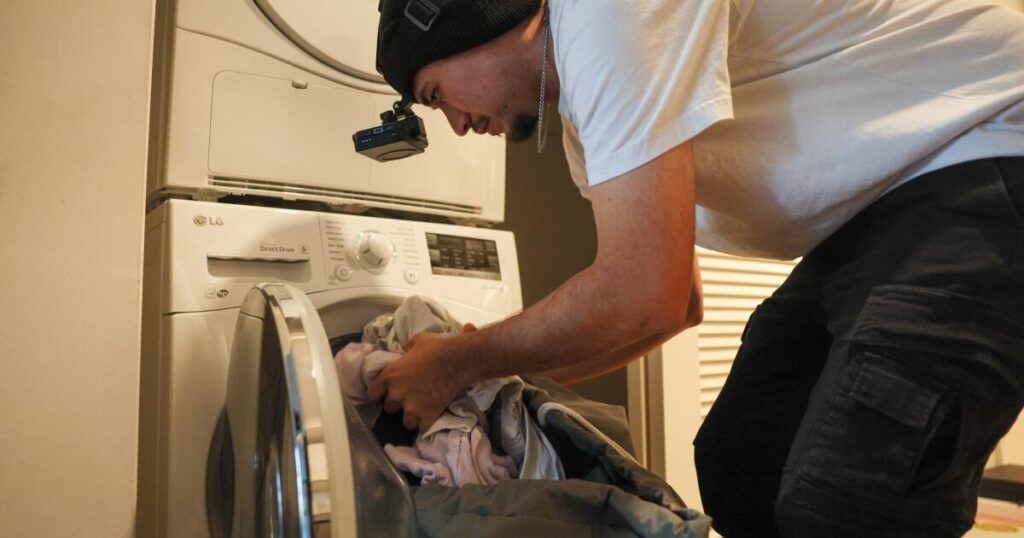
The hottest new gig-economy job in Los Angeles is performing at home to help artificial intelligence understand how humans move.
Hundreds of people from Santa Monica to Los Feliz are strapping cameras on their heads and hands as they do chores at home so bots can watch how they make coffee, scrub toilets, water plants and wash dishes.
At a corner table at Urth Caffe downtown, a woman is sitting next to a big black bag. A constant flow of visitors stops by. She slips each a package and instructions, and they move on.
“People think I am selling” drugs, she says.
She’s actually a manager for a San Francisco-based recruitment firm called Instawork, and she’s handing out headbands with phone mounts, a simple piece of equipment that lets people record their every move — movements that will be turned into data to train robots how to act.
She hands Salvador Arciga a headmount and tells him to go home and do the dishes and clean his kitchen.
He has done odd jobs all over town: DoorDash delivery, handing out hats at Dodger Stadium, washing dishes at Disneyland, hanging holiday lights at the Los Angeles Zoo and more. This job seems relatively easy, and it pays $80 for two hours of footage.
“I need to do chores anyway,” he says. “Now I get a chance to get paid to do it.”
AI chatbots like ChatGPT learned to converse, make music, generate images, and write code by using all the information they could get from the internet. Now, as AI and robotics companies figure out how to do the same in the physical world, the models need much more information about real-world movements.
It is not as readily available online, so the quest to capture data on human movement has given rise to a micro-economy that supplies real-world demonstrations of what some call “physical AI” systems, such as humanoid robots.
“Humans are supplying ground truth, judgment, or structured feedback that models can’t reliably produce on their own yet,” said Jason Saltzman, head of insights at market intelligence firm CB Insights.
Some countries already have “arm farms,” dedicated facilities where hundreds of humans record first-person footage of them opening doors or folding laundry for robotics. In China, there are more than 40 state-owned training centers where humans operate robots wearing virtual reality headsets.
The development of robotic models is a key focus for major tech companies like Tesla and Google, as well as California startups such as Figure AI and Dyna Robotics.
Goldman Sachs forecasts the market for humanoids could reach $38 billion by 2035. Much of that will be led by China, but California is also a growing center of next-generation robotics.
This intense demand is driving significant activity among niche data providers. San Francisco-based Encord, for instance, raised $60 million in February after its physical AI operations revenue increased tenfold in the last year. In the same vein, Meta-backed Scale AI has gathered 100,000 hours of footage for robotics, while its Palo Alto-based competitor Micro1 employs 1,000 people across 60 countries to record household tasks.
The global data collection and labeling market alone could reach $17 billion by 2030, says market intelligence firm Grand View Research.
Critics argue this work is extractive and poorly compensated, especially when these AI systems are being trained to ultimately replace human labor.
Still, in an embattled economy, with rising inflation and growing unemployment, more workers like Arciga are turning to these jobs for quick cash. In some cases, entire families sign up to record video, speech and images for AI training to supplement their income.
“It’s one of the biggest gig economies that is going to exist in the whole world,” said Shahbaz Magsi, co-founder of Sunain, a human data capture startup.
Arciga fastens the headset over his black beanie and enables “Do Not Disturb” on his iPhone, before fastening the phone to his head to record.
As he grabs a paper towel to wipe a stain on his stovetop, he narrates what he is doing, as the manager he met at the cafe had instructed him to do. She said it didn’t matter whether he said it in Spanish or English.
“Right now, I am going to use the spray,” he says.
Each task recorded — be it plant watering or kitchen cleaning — has to last between two and 15 minutes.
Instawork, the company that hired Arciga and more than 50 others like him that day, has historically been an employment agency, catering largely to stadiums, hotels and kitchens that need temporary workers.
It has also entered the human movement data capture business to leverage its workforce to train and support robotics systems.
Many new startups have begun building custom hardware — cameras and bodysuits — to capture nuances of human movement, pressure, depth of touch and human pose reconstruction for their datasets.
Egyptian immigrants Azzam and Samra Ahmed are padding their savings by performing for bots in their one-bedroom apartment in Pasadena.
They put on wrist and head cameras before preparing dinner.
The wrist camera captures how every muscle moves as they chop vegetables, season and grill chicken and roll up their shawarmas. This level of detail is needed for a robotic model to learn exact hand movements that cannot be caught by the standard human point of view.
Sunain, the human data capture startup, ships these custom wrist cameras to vetted contributors in its network. It has more than 1,400 contributors in Los Angeles, from Culver City and Santa Monica in the west to Pasadena and Los Feliz in the east.
“The region offers unmatched diversity of homes, lifestyles and people,” said Magsi, CEO of Sunain.
Where Instawork orders scripted movements, Sunain encourages its gig workers to record natural human behavior, including jumping between tasks.
If humans hear a running tap in the bathroom while cooking, they pause cooking to go close the tap before returning to cooking. That’s how robots will be expected to behave in the real world.
“These robots need to understand the context switching that humans do,” Magsi said.
For the Ahmeds, who work during the day as a mechanic and a nail salon employee, life in their apartment has been reshaped by robot training. They watch Netflix, cook and play table tennis wearing their gear. Their parents are shocked to see the couple living their normal lives covered in cameras.
“We are making money off something that we do every single day,” Azzam Ahmed said. “That’s like getting paid for breathing.”
It’s not always easy work.
Some workers complain that receiving calls and messages can interrupt their recordings, and having a phone strapped to their head is uncomfortable. Some complain that their videos aren’t accepted sometimes, so it takes longer than they expect to get the right footage to get paid.
A recent attempt by the Ahmeds to record cooking was disqualified for payment after reviewers found that steam from the dish had blocked the video. Since then, the couple have avoided cooking steamy dishes.
Still, they each earned $1,200 by doing chores they recorded.
“That money goes directly to our savings,” Azzam Ahmed said.
Sunain has expanded its robot data capture to homes in Turkey, Singapore, Canada and Malaysia. The company has 25,000 contributors across 30 countries to work on voice, video and text completion tasks.
Arciga says some of his friends have challenged him to reconsider whether he should be training AI to do what only humans can do. “Sometimes they do tell me, ‘Well, you’re the problem,’” he said.
His response is that new technology always brings fear and change and it also creates new kinds of jobs, like his latest gig, and people will always demand a human connection.
“People will still need people,” he said.
The post Why hundreds of people in L.A. are strapping cameras on their bodies to do chores appeared first on Los Angeles Times.