Even before the war in Iran raised fertilizer and diesel costs, a majority of American farmers said they were “much worse off” or “somewhat worse off” than one year ago, and their biggest concern was the high cost of the essentials needed to plant their crops.
Those findings are based on a January survey by Pro Farmer, a part of the agriculture magazine Farm Journal. The war in Iran has added to those pressures. With input prices already high, the attacks have sent prices soaring, as ships carrying materials to make fertilizer are largely unable to transit the Strait of Hormuz and exit the Persian Gulf.
The cost of a gallon of diesel fuel, which powers tractors that plant crops and the trucks that deliver farming supplies and haul away the harvest, is up almost $1 in just the last week. A ton of urea, a key nitrogen-based fertilizer, is now selling for $585 at the port in New Orleans, up from $470 before the war.
The American agricultural economy has been stressed for years, especially for crop growers. Pandemic disruptions, the war in Ukraine and rising inflation sent the cost of inputs soaring, while the prices farmers receive for their crops have remained stagnant. Farm debt and bankruptcies are rising, and for most farmers, 2026 projects to be their third or fourth year of losses.
The war in Iran is not the sole cause of farmers’ problems, then, but one more thing added to their list. “Even before any of this happened, we were already at a break-even or lose proposition on most row crops in South Carolina,” said Harry Ott, the president of the South Carolina Farm Bureau.
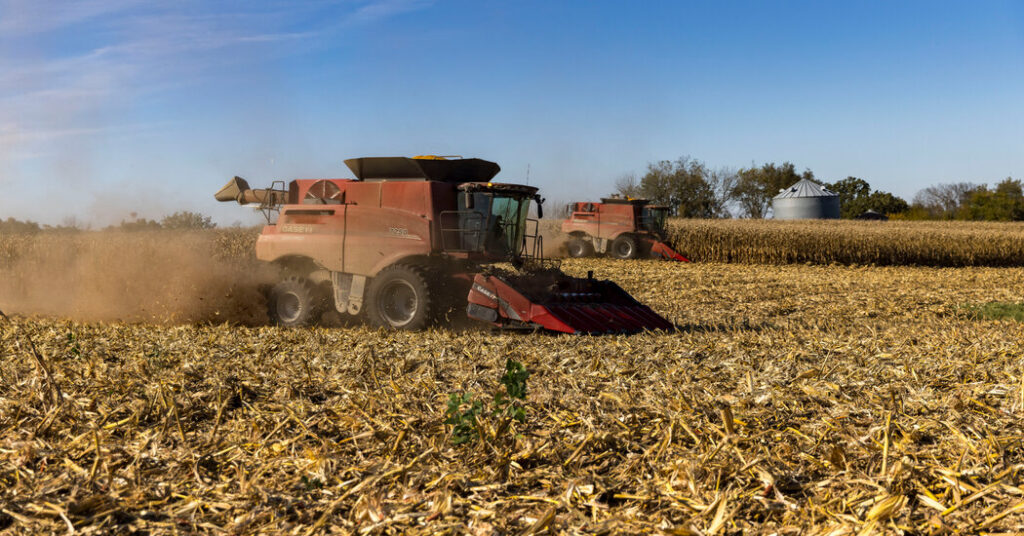
Some farmers are already out tilling and preparing their fields for spring planting. But the difference between a small profit or loss for the year could depend on whether they locked in the price of fertilizer and fuel before the war.
“Luckily for us, we have made most of our purchases already on the nitrogen products,” said Andy Jobman, who farms 2,500 acres of corn, soybeans and alfalfa in central Nebraska. Nitrogen is the most important fertilizer for achieving high corn yields, and about half of all nitrogen used on corn is applied during spring planting.
Mr. Jobman signed a contract for his nitrogen products early last fall, even though the price was already high. He said his supplier had told him that stocks were tight, and that the price wasn’t likely to come down over the next six months. He was slower to buy phosphate-based fertilizers, he added, because prices were at a high and his supplier thought they would drop.
“We have been purchasing fertilizer earlier and earlier over the last five years,” he said.
Not every farmer signed a contract in advance. When Farm Journal surveyed corn growers in 2024, just 45 percent reported that they had finished making their decisions about fertilizer by the beginning of March. That trend has continued through to this year.
“Because of the poor farm conditions we were already in, a lot of people didn’t pre-buy,” said John Newton, the chief economist at the American Farm Bureau Federation, an agricultural lobbying organization.
Fertilizer is so important, and the timing of this war is so bad, that the Farm Bureau is calling for the U.S. Navy to escort ships carrying fertilizer through the strait.
The Middle East is key to worldwide fertilizer production. Most nitrogen fertilizer is made through the Haber-Bosch process, which uses a tremendous amount of natural gas. Qatar, Iran and Saudi Arabia are all major exporters of nitrogen fertilizer, and ship their fertilizer through the Strait of Hormuz. And many countries that produce their own fertilizer do so with natural gas from those countries.
Sulfur, a key component in the production of phosphate fertilizers, is also exported worldwide from the Middle East. A third of the world’s fertilizer trade passes through the strait, according to the United Nations.
“Like oil, global fertilizer markets are highly vulnerable to disruptions in maritime transit routes, especially through the Strait of Hormuz,” Zippy Duvall, president of the Farm Bureau, wrote in a public letter to President Trump. “Acting quickly to prevent disruptions in fertilizer supply chains will help avoid additional financial strain on farmers and ensure that U.S. farmers have the supplies they need to feed families across America.”
Since the marketplace for agricultural inputs is global, the war’s cascading effects could also become a problem. Israel has stopped sending natural gas to Egypt, a major fertilizer producer. India also cannot get enough natural gas, increasing the likelihood it will not be able to produce enough fertilizer domestically and instead will buy it on the world market, driving up prices everywhere else.
“The longer this goes on, the more the intermediate supply chains break down and it takes longer to put back together,” said Samuel Taylor, who leads Rabobank’s farm inputs division.
Mr. Trump and the Agriculture Department have said they are the most pro-farmer administration in decades, and blamed former President Joseph R. Biden Jr. for most of the challenges farmers are facing. But little has turned positive for farmers in the last 14 months, with the administration adding a trade war and tariffs.
The Agriculture Department’s $12 billion bailout for farmers — of which about $6 billion has already been distributed — hasn’t changed their opinion. Few farmers think their situation has improved. Nearly three-quarters of farmers in the Pro Farmer survey said the crop sector was in a recession, and two-third said the biggest hurdle to profitability was the price of materials.
Those findings are echoed by Purdue University’s Ag Economy Barometer. While farmer sentiment rose during the first few months of Mr. Trump’s term, it has fallen in the last several months, with farmers even more pessimistic about future expectations than current conditions.
“President Trump is utilizing all the tools available to ensure farmers have what they need to continue their farming operations — emphasizing the long-term gains will far outweigh any short-term disruptions,” an Agriculture Department spokesperson said in a statement.
A number of bills that farmers largely support, like a new Farm Bill and the expansion of ethanol sales, are being debated in Washington. Some senators are floating the idea of a second aid package for farmers. But it is not clear if they will ameliorate the structural problems farmers face, if they will become law or if they will fall victim to other Republican priorities.
Last month, after the Supreme Court struck down the president’s tariffs, nearly every major agriculture organization released statements calling on him to cease his trade war. “We urge the administration not to pursue similar tariffs under other authorities, and we call on Congress to exercise its oversight role to ensure trade policy supports — not undermines — America’s family farmers and ranchers,” said Rob Larew, president of the National Farmers Union.
Hours later, Mr. Trump announced new worldwide tariffs.
Kevin Draper is a business correspondent covering the agriculture industry. He can be reached at [email protected] or [email protected].
The post War With Iran Puts Further Strain on America’s Pessimistic Farmers appeared first on New York Times.