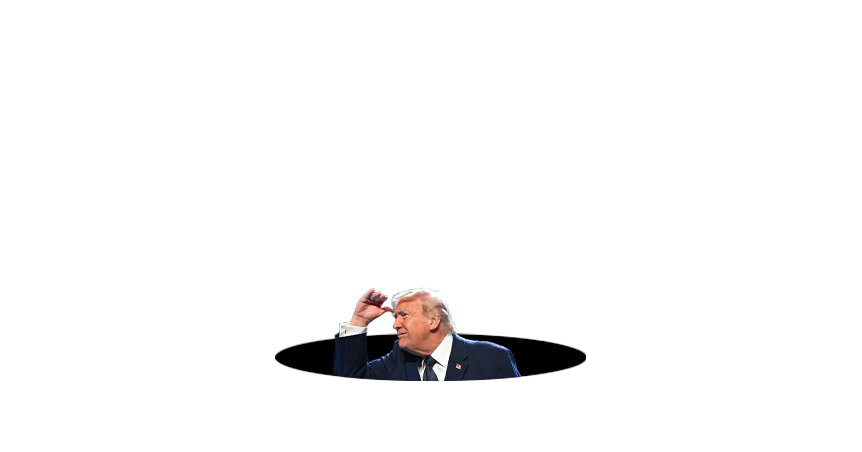
America is drowning in debt. It has expanded over years and even decades, but President Trump and his allies in Congress have piled on a giant new load.
In fiscal year 2025, the United States spent roughly $7 trillion and collected about $5.2 trillion in tax revenue. That leaves a $1.8 trillion gap that has to be closed.
There is an enormous tension for an administration that now claims greatness as isolationism and regularly alienates and insults (and worse) global peers but also cannot finance itself without the support of other countries. These two opposing ideas operate at the center of the American debt story.
That is why “America First” does not make sense financially. The United States will no doubt, for the time being, find buyers of its debt — but the cost and terms of those exchanges are shifting as the rest of the world reconsiders its arrangements with President Trump’s way of doing business.
America First is inviting the world to use our debt as a weapon against us.
The government borrows the amount of our deficit by selling Treasury securities, I.O.U.s that promise to pay investors back with interest over time. The United States carried over $30 trillion in publicly held debt in fiscal year 2025, and a significant chunk of that debt matures every year and has to be refinanced at whatever interest rates exist at that moment. So if rates rise, the annual cost of servicing the debt climbs, too — and keeps climbing as more debt turns over. The system holds together as long as the world keeps buying.
And that’s how U.S. capital markets work. Historically, everyone has wanted to own a little bit of the United States. Foreign investors held a record high of over $9.3 trillion in U.S. Treasuries in November 2025. Japan remains the largest holder. Britain is second and mainland China is third, even after reducing its holdings over the past decade.
This foreign participation in U.S. Treasury markets is really important for two main reasons: It lowers what the United States pays to borrow, and it expands how much the United States can borrow in the first place.
Foreign buyers functionally lower U.S. borrowing costs because they provide more demand, resulting in lower rates. If only U.S. investors were buying Treasuries, interest rates would have to rise to attract domestic buyers. In that case, borrowing prices would rise for Americans. Foreign investors act as a shock absorber, taking in U.S. debt and allowing the country to spend money on health care and Social Security.
This also allows the United States to run deficits that would be impossible to finance alone. The Treasury has to sell trillions in new securities each year just to cover the deficit, before accounting for the trillions in existing debt that mature and must be refinanced. Without foreign buyers competing for that paper, domestic investors would need to absorb it all, and they would demand significantly higher interest rates to do so, which would ripple into all consumer loans.
So the United States has to find buyers elsewhere through foreign governments, sovereign wealth funds and private institutions. This is largely a feature, not a bug. But it means that when you borrow from the world, your borrowing costs depend partly on the world.
Also, the United States is the absorber of last resort. Surplus economies like China produce more than they consume and export the difference as savings. Those savings have to go somewhere, and for decades, the answer was U.S. Treasuries. Capital flowed in, the dollar stayed strong, and the United States absorbed much of what the rest of the world couldn’t spend at home. That is the price of running the world’s reserve currency.
All of this — the United States as a sponge, borrower and spender — has worked remarkably well for decades. The United States benefited from something economists call “exorbitant privilege” — the dollar’s dominance meant global investors had few viable alternatives to U.S. Treasuries. When uncertainty hit anywhere in the world, money flowed toward America, not away from it. Foreign demand didn’t require the United States to be perfectly managed, just reliably open and stable.
But that assumption is being tested from multiple directions at once. The rest of the world is developing better options and better reasons to keep capital at home.
Japan is a good example. They are the largest foreign investor in the United States. Japanese investors hold more than $1 trillion in Treasuries. But Japan is at a turning point in its own economy. The Bank of Japan has been raising interest rates to keep inflation under control. The yen has shown signs of rebounding over the last year or so. When that happens, Japanese investors have better reasons to keep capital at home, and global investors who borrowed in yen to buy U.S. assets start unwinding those positions. The result is upward pressure on U.S. borrowing costs — not because of any political decision but because the math changed.
It’s a similar story with Europe. European investors have been steady buyers of U.S. debt for years. But Europe is now increasing its own borrowing to fund defense spending and going through a period of deregulation. As Europe builds out this deeper bond market, global investors have more choices about where to put their money. That means there’s more competition for global savings outside of the United States.
So there are significant alternatives to U.S. capital markets, which threaten the status of Treasuries, and there are also threats of exit. Europe is talking of selling their U.S. Treasuries. Europe holds over $3 trillion of Treasuries, and there has been increasing talk of “weaponization of capital” in the face of U.S. volatility. If they do choose to sell, that would raise the cost of capital for the U.S. government (the president has already threatened to retaliate).
The rest of the world is choosing to deal with one another rather than the United States. The enormous trade pact between India and the European Union, the strategic partnership between China and Canada — the rest of the world is showing that the United States isn’t the first stop anymore.
We now have a live example: the Iran War. With the Strait of Hormuz effectively closed, oil prices surged (and then fell and then surged again). No one knew which way was up or down — it all seemed reckless.
The bond market made the same point in a different language. Historically, geopolitical crises send investors rushing into U.S. Treasuries as a safe haven, so yields fall as prices rise. That didn’t happen this time. Instead, yields rose on inflation fears: more oil disruption, more inflation, more deficit spending on defense, more Treasury issuance. Yields spiked when the war escalated and pulled back only when de-escalation looked possible. The safe-haven response that investors have relied on for decades failed to materialize.
And what does that mean for the boatload of U.S. debt that has to be financed?
It will likely continue to be financed — but at what cost and on whose terms? Our “exorbitant privilege” depends on trust in U.S. institutions, stable policy, consistent messaging and confidence that America remains a safe place to invest money. It’s currently being threatened by the rest of the world’s generating better returns and by domestic U.S. rhetoric that it does not need the rest of the world.
When there are policy miscommunications — like the Commerce secretary saying a weaker dollar is “more natural,” or the Treasury secretary insisting on a strong dollar policy — when Federal Reserve independence becomes a real point of concern and when foreign policy becomes chaotic and unplanned, that signals to the global investors America depends on that something important may be shifting.
There is a lot of talk about reducing reliance on foreign capital. But the United States cannot get there through rhetoric alone.
What is more important — and controllable — is trust. Trust is the actual asset underlying America’s ability to borrow cheaply and was what made foreign capital want to come here. Every signal that America no longer considers itself bound by the rules it wrote chips away at that asset. When it goes, the costs hit at home, landing in higher mortgage rates, car loans, credit card rates and a government that can no longer afford its own ambitions.
Source photographs by Roberto Schmidt/Getty Images.
Kyla Scanlon, a contributing Opinion writer, is the author of “In This Economy? How Money & Markets Really Work” and Kyla’s Newsletter.
The Times is committed to publishing a diversity of letters to the editor. We’d like to hear what you think about this or any of our articles. Here are some tips. And here’s our email: [email protected].
Follow the New York Times Opinion section on Facebook, Instagram, TikTok, Bluesky, WhatsApp and Threads.
The post Trump’s Way of Doing Business With the World May Cost All of Us appeared first on New York Times.