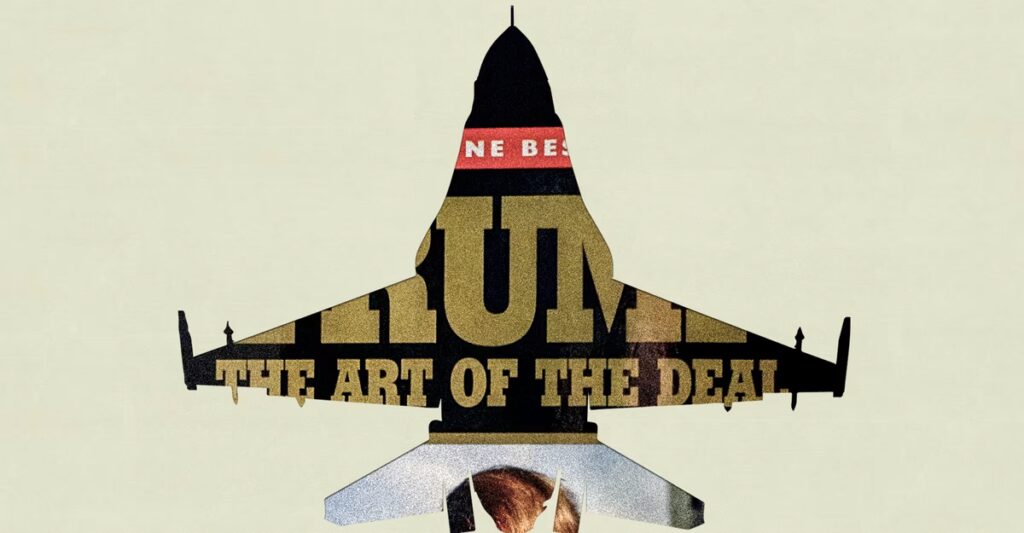
A year ago yesterday, President Trump turned the White House lawn into a Tesla showroom to try to boost the slumping sales of his then-pal Elon Musk’s electric-car company. A few months ago, Trump declared from behind the Resolute Desk that he was Boeing’s “salesman of the year,” claiming to have helped facilitate the purchase of hundreds of aircraft. And long before he entered politics, Trump slapped his name on just about anything—apartment buildings, steaks, even a dubious for-profit university—to market it to the masses. Trump will sell anything.
He has now made one of the most consequential decisions of his presidency: launching a war against Iran. The conflict, which is well into its second week, has widened throughout the Middle East, sent oil prices skyrocketing, and caused tumult in the financial markets. Yet Trump has not sold the war. In many ways, he hasn’t even tried.
The absence of a sales strategy is all the more confounding when you consider the political stakes. The upcoming midterm elections were supposed to be about the economy. That was perhaps Trump’s most effective issue in the 2024 presidential campaign, as voters grew frustrated with the stubborn inflation that permeated Joe Biden’s presidency. Trump vowed to fix it, but his record over the past 15 months is inconsistent: Yes, inflation has cooled some, but last month’s jobs report was brutal; the president’s tariffs have created confusion and kept costs high; and the economy is starkly stratified—the rich are doing great, and everyone else is decidedly less so. Republicans have been on a losing streak in a series of elections, and poll after poll reveals a clear disapproval of Trump’s handling of the economy.
But there were some real silver linings. Chief among them: gas prices. Ron Klain, who was Biden’s first White House chief of staff, told me a few years ago that the first thing he did each morning while in that role—even before seeing if the president had called—was check the price of a gallon of gas. Bill Clinton was equally obsessed, realizing that gas-station signs were billboards for the nation’s economy. Trump made the low cost of gas a staple in his stump speech and gave it a central spot in his State of the Union address a few weeks ago. It was key in White House talking points for Republicans pitching voters to keep them in power: See, things are getting better. Give us time to finish the job.
That pitch just got harder to make. Even before the war began, most Republicans privately acknowledged that keeping the House would be challenging. Now they will be forced to defend a war that, polls show, Americans didn’t want. Already, seven U.S. soldiers have died, and approximately 140 more have been injured. Tens of thousands of Americans were stranded in the Middle East after the Trump administration did not facilitate their departure—or evacuate government outposts—before Iran retaliated. And, of course, there is the price of gas. The average cost of a gallon has jumped by more than 50 cents since the conflict began. This spike has been the subject of relentless news coverage and, yes, has been splashed across those gas-station billboards. Even for voters who rarely care about foreign policy, the rising cost of filling up their tank has been unavoidable. And more price hikes are likely coming to airfare, shipping, and groceries, just to name a few.
Elections are in many cases won or lost on economic issues. But there are moments when Americans are willing to endure fiscal hardship or accept that the nation will make sacrifices for a greater good. Presidents of the past have made a point of convincing Americans that it was worth it. Franklin D. Roosevelt famously made the case for World War II, and his nation endured years of rations while sending a generation of young men off to battle. George H. W. Bush built an international coalition and sold the public on the need to push Iraqi forces out of Kuwait. And although the public would eventually sour on his son’s own war in Iraq the following decade, George W. Bush made the case for the conflict.
Trump has done none of this. He faced his biggest audience of the year just three weeks ago during the State of the Union address, in which he gave Iran only a passing mention: a few lines near the end of a 108-minute speech. Trump that night declared Iran the “world’s No. 1 sponsor of terror” and warned its leaders against developing a nuclear program. He didn’t prime the public, and his administration barely briefed Congress. (Aides later claimed that he did so to maintain the element of surprise, a perplexing notion considering the unmissable size of the U.S. armada parked in the waters off Iran.) When Trump eventually announced the conflict, he did not do so with a major speech or a prime-time address from the Oval Office. Instead, news of the war came via a social-media video filmed at his Mar-a-Lago estate and released in the middle of the night. Trump, wearing a baseball cap but not a tie, did not offer a clear rationale.
[Read: The Pentagon cut its civilian safeguards before the Iran war]
Since then, the explanations that the president and his team have offered for the invasion have grown only more muddled. As documented by my colleagues Marie-Rose Sheinerman and Isabel Ruehl, the reasons have shifted from Iran was posing an imminent threat, to Israel made me do it, to We’re doing it for the grandkids. Trump has also taken to briefly answering dozens of reporters’ phone calls in the first weeks of war, and offers a variety of explanations for the invasion (without providing much opportunity for follow-up questions). His administration’s goals for the war have been equally opaque. Only on Tuesday did Defense Secretary Pete Hegseth and the chairman of the Joint Chiefs of Staff, General Dan Caine, clearly lay out three primary objectives: Destroy Iran’s missiles and its ability to make them; cripple its navy; and permanently end its nuclear program. But Trump himself continues to step on that, musing about the possible need for regime change in Tehran and how he wants to be involved in choosing Iran’s next leader. Iran’s initial response was a strong no: It empowered the slain Ayatollah Ali Khamenei’s son Mojtaba Khamenei, who is viewed by many as more militant and is likely embittered toward a United States that was involved in killing his father, mother, wife, and son.
A few people close to Trump believe that his lack of clarity comes from a confidence that he doesn’t need to be clear. He’s gotten rusty, perhaps, in convincing anyone of anything. The GOP-controlled Congress has been compliant, his staff is almost exclusively populated by true believers, and although he takes plenty of reporters’ questions, a healthy percentage of them are from journalists who work at sympathetic, right-leaning outlets. Over the past year, the president has fallen in love with overwhelming, one-and-done demonstrations of force, like the kind he ordered in Venezuela, in Nigeria, and last summer in Iran. He appeared confident that a quick strike would suffice this time too. The United States’ and Israel’s military’s performances have been impressive, but Tehran has been resilient—and the Trump administration now expects the conflict to drag on for weeks, not days.
Trump, though quick to extol the damage that the military is inflicting on Iran, has still not laid out what goals would have to be accomplished to declare victory and end the American air campaign. One of his closest allies, Senator Lindsey Graham, a longtime Iran hawk, made his views clear yesterday, saying, “There’s no way you can say you won this war with an ayatollah in charge.” (Graham and a few other pro-war Republican senators have privately indicated that the conflict’s political consequences are overrated, because they believe the GOP was going to lose the House anyway, a person familiar with the conversations told me.) Israeli Prime Minister Benjamin Netanyahu also has advocated for the permanent elimination of Iran’s regime. But that goal will be difficult—verging on unattainable—and would likely require a lengthy military commitment. Experts also note that achieving the Pentagon’s goal of ensuring that Iran can never build a nuclear weapon would be more or less impossible; even if the current facilities were destroyed and its scientists killed, another effort could be mounted in the years ahead.
The lack of clear objectives complicates Trump’s ability to find an off-ramp from the war. Iran has continued to pummel its oil-producing neighbors and has threatened to menace the Strait of Hormuz, through which 20 percent of the world’s petroleum normally travels. Tehran has already struck more than a dozen vessels there, including at least three yesterday, despite Trump’s warnings. Officials said that the U.S. has destroyed at least 16 minelayers, and Trump is considering dispatching naval vessels to act as escorts to the oil tankers. But even state-of-the-art battleships could be vulnerable to Iranian drone and speedboat attacks.
A senior administration official downplayed to me the extent of America’s economic punishment, declaring it “short-term pain; long-term gain.” Yet the price of gas seems likely to keep rising, which alarms Republicans. Senate Majority Leader John Thune told reporters this week that “the price of gas is always kind of a benchmark” and is “something obviously we’ve got to pay attention to.” Senator Rand Paul added that the war could lead to a “disastrous” midterms for Republicans.
The White House disputed that Trump has been muddled on the war’s goals, and White House Press Secretary Karoline Leavitt told me in a statement that “the military objectives of Operation Epic Fury have been clearly outlined by the President” since “the very first strikes.” Yet Trump, even as the bombing raged, told reporters at the White House yesterday, “Let me tell you. We’ve won. You know, you never liked to say too early you won. But we won.”
There are some influential MAGA voices—Steve Bannon, Tucker Carlson, Megyn Kelly—who believe that the Iran attack conflicts with Trump’s “America First” agenda, and his 2016 campaign commitments to end the forever wars of Iraq and Afghanistan while avoiding new Middle East entanglements. A few elected Republicans, such as Representative Thomas Massie, also oppose the war. But Republicans largely continue to back Trump, making it easy for Democrats to tie them to the unpopular war. A new poll conducted just before the conflict by Navigator, posted yesterday, shows that Trump and his fellow Republicans were perceived as caring far too much about foreign conflicts (as well as immigration), as opposed to caring about the economy. The Democrats have also seized upon Trump’s lack of clarity about the war’s motivations and its endgame. After a briefing from administration officials, Senator Richard Blumenthal told reporters that he was “dissatisfied and angry,” and his colleague Senator Chris Murphy alleged on social media that “all the briefings are closed, because Trump can’t defend this war in public.”
[Read: Why hasn’t Trump mentioned Iran’s oil?]
Trump, of course, has no shortage of opportunities to change the war’s narrative. He traveled yesterday to Cincinnati and northern Kentucky for a series of events. And in a lengthy Truth Social post that he unleashed while en route, Trump laid out a case for why he believed that drastic action is needed to remove a “COMPLETE AND TOTAL DISASTER” from power—just not the one in Tehran.
“Thomas Massie,” Trump wrote, “is disloyal to the United States of America! He is a MISFIT, who should be voted out of Office, ASAP.”
Vivian Salama, Ashley Parker, and Michael Scherer contributed reporting.
The post Trump’s War Lacks a Marketing Plan appeared first on The Atlantic.