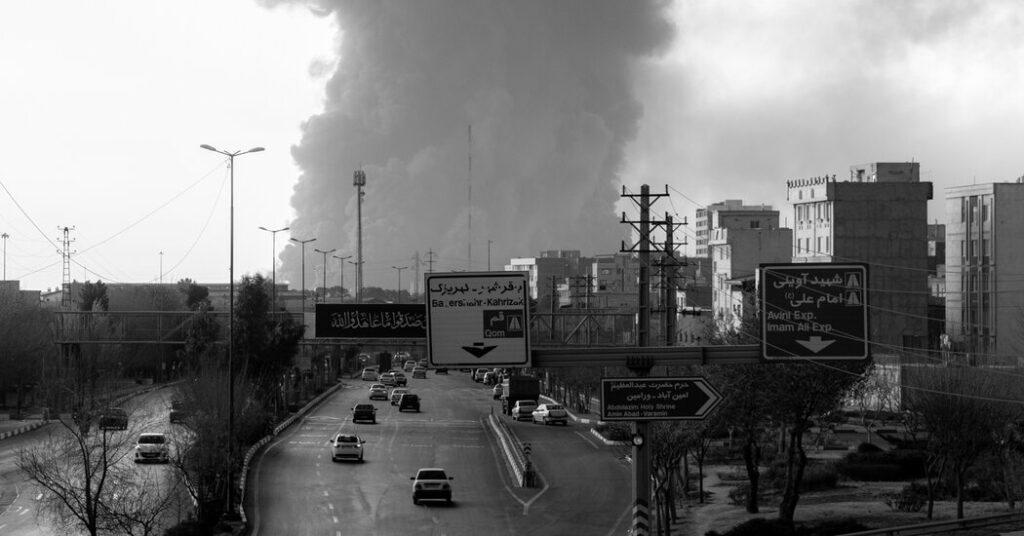
The towering flames and black smoke that filled the skies above Tehran this week after Israel bombarded oil depots there looked apocalyptic.
As soot and black rain fell on the more than 10 million Iranians living in the city, the tremors from those airstrikes vibrated all the way to Washington, where officials felt the unequivocal impact of divergent ambitions in this war.
It seems that President Trump’s aims in joining the air war against Iran are beginning to rub against the long-term objectives of Prime Minister Benjamin Netanyahu of Israel. While Mr. Trump has said in recent days that America’s military goals are nearly complete — even though the ayatollahs remain in power — Israel seeks an end to the regime and to crush its regional influence.
In short, Mr. Trump wants to bend Iran. Mr. Netanyahu seeks to break it.
Images of oil going up in smoke — regardless of whose oil it is — could not have been a welcome sight for the Trump administration as prices skyrocketed at America’s gas pumps. The war in Iran has wreaked havoc on world energy markets, prompting countries to prepare for protracted economic blowback caused by rising fuel costs. At least three ships were hit on Wednesday in and around the Strait of Hormuz, as the fighting chokes off one of the most vital routes for the world’s oil trade. All of this creates political headwinds for Mr. Trump as a war-weary public remains unpersuaded by the arguments for conflict.
At the moment, the leaders’ interests mostly align. As the air campaign enters the middle of its second week, the Israeli and American militaries continue to coordinate to hit thousands of targets across Iran. The U.S. and Israeli objectives overlap in their short-term goals: destroying Iran’s missiles, nuclear program, navy, weapons production and military command-and-control. Both sides agree that the Iranian regime is intent on inflicting as much harm as it can on the United States and Israel while destabilizing the broader Middle East.
But their opposing visions of long-term victory — a more compliant government in Tehran versus a new one altogether — must be resolved if the United States is to avoid another extended war. Sustained attacks on multiple rungs of leadership and infrastructure are the surest way to bring about the kind of protracted nation-building exercise Mr. Trump has railed against for years. White House officials were reportedly dismayed by the burning oil fields in Tehran and not just because of oil prices: The scene conjured the uncontrolled chaos of Iraq and Afghanistan.
Defense Secretary Pete Hegseth sought this week to differentiate those examples of military adventurism from the administration’s mission in Iran. “This is not 2003. This is not endless nation-building under those types of quagmires we saw under Bush or Obama,” he said Tuesday at a Pentagon briefing.
Mr. Hegseth said the American military campaign is “not even close” to that point today — but that may not be the case one, three or six months from now. After all, the U.S. military bombarded Iran’s nuclear facilities in June, but when subsequent diplomatic negotiations dragged on, Mr. Trump ordered another complex military mission over the country just eight months later. Seven American service members have already been killed, and 140 have been wounded since the renewal of operations. At least 11 bases and installations hosting U.S. forces in the region have been damaged.
Mr. Trump has suggested in recent days that the U.S. role in the war could be nearing an end because much of Iran’s military capacity has been destroyed. But that’s not what initially provoked him to threaten Iran with military force. The president first cited the Iranian government’s deadly crackdown on protesters in January as a justification for action. Since then, he and administration officials have provided a long list of shifting reasons for the campaign: the nuclear program, missile production, naval ships, and — the most curious of them all — pre-empting Iranian retaliation for Israeli military action.
Secretary of State Marco Rubio made that claim last week when he suggested the United States acted because it knew an Israeli strike would prompt Iran to strike U.S. forces in the region. Americans aren’t used to hearing that their president was escorted into war by an allied leader. Whether or not it’s true, the sentiment has likely contributed to the record-low support for the conflict: Just 41 percent of Americans support the conflict with Iran, compared to a large majority of Americans who supported intervention in Iraq in 2003.
This is another reason Mr. Netanyahu and Mr. Trump’s interests deviate. Most Israelis back the war, making it a political strength for Mr. Netanyahu, who faces a tough re-election bid expected this year. Mr. Trump, on the other hand, doesn’t want an unpopular war roiling as the midterms draw near in November.
It’s no surprise then that Mr. Trump has started to indicate that he may be looking for the exits, said Javed Ali, a former senior U.S. counterterrorism official. “His patience was always going to run thin with this war fairly quickly,” he said. “The message he wants to convey is: Iran has been defanged militarily. Now it’s time for a deal.”
Mr. Trump has said contradictory things about his plans for Iran’s future. He’s talked about regime change, negotiations, unconditional surrender and the need to him to personally handpick a new leader. Mr. Trump saw his dream scenario play out in Venezuela when U.S. forces captured and removed Nicolás Maduro from power and a more pliable insider, Delcy Rodriguez, took over. He told Axios last week he’d like to see a replay of that in Tehran. “I have to be involved in the appointment, like with Delcy in Venezuela,” Mr. Trump said.
Iran has other plans. It has since named Mojtaba Khamenei, the son of the recently killed Ayatollah Ali Khamenei, as supreme leader. There are no immediate indications he’s willing to acquiesce to the United States.
So, the bombing continues. Two nations started this war together. It’s hard to see how they can join forces to end it.
The Times is committed to publishing a diversity of letters to the editor. We’d like to hear what you think about this or any of our articles. Here are some tips. And here’s our email: [email protected].
Follow the New York Times Opinion section on Facebook, Instagram, TikTok, Bluesky, WhatsApp and Threads.
The post Trump and Netanyahu Are No Longer on the Same Page appeared first on New York Times.