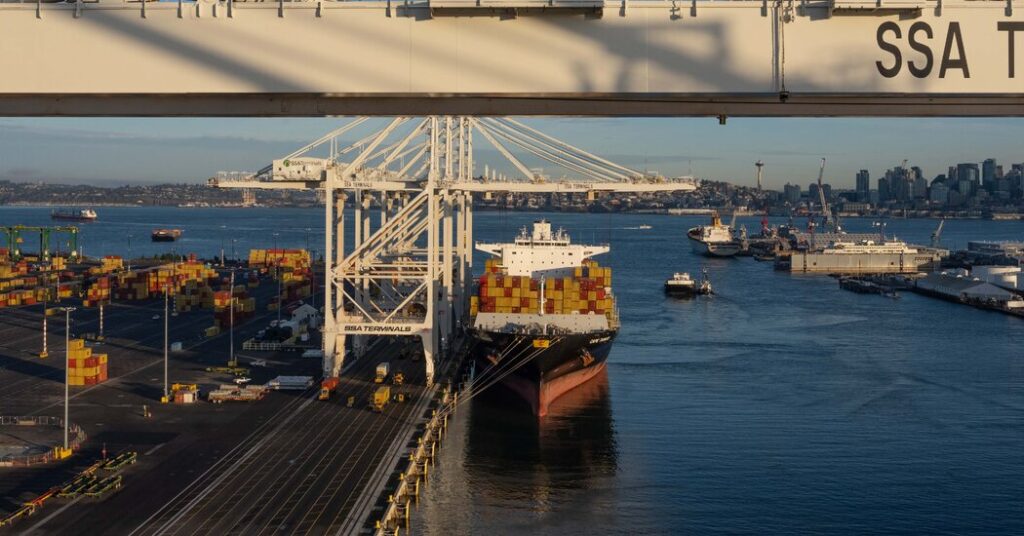
As soon as the Supreme Court struck down President Trump’s steep global tariffs last month, a flood of U.S. businesses began to file lawsuits in the hopes of getting their money back.
But there was a problem, or so the administration later said: It could take the government as many as 4,431,161 hours to manually process all of the refund requests.
By its own count, there were more than 53 million entries for goods — cars, toys, clothes and more — that were subject to illegal duties during the most punishing phase of Mr. Trump’s trade war. To return all the money, the government told a judge, it would need more time.
The admission in court has come to underscore the legal limbo surrounding the roughly $166 billion collected under Mr. Trump’s now-invalidated emergency duties. From the beginning, the administration warned that it would be difficult and perhaps damaging to return that tariff money to the businesses that have shouldered the bill for more than a year. But Mr. Trump and his aides have not always taken steps to make the forthcoming refund process simpler, either.
Mr. Trump has made clear he opposes returning any tariff money, which he has long heralded as a fiscal boon for Washington. His administration has already tried to slow the process in court. And the president has maintained that it could take years to complete the legal wrangling over what the governments owes, suggesting that he may try to thwart refunds in other ways, too.
The Trump administration must provide its latest thinking about refunds by midday Thursday to the U.S. Court of International Trade, which ordered the update as it began to sort through thousands of requests by businesses.
But a U.S. customs official previewed the preparations “for the potential need to refund” tariffs in an affidavit last week. The official told the court that a set of computer upgrades meant to facilitate refunds could be “ready for use” by mid-April. That, the official added, could speed the work to return money to businesses, significantly cutting down on the four million hours in projected work. The customs agency did not offer a more complete timeline for tariff repayments.
The White House did not respond to a request for comment. Customs and Border Protection, which manages the collection and refund of tariffs, also did not respond to a request.
The uncertainty has offered little comfort to the thousands of U.S. businesses caught in the middle of the legal clash over the president’s trade powers. Tariffs are taxes on imports, so U.S. companies and consumers tend to foot the bill from Mr. Trump’s duties — even though the president has long insisted that foreigners would shoulder the greatest financial burdens.
The result is a vast and growing universe of claims seeking repayment now that Mr. Trump’s initial slate of tariffs has been thrown out by the Supreme Court. Governors have demanded refunds on behalf of their states’ residents, consumers have started preparing class-action cases and businesses have filed a dizzying array of lawsuits, all in anticipation of a refund process that may prove — even in a best-case scenario — to be agonizing and lengthy.
It is not the first time that the U.S. government has found itself in such a difficult fiscal position. Nearly 30 years ago, the Supreme Court struck down a harbor maintenance tax as unconstitutional in a move that required customs officials to repay the money they had collected. That, too, touched off a flood of claims and years of legal wrangling over how much Washington owed, and to whom.
Much has changed since 1998, and federal customs officials now have a far more digitized operation for processing or refunding tariffs. Still, the earlier set of repayments totaled in the hundreds of millions, not the hundreds of billions that the Trump administration may have to repay today. By law, that money must also be returned with interest, which is accruing at a rate of about $650 million per month, according to recent court filings.
Patrick Childress, an international trade lawyer at the law firm Holland & Knight, said that businesses were still awaiting precise instructions on the timeline and mechanics for recovering the money. For one thing, he said, it was not clear whether companies needed to sue quickly to obtain their own refunds, or if the trade court could order “refunds writ large to all importers.”
Further muddying the picture, Mr. Trump has raced to re-establish his tariffs using other trade authorities, while his aides have tried to shame businesses that have sought to recoup their costs.
Before the Supreme Court ruling, the president warned that refunds totaling into the billions of dollars would unleash fiscal havoc upon the U.S. government, perhaps even touching off a new economic depression. Then, once a majority of justices struck down his duties in February, Mr. Trump redoubled his opposition and suggested that he might try to seek a rehearing of the case.
While the administration has not actually taken that step, it did initially try to delay the legal proceedings around refunds. In a little-noticed, late-night court filing at the end of last month, the government proposed to halt the fight for about four months, but a panel of judges quickly rejected that request.
Terence Lau, the dean of the College of Law at Syracuse University and a former lawyer for Ford Motor, said the actions reflected an effort by Mr. Trump to introduce “administrative friction” around the $166 billion in tariff collections.
While Mr. Lau acknowledged that the refund process was so complex that it necessarily would take some time, he said the government’s court filings also showed “they are trying to narrow who gets refunds, and they’re stretching the timeline.”
Adding to the concern, the U.S. government has continued to finalize companies’ tariff bills into March based on the very same emergency duties that the Supreme Court deemed illegal. That prompted an outcry from businesses, which flooded the Court of International Trade seeking swift help.
While importers generally pay tariffs at the time that a product enters the United States, their final costs are tabulated over an intricate, roughly yearlong process known as liquidation. That process is still underway for many of the goods that have come ashore since the start of Mr. Trump’s trade war — roughly 20.1 million entries had not been liquidated as of last week, according to the government.
Customs officials later said they simply could not reprogram their computers quickly enough to stop finalizing tariffs based on those imposed using the law the court had rejected — the International Emergency Economic Powers Act, or IEEPA. But their approach failed to satisfy Judge Richard K. Eaton, who ordered the Trump administration at a hearing last week to start taking procedural steps toward issuing refunds.
“The law is clear, that the IEEPA duties were unlawfully imposed,” Judge Eaton said, adding that the law is “equally clear there is nothing particularly novel about the provision of refunds.”
He later relaxed his directive slightly, after the Trump administration offered a more detailed explanation of the hurdles it faces.
Describing the volume of requests as “unprecedented,” Brandon Lord, the executive director for the trade programs directorate at C.B.P., said in a sworn affidavit last week that the customs agency’s “existing administrative procedures and technology are not well suited to a task of this scale and will require manual work” to complete.
Mr. Lord added that the agency was already working on an upgrade to its computer systems that might allow it to issue IEEPA refunds in bulk, based on the importer, which would save the agency “over four million hours” of work. He said the upgrade could be ready in the next 45 days, but cautioned there could be other delays, citing the fact that many businesses still had not even registered with C.B.P. to receive refunds electronically. The agency asked companies to do this in early February.
Many trade experts said they were not sure what to make of the disclosure, particularly given Mr. Trump’s history of tariff threats.
Lynlee Brown, a partner in the global trade practice at the accounting firm Ernst & Young, described the timeline at customs as “aspirational,” noting that C.B.P. faces a daunting task to determine which of Mr. Trump’s patchwork of tariffs to retain and which to refund. To this point, she said, the main database used by C.B.P. to track tariff calculations “rarely meets the timeline.”
Dan Anthony, the executive director of We Pay the Tariffs, a coalition of small businesses that have opposed Mr. Trump’s policies, said the developments offered mixed signals for companies that may be in dire financial straits.
On one hand, he said, the court made clear that it expected refunds quickly. But on the other, he said, there is no way to tell how long it will take in practice for money to reach those that paid it.
“Forty-five days is an aspirational time to have this set up, and there was no real detail about what expected timelines look like from there,” Mr. Anthony said. “That uncertainty still causes a lot of concern.”
Tony Romm is a reporter covering economic policy and the Trump administration for The Times, based in Washington.
The post Trump Administration Suggests Tariff Refunds May Take Significant Time appeared first on New York Times.