The 2024 election didn’t just return Donald Trump to the White House. It also left the Democrats confronting a potentially era-defining defeat. But here we are in 2026: President Trump is deeply unpopular and Democrats are leading in the midterm polls.
Still, I want to know, what are they actually for? Have they learned anything from their 2024 defeat on immigration, especially?
Do they have leaders who are capable of speaking to swing voters while also wooing a party base that’s girded for an existential battle? And are they ready for the dawning age and the new politics of artificial intelligence?
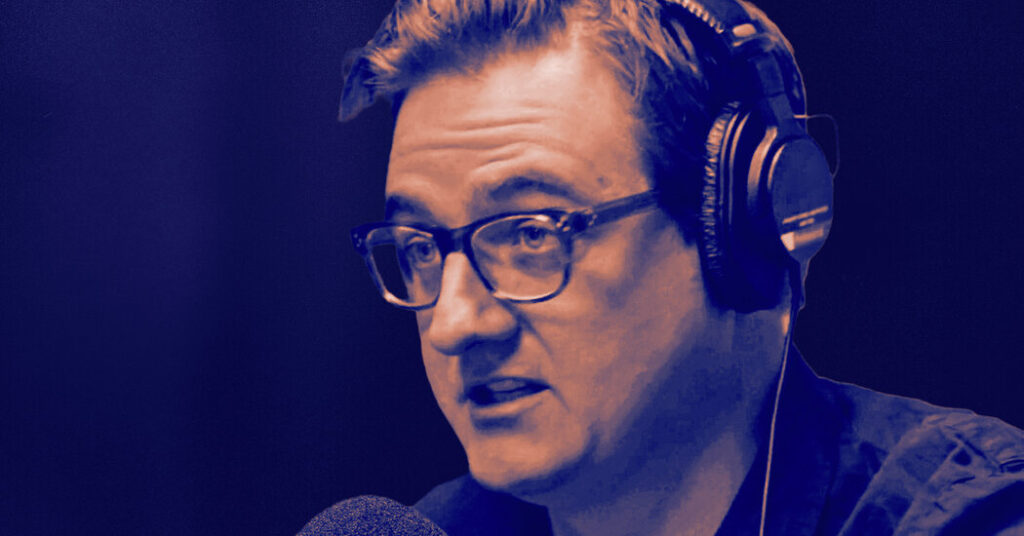
Who better to answer all of these questions than my guest this week, Chris Hayes, who spends every weeknight talking to some of the most liberal viewers in America as the host of “All In With Chris Hayes” on MS NOW.
And I just want to note, Chris and I recorded this conversation just before President Trump launched a military campaign against Iran, but I don’t think the issues we discussed have changed that much, or at least not yet.
Below is an edited transcript of an episode of “Interesting Times.” We recommend listening to it in its original form for the full effect. You can do so using the player above or on the NYTimes app, Apple, Spotify, Amazon Music, YouTube, iHeartRadio or wherever you get your podcasts.
Ross Douthat: Chris Hayes, welcome to “Interesting Times.”
Chris Hayes: It’s great to be here.
Douthat: It’s great to have you. So, you are, in my own mind at least, not just a nightly news host and a podcaster, but a true man of the left.
Hayes: I think that’s true.
Douthat: Is that fair? I think that’s fair.
Hayes: Yes. Yeah.
Douthat: When we first met, you were writing for In These Times.
Hayes: Yes, that’s right.
Douthat: Which, for those who don’t know, is a classic — classical? — I don’t even know what it is.
Hayes: A socialist newspaper.
Douthat: So those are your roots. And I want to talk to you about the left and where it’s going, what it stands for, how it relates to our exciting new technological future.
But first, we’re going to do a little bit of partisan politics. We’re going to talk about the Democrats, which is not the same as the left.
Hayes: No. As they will tell you.
Douthat: As they will tell you — maybe.
So here we are. I would say we’re about 14 months beyond a point in American politics when Trump had won and the Democrats were, I don’t know, flat on their backs, as beaten as I’ve seen them since 2004 maybe.
Hayes: Very much so.
Douthat: And now, there’s a certain kind of confidence on the Democratic side that they’re not just going to be living under Trump’s rule forever.
But they’re also very unpopular.
Hayes: Yeah.
Douthat: Unpopular with swing voters, unpopular with their own base, with the left.
From your position, give me a “State of the Democrats.” How’s the party?
Hayes: Well, I think the first thing to acknowledge is that first of all, thermostatic public opinion does a lot.
Douthat: It does a lot.
Hayes: Then you’ve got just an incredible amount of overreach by Trump, a sort of misunderstanding of whatever mandate there was. He just has a project that’s distinct from what most Americans want, which is a project to transform the constitutional order into a personalist presidential dictatorship.
And I think that’s actually not a particularly popular project.
Douthat: Yeah. I would say it’s not what the people who had swung to Biden and swung back to Trump were voting for.
Hayes: Correct, yes.
Douthat: The president having absolute authority to levy tariffs anywhere he wants, that was not the core issue of the 2024 election.
Hayes: Yes. So, all of that gets you a long way.
So there’s a bunch of places where Democrats are still not trusted as much as Republicans, things like immigration, crime, the economy — still, if you ask the partisan trust question.
There are ideological factions within the party — we can talk about that. Those ideological factions I think are a little displaced now on a few other more important axes that are the main ones of conflict. One is kind of “business as usual” versus “radical break.” And sometimes that looks like “go along to get along” or “fight, fight, fight.”
Douthat: So this would be, for example, the debate over the government shutdown?
Hayes: Yes.
Douthat: That would be a classic example of some people in the party saying, if we do this, it helps Trump, and other people saying, how can you just stand here letting Trump run roughshod if you have tools?
Hayes: Exactly. And I want to give credence to both sides of the argument because I think those are fraught debates where there is a real profound question. At one level, it’s like: Should you be funding a Department of Justice that is manufacturing obviously pretextual criminal cases against political opponents?
I think there’s a case you shouldn’t. At the same time, by that logic, you kind of just pull yourself out into a total boycott of the government. Because in some senses, he’s doing some things in each department that are manifestly abusive from the perspective of a lot of legislators and Democratic politicians and voters.
So I think there’s a real tension there that’s hard. You’ve got the momentum on the side of the “fight” folks, not “business as usual.” And I think that’s going to be an interesting animating force in the primaries this year.
The Democrats never really had their Tea Party. Levels of trust in the party establishment have been higher. The level of just pure rage at the party establishment — like, “I hate this party and anyone at the top of it” — that animated a lot of the Tea Party. and then Trump, has not quite broken that way in the Democratic Party. So one big question that looms over the party is: How much do we see that play out this year, particularly along that axis?
And related to that axis of conflict is just new leadership versus old leadership. There is a real exhaustion, a real sense that people that came of age 20 or 30 years ago and had their formative political experiences then are not well tuned to the moment.
Douthat: Yeah, I feel like the connection to the leaders who held the Democratic center together is gone. But before we get to who the new leaders are, how does this affect policy? Are there actual policy fights happening in the Democratic coalition right now that are meaningful, that we should be paying attention to?
Hayes: Yeah. There are some. The clearest is on foreign policy, particularly vis-à-vis Israel. That’s just an enormous, clear fight: Should the U.S. government align itself in a bipartisan fashion with the Israeli government? Should it give them weapons? Should it fund them?
Douthat: Would you say that broadly tracks the “business as usual” versus “fight” lines in the Maine primary? Which, for those who aren’t following it closely, pits the Democratic governor of Maine, Janet Mills, against Graham Platner, who really is a kind of Democratic Tea Party figure — —
Hayes: Yes, very much so.
Douthat: Complete with a checkered, possibly Nazi-adjacent ——
Hayes: Tattoo.
Douthat: Tattoo, past — whatever. But there, it would seem like Platner would be fully aligned with the no more liberal Zionism as the dominant force, right?
Hayes: Definitely. And in fact, I think it’s worth actually spending a little time on this ideological fight because I think it’s come to occupy a huge center of the fights. There’s a bunch of things that have been stacked atop it, if that makes sense.
So outsider/insider, incumbent/fresh voice, status quo/radical break, even age, have lined up around this axis. In some ways, the reason it’s so important is that I think the experience of the Gaza war represented both a genuine and profound wedge tension on a coalition that literally contains people on both sides of what is arguably the most polarizing issue in the globe over the last thousands of years. Like, quite literally.
Douthat: People strongly and passionately on both sides.
Hayes: Yes. Both within the coalition. So you’ve got that. That’s always going to be a huge problem for any political coalition.
But what’s happened is it’s come to represent a bunch of other corporate-versus-grass roots, establishment-versus-challenger axes. So it’s both a first-level fight about an actual policy disagreement, and then there’s a bunch of ways in which that fight has come to embody something broader about what Democratic Party it’s going to be.
Douthat: So what about domestic policy, then? If the Gaza war is the key place where policy lines up, are there meaningful domestic policy arguments?
Hayes: There’s a fight right now within the Democratic Party about ICE enforcement, which I think is a really important and interesting one. So there’s “ICE needs to be reformed, so we should take the masks off.” There’s “ICE needs to be abolished. The country did perfectly fine for 230 years without that particular agency.” That is proxy fight for a larger fight, which I think isn’t actually being had right now in earnest, but will in the primaries.
Douthat: Meaning: What should our immigration policy be?
Hayes: I think there’s a sense that the old consensus is dead.
Douthat: What was the old consensus?
Hayes: The old consensus was what was called by the “groups” — the notorious “groups” — comprehensive immigration reform.
Basically, the old structure of Democratic policymaking on immigration went this way: increased enforcement, particularly funds. There was a ton of money that was, in 2009, ’10, ’11, put into border enforcement. I think people sometimes underappreciate just how much the spending on the infrastructure of essentially immigration enforcement has gone up in this country. And then in exchange, a path to citizenship for however many folks are here.
Now, that said, that started to come apart in a bunch of different directions. One, it starts to come apart because, starting in 2014, there’s a new phenomenon that starts happening — and I think this is also underappreciated. The immigration arguments that we had, particularly in the ’90s and the ’10s, were largely about undocumented immigration, who are economic migrants, largely from Mexico. That was the focus of it.
This new thing starts happening around 2014 with border presentments.
Douthat: Meaning people who show up at the border claiming asylum and who are not sneaking across to get in.
Hayes: Exactly. This is a key difference. They’re not hiring a coyote to sneak in under the cover of night to get over. They’re actually coming and saying: There’s a part of your law that applies to me.
Those numbers expand and contract. They expand wildly in 2023, quite famously.
Douthat: Twenty-twenty-one, right? Early Biden.
Hayes: Right, early Biden. They really grow, and then they come down. But ’22 to ’23, they go really high.
The reason I say all this and walk through this history is that the way that policymaking happens in Democratic coalition politics is that there’s grass-roots fights, and then there’s policy apparatus, and then there’s what’s called the groups, and there’s these coordinating middle spaces that these policy arguments happen in.
Right now, I think there’s a lack of consensus on what that affirmative vision is.
Douthat: But to me, and you can tell me why this is wrong, it seems that there’s a desire actually to default back to what you just described as the old consensus from at least some Democrats, right?
Hayes: Oh, totally. Yes.
Douthat: You have people whose view is essentially: OK, things got out of hand under Biden, but Trump’s enforcement is super unpopular.
Hayes: Correct.
Douthat: But we don’t want to go all the way back to what the Biden administration was doing, which was effectively allowing millions of people into the country on the promise of giving them a hearing at some future date. We don’t want to go back to that. We concede that that was unpopular.
So what’s the sweet spot? Guess what we’re going to say? We’ll do border enforcement like Trump is doing — that’ll be popular. And then we’ll do a path to citizenship. Boom. Problem solved.
I hear that from Democratic politicians.
Hayes: I think you’re right. I just think it’s not going to work.
Douthat: Why is it not going to work?
Hayes: Well, I think it’s a few things. One, it reminds me, to go back to that defining Israel-Gaza thing, when sometimes you see a politician cornered on a question about Israel and they say: Israel has a right to defend itself — and it’s one of these thought-terminating clichés. It’s like, when you have nothing else, just go with that. And who can argue with that?
Border enforcement path to citizenship has this ——
Douthat: Right. Who could be against it?
Hayes: That’s the sweet spot. And honestly, I think there’s a reason for it. I think there’s structural and actual substantive policy reasons that that’s a combination that works both in polling and policy.
To me, the bigger thing is: There’s a fundamental fight over what kind of country we are, happening right now, that cannot be addressed with that at that level.
The emergence of a genuine “blood and soil” strain of conservatism — “this country is for us,” and by “us,” meaning the people who can go and visit their ancestors’ graves, where they will bury their children — that’s what this country is.
It’s not a country of ideas, it’s not a creedal nation. All that pluralist claptrap that you got taught, that people come from all over and they can all be Americans — the famous Reagan speech where he says you can go to Germany and can’t be a German, but anyone can come here and be an American.
Douthat: This was his last speech, basically.
Hayes: His last speech, yes. Which is a perfect articulation of what used to be a fairly consensus vision that underlay the debates happening above it. That consensus is torn apart.
When that fight is happening at this elemental level, I think it’s very hard to come back in with the old policy question without actually making an affirmative case for what country you want.
Douthat: But why can’t you make the Reagan case and pair it with a moderate-seeming agenda?
Hayes: I think you can.
Douthat: When I look at younger right-wingers associated with nationalism, what you’ll often see is that if you push, people, even self-proclaimed Christian nationalists who believe that white America is under threat, are still kind of civic nationalists.
Hayes: Yes, I agree with that.
Douthat: The actual support for a true “heritage Americans are the only real Americans” is really narrow. So if the Republicans seem to be moving in that direction, that seems like an opportunity for the Democrats to present themselves as an extremely normie, mainstream party.
Hayes: Yes.
Douthat: But with the problem that nobody trusts them to enforce the border.
Hayes: Correct, yes. That’s the problem. One place that you have to deal with this head on is changing asylum law. It is bizarre to me that this thing, which is the central technical issue at the heart of the way that we’ve experienced immigration in the country, really since 2014 — I remember covering that. That was a huge moment, right? People’s kids start showing up at the border.
Douthat: Yeah. The first child migration crisis. Yes.
Hayes: It’s kind of weird that there has been no progress on rewriting the law on this. Just to flip it on the other side for a second, you would think a thing that a Republican-unified government would do would be like: Well, wait a second. Yes, we’re going to close down the border using executive action, but this thing is broken and written by libs. Let’s change asylum law.
Douthat: Yes. You would imagine that, but you would imagine that a Republican administration would ask Congress to do a lot of things that this administration does not.
Hayes: Yes. But that’s a vacuum for Democrats.
Douthat: It’s a vacuum, but it’s a vacuum, it seems to me, that only a relatively small group of self-consciously moderate Democrats would want to claim. If you’re on the insurgent side, and then you’ve got an insurgent vision, plus you agree with Chris Hayes that we’re having this existential battle about ——
Hayes: What kind of country we are.
Douthat: What country we are, are you really going to want to be the Democrat who comes out and says: And by the way, we’re going to reform asylum so that fewer people can apply for asylum here.
Isn’t an impossible sell in the Democratic Party right now?
Hayes: I don’t think it is, actually.
Douthat: OK.
Hayes: I think — I’m not the politician who’s going to do this, right? But my own thing is that ——
Douthat: Well, we’ll see, man. Your time may come.
Hayes: Just to be clear, I just want to say: There is, to me, an absolutely compelling case for essentially open borders — like, in a moral sense.
Douthat: We’re saving this clip for when you do run for president. Yes.
Hayes: I mean, I would not support it as a politician. I wouldn’t vote for it. But I also think it’s not a ludicrous idea.
Douthat: Yeah. You and the Cato Institute are there. Yeah, absolutely.
Hayes: [Chuckles.] So that animating moral spirit, you’re right to identify as animating a huge part of the left and fundamentally causing a tension with the fact that most people don’t want open borders.
There are people that are morally committed to essentially that vision, and I don’t think they’re necessarily ethically incorrect. As a policy, I don’t think it works. And most importantly, it’s impossible, I think, to marshal majority support for that.
In this sense, to me, the fundamental thing to keep in mind is: Immigration policy has to be in the national interest first, orderly and humane.
The key part of that — and this is why I come back around to this discussion about what kind of nation we are — the key thing that has fallen away, I think, on the Democratic side in this discussion is the first one. It is in the national interest.
Immigrants are great. Immigrants are awesome. Immigration is an incredible bounty and gift to this country. It is the reason that the differentiating thing that has made America different — I’m just going back to the civic pluralism of like a 1980s public school education in New York City — it’s amazing that we have all these people from all these different places who bring all these different talents and perspectives and come here and become American and bring that to do things like win gold medals and start companies and be your doctor.
Douthat: Right. But you have to sell ——
Hayes: You have to make that argument.
Douthat: But you have to make the 1980s New York City public school argument, which was perhaps slightly more liberal than the country as a whole, combined with an argument that persuades people that you’re not going to do what Joe Biden did.
Hayes: Correct. Yeah.
Douthat: So let’s talk about potential leaders of the Democratic Party who could make that argument — or not. Who is the leadership class for the Democrats going into 2026 and beyond?
Hayes: Well. I think out parties are always in this position, where there is no national leader.
Douthat: Right. You’re trying to discover one. Yep.
Hayes: But it’s a particularly intense one here, I think, because of the rupture represented by Trump. A really important thing to understand, from the perspective of people in the broad center-left, is that it’s a real “before and after” situation.
If you view Donald Trump’s project as a fundamental assault on the constitutional order, which is to fundamentally transform the nation into something that’s not democratic, it’s very hard to find continuity in the politics of old. His abnormality and the abnormality of his conduct creates a world in which you’ve been untethered from the spaceship and you’re just floating out into space.
Douthat: OK. That’s right. So you didn’t give me a single name.
Hayes: But what I’m saying is: I think you need to understand that the way Democratic Party voters are viewing this is in extreme terms — I guess that’s what I’m trying to say.
Douthat: Yes. I can see that. And I can see that the core reality for a lot of Democratic voters in 2026 is total frustration with anyone who told them, in 2016 or 2018 or 2020 ——
Hayes: “This will go away.”
Douthat: “This will go away. You just have to be normal, restore normalcy” — and so on, right?
Hayes: Yes.
Douthat: But the dilemma for the party is, to win national elections ——
Hayes: They actually have to be normal and restore normalcy. [Laughs.]
Douthat: But you also have to win people who voted for Trump.
Hayes: Yes. Correct.
Douthat: And this was something that Democrats didn’t think they had to do after 2016, because Trump didn’t win the popular vote. But guess what? After 2024, he won the popular vote. You also need to win Senate seats, in seats that Trump won by more than a few points.
So it seems like this is not an impossible problem to solve, but a very challenging one, where you have a base that wants an acknowledgment of rupture and abnormality, and a swing constituency that you need to win or hold that is just living in the new reality.
Hayes: Correct. So let me give three examples of national figures who I think are doing interesting things to pull that off — because you’re right, that’s the fundamental thing that you have to do: Mark Kelly, Ruben Gallego and Raphael Warnock. You can even say Jon Ossoff, too.
Douthat: Tell me which state each of those men represents.
Hayes: So, let me give examples of two states that are key states here, which are Arizona and Georgia, and the four Democratic senators in those states. They’ve all won statewide office, and they won it in the era of Trump — Ruben Gallego and Mark Kelly in Arizona, Jon Ossoff and Raphael Warnock in Georgia.
I’m choosing them advisedly because, of course, Arizona and Georgia being the key states that Biden won and that Kamala Harris lost. And particularly because they’re outside of the blue belt, the blue wall, this was a huge deal that these states flipped to Democrats in 2020. And I’m not saying they’re necessarily national leaders, but what I would say is that all four of them have their own way of dealing with precisely this issue.
Ruben Gallego’s voting record is fairly moderate. I think all four of those senators, if I’m not mistaken, voted for the Laken Riley Act. That was one of the first votes. It was a big Republican-led measure to essentially increase sanctions for immigrants who committed crimes —
Douthat: Named for a woman who was killed by an illegal immigrant.
Hayes: Yep. All four of them voted for that and, I think, were looking at their internal polling and understood the states they represented. I think there were issues with that legislation substantively, but putting that aside, all four have found different ways to rhetorically emphasize how abnormal and wrong they think the direction of the country is, while keeping their eyes on the main issues that won them their Senate seats.
Warnock is an amazing example. Warnock speaks in the register of a preacher, which he is — broad moral language. That guy will bring it back to health care and kitchen-table issues every single time. He will call what’s happening aberrant and evil, and he will also go back to this sort of kitchen table vision.
Mark Kelly’s another great example. Mark Kelly’s got a fairly moderate voting record in the United States Senate. He is maybe being prosecuted, his military pension possibly reduced, I think, illegally.
Douthat: All of which is clearly good for his political position.
Hayes: The best possible thing for him. Yeah.
And so I think in all those cases, you’re seeing a combination of a rhetoric that speaks to the deep sense of Democratic and spiritual crisis in the center-left that I think all four of those are pretty popular figures with basically a voting record and a substantive policy agenda that pretty squarely sits in a center of the nation’s politics.
Douthat: I would say that all of them also have personal characteristics that separate them in some way from the churchiness of academic progressivism, maybe.
Hayes: Yes, exactly.
Douthat: Warnock speaks the language of Christianity in a way that Democratic coalition tends to be comfortable with.
Hayes: Yep.
Douthat: Gallego, I would say, is just an unwoke Hispanic dude.
[Hayes chuckles.]
Douthat: You don’t have to comment on that, but that would be my take. And Mark Kelly is, like, the whitest white astronaut you ever saw.
Hayes: Right.
Douthat: And some of these are policy positions, some of these are identity positions, but all of them create a perception that this is a form of Democratic politics that is somewhat distinct from the competition to say “Latinx” the most.
Hayes: Yes. I also do think there’s a little bit of fighting the last war on that. I do think there’s a little bit of the alienating rhetorical excesses of a certain part of the, let’s say, nonprofit, academic and online left, which came together on Twitter, particularly in 2014, ’15, ’16 — which were real.
Douthat: Real enough. Yeah.
Hayes: But it did get beaten out of people a bit. The idea of what the language of that 2016 or 2020 primary looks like compared to now is pretty different, and I think partly that’s just because people have lost elections. The Democratic Party lost the most important election of its lifetime.
You have to talk in a way that people understand and feels like a thing that they’ve heard before.
Douthat: So let’s do the horrible thing though when we talk about presidential politics in 2028. I would say, just as an observer of American politics, that if I were going to pick nominees for the Democrats in 2028, all of the guys you just mentioned would be very plausible presidential or vice-presidential candidates if you’re trying to maximize your popular vote and maximize your share of swing states.
The people leading the polls in the Democratic primary right now are Gavin Newsom and Kamala Harris, who represent somewhat different models.
Hayes: Yes.
Douthat: Harris is a legacy candidate whose polling could potentially collapse upon contact with political reality. It’s name recognition, that’s possible.
Newsom — tell me what you think about Gavin Newsom.
Hayes: I think Newsom has a Hillary Clinton problem, which is that Hillary Clinton was perceived, outside of the Democratic Party and Democratic coalition, as the ultimate lib. Like, the libbiest lib who ever lived, and was never actually like that much of a lib. And also had a record that was fairly centrist, particularly as a U.S. senator.
That’s the worst uncanny valley for a Democratic politician to be in, where the base doesn’t trust you because you don’t have an organic relationship with the left parts of the party, and then the swing voter just thinks: That’s a lib.
You want the inverse, right?
Douthat: Right.
Hayes: You want the person that has authentic relationships with the left parts of the party and the grass roots, and also communicates broadly, and is viewed as a not particularly partisan or liberal figure — Barack Obama being a good example of that.
I just think right now — and this could change — Newsom has the opposite set of factors. He has made very clear attempts to show that he’s bipartisan, centrist, independent.
And there’s some stuff he’d done around the billionaire tax and policy around trans folks that have been actual substantive things he’s done.
Douthat: Moves to the center.
Hayes: Yeah. Or to the right, as some people would say.
Douthat: Yep.
Hayes: But I haven’t seen evidence that that comes through. I just think there’s a reputational thing that’s very problematic. Also, the governor of California is a tough place to get the next Democratic nominee from. [Laughs.]
Douthat: Right. Like Kamala Harris, he has never run an important election in which he had to win large numbers of centrist to center-right votes, and that showed up big time in Harris’s campaign style, I think. You could see it as his weakness.
But look, here’s his strength: He is able to get attention and hold attention.
Hayes: Yes.
Douthat: And you, Chris Hayes, wrote a book recently called “The Sirens’ Call.” It’s a very interesting book — I highly recommend it, even though I disagree with important parts of it — about what the internet has done to political culture.
You talk a lot about attention in that book. What is the power of attention, and how has Newsom succeeded in grasping it?
Hayes: The thesis of “The Sirens’ Call” is basically that attention is the most valuable resource of our age, and the competition for it has grown so fierce that it is increasingly valuable — both to us, and to the companies that can extract it.
That’s the main thesis of the book. But it has a specific importance in politics. Attention is prior to everything else you need to do in politics. Name recognition is the thing we use, right? Part of why Gavin Newman is running high is he has high name recognition. That’s been true forever, but it’s more true than ever because more things are competing for our attention than ever before. They’re filtered through these algorithmic platforms that can pull us hither and yon.
To be a successful politician, the primary thing you have to figure out more than ever before in my lifetime is how to get people’s attention and cut through that. Donald Trump did it incredibly effectively, and had a whole bunch of innovation in how he did it. And I think you’re right to identify the fact that Newsom has a real talent for that.
The whole shtick he did, where he was posting in Donald Trump’s voice — some people found it cringey, some people found it hilarious. But it worked.
Douthat: It got attention.
Hayes: Yes. So the question is: How does that fit with the analysis?
The ideal situation you want, I think, if you’re designing this in a lab, is someone that has both a proven ability to speak to swing voters, the voters you need, and is also really good at attention. And the nightmare scenario in a Democratic primary is someone who’s bad at the former and good at the latter.
Douthat: I don’t think the Democrats nominate someone in 2028 who is a pure creature of base craziness or whatever. I do think, though, that there’s a way in which the narrative of attention is itself potentially something that people can reach for as a substitute for, again, doing hard things like pivoting to the center. If you look at the Senate ——
Hayes: But he is pivoting to the center.
Douthat: Well, he’s pivoting to the center, but I would say, from a position — and this is to your point — as governor of California ——
Hayes: Right. That’s the problem.
Douthat: That where he’s starting from is tough.
Hayes: Yes. Right.
Douthat: It makes a pivot tough.
Hayes: But he is trying to do it, clearly. The thing that I think you’re going to see a lot of politicians try to pull off, and it’ll be interesting to see how the base responds, is a maximal attentional-trolling, resistance rhetorical performance, and substantive pivot to the center. That’s what you’re going to see a lot of people try to pull.
Douthat: But you do have a lot of situations right now that I see — again, as a conservative looking at liberals — if you look at the Democratic Senate primary in Texas. And James Talarico has a kind of religious pivot to the center, but fundamentally, I don’t see that in his positions. He’s just doing a Christian gloss on very conventional progressive messaging.
I just wonder if you see that — again, as the author of a kind of attention thesis — as a situation where Democrats are like: Yeah, we’re winning the attention war, and therefore, we don’t have to worry about swing voters.
Hayes: I think we have to interrogate some of the premises here, right? Because underlying this ——
Douthat: Listen to this academic liberalism, Chris. “Interrogate the premises.” Go on!
Hayes: [Chuckles.] Well, here’s the question: All of this depends on how much we’re dealing with median voter theory. There’s a median voter. That voter is in the middle of a traditional ideological axis. They’re cross-pressured on issues, and they move towards the people who substantively align with their policy views the most. I think there’s a lot to that. I think that clearly was very true on immigration in 2024. Like, a really clear story to tell there about that.
I also think that Donald Trump and his success just confounds that in a million different ways. And people will be like: Well, he moderated on Social Security and Medicare. And it’s like, yes, OK.
Douthat: That mattered. I think that mattered a lot. Yes?
Hayes: Yes, it mattered. Was that why Donald Trump became the president of the United States twice? Eh, I’m a little skeptical about that.
The reason I say that is that the question presumes that the way to go back is that you need to move to the center on this traditionally ordered axis, right?
Douthat: Right.
Hayes: Which is the left-right axis on individual issues, and I’m just a little skeptical that that’s true. Like, you need to be perceived as a moderate — 100 percent. That is true. You need to be perceived as relatively independent, as not a traditional partisan to win swing voters.
Is the way that you get that perception what your substantive policy is on asylum law? Maybe, maybe not. It’s just not clear to me that those two things add so neatly to each other.
Douthat: All right, this seems like a good moment to pull away from electoral politics a little bit and talk about the left just as a force unto itself. A force that wants to pull politics in its direction, doesn’t necessarily want to worry about exactly what the median voter thinks, but wants to be a kind of gravitational force in American politics, independent of what you need to do to win, election after election.
Hayes: Totally, yes.
Douthat: I’ve asked you where things stand for the Democrats. Where do things stand for the left? What does the left want, besides Donald Trump out of office and defeated and so on? What is the positive left-wing vision in American life right now?
Hayes: The question of the left is a little complicated because we’re talking about the people to the left of liberals, the kinds of folks online who would use “liberal” as an insult.
Douthat: Let’s start with people who would define themselves as left, as opposed to liberal, mainstream Democrat — whatever else. People who have a self-conscious identity.
Hayes: I mean, I think the positive vision would be a society of shared flourishing and equality and human solidarity. [Laughs.]
Douthat: OK. Well then, let me frame the question differently. Before we got to the possibility of some artificial intelligence revolution — and we’re going to talk about that possibility in a minute, but let’s bracket A.I. for a second — it seemed to me like the left all across the Western world had run into a big cul-de-sac obstacle in the last 10 or 15 years.
Basically, you have a bunch of countries that are rich, have big welfare states, they’re all pretty expensive. These societies are getting old at a really rapid clip. And it seems to me that basic dynamic just traps the left in a desperate attempt to shore up a status quo that’s under threat ——
Hayes: Yes. Defensive battles.
Douthat: Defensive battles — and doesn’t leave room for a utopian revolutionary vision, which is essential to the left, as I understand it.
Hayes: Yeah, I think that’s a fair critique.
Douthat: It’s not a critique. To me it’s the challenge, and are there solutions?
Hayes: Well, I think that that is truly the case of the center-left parties of, say, the Socialist International in Europe, which are completely hollowed out, moribund and electorally in a lot of trouble.
The Western Hemisphere is a very different story for a bunch of different reasons.
Douthat: We can stick to America.
Hayes: But in the U.S., yeah, one attempt to do that was the Green New Deal vision. It was: Let’s talk about a techno utopian world.
We could have a world — and this is actually a world that still exists, possibly, in the future, although it seems so remote — of essentially zero marginal cost energy that’s carbon-free that would allow us to do all sorts of things, and a society in which we don’t have this enormous concentration of both wealth and energy wealth that’s much more distributed and much more equal.
The biggest issue right now on the left, I think, is they have the wind at their backs on the central political economy question, which is: Does American capitalism work for the ordinary person?
And I think the polling reliably shows people say the answer to that question is: No. Profoundly, no.
Douthat: Younger people especially.
Hayes: Younger people especially. And I think the level of wealth concentration we’ve seen, the explosion in spending by the wealthiest folks on our political campaigns, whether it’s efficacious or not, and the tech folks all there at the inauguration — all of this creates a world that should be ripe for a left critique.
And in some ways, has been. There’s a reason that the mayor of New York is a democratic socialist, which would’ve been a very remote possibility 15 years earlier.
The question is: What kind of society do you want?
Douthat: But isn’t the question: How do you pay for the society you want?
Because it seems to me that that vision is, in principle, very popular. Bernie Sanders has been a very popular figure making that kind of case. The right — the populist right — has traded on elements of that vision and tried to appropriate it.
But when it comes to whether we are going to do a massive new public works program, it seems like the left hit one wall with inflation under Biden — it spent a lot of money and got inflation, which is incredibly unpopular — and another wall is that, yes, you can tax the billionaires and that’s popular, but to fund a totally revised welfare state, you need to tax a lot more people than that, and that is deeply unpopular too. And does anything change those facts for the left?
Hayes: Well, I would say there’s a different set of questions that are, to me, a little more important. I think one of the traps in center-left policy in the last, say, 30 years, is that we have this sort of pretax and transfer inequality, and then tax and transfers to change it. And we just keep getting more and more inequality in what the market does, and then the recipe is more and more redistribution.
It’s more than rhetorical. Ask rich people in New York whether the leftist project of taxing wealthy people in New York has been rhetorical. It has very much not. [Laughs.]
Douthat: I won’t ask you how you’re aware of that, Chris.
Hayes: It is the most redistributive tax regime in the entire country. There’s a line put in above $25 million. They’re trying to get the billionaire tax in California. That’s real stuff and real money.
Douthat: That’s real stuff.
Hayes: The problem is you can’t have a political economy that just keeps producing larger and larger forms of inequality that then have larger and larger amounts of redistribution to produce an equitable society.
So the question then becomes: What is a vision for an equitable market economy or labor market or labor force or society that is genuinely middle class?
Douthat: But even for that, I just don’t think you get that more equitable society by passing some pro-labor regulations or something. You mentioned the Green New Deal. Any story you want to tell about changing the way people are employed and paid in America itself would require massive public works spending and a massive new industrial policy. And that money has to come from somewhere, and the left certainly doesn’t want to cut Social Security or Medicare or anything like that.
So isn’t it still stuck saying: We’re going to add another line above $25 million to get the money to create the pre-distribution?
Hayes: Well, I just think that it’s thinking in too narrow terms to think about this specific tax and transfer question.
The other thing I’ll say is: There really is a lot of money at the top. You can’t fund a welfare state with it, but you can start with a wealth tax. That is actually a very developed, clear idea. It’s very popular. It would be fought tooth and nail, but ——
Douthat: Yeah.
Hayes: There really is a lot at the top.
But yes, you’re correct that you have to build — I mean, what’s the most durable form of social transfer? Social Security and Medicare — really, Social Security the most. And Social Security is actually relatively regressive as a tax and is broadly shared.
So to get back around to the point I think you’re making: You do, at a certain point, have to take the tax revolt head on. Yes, you do.
Douthat: You have to convince some middle- to upper-middle-class people that they should pay more taxes.
Hayes: People have to pay more taxes, correct. But if that’s what your ultimate project is, the thing I would say about that is this would be what Bernie Sanders’s Medicare for All would require, and he was clear about that. Yes, there will be more in taxes, and yes for you — he didn’t try to wave away the math on that. He was crystal clear about it.
That said, that is only a plausible political vision — a shared vision — if you’re also really going after the billionaires.
Douthat: Right.
Hayes: A country in which those people who are billionaires are paying a lower effective tax rate — and, yes, is this a campaign cliché? Yes. Is it true? A hundred percent, it’s also true — is not a world in which you can plausibly ask people to have this shared vision.
Douthat: Let’s talk about how artificial intelligence might shake up the landscape, because I think it enters into all of these debates in powerful ways.
Hayes: Yes. Very much so.
Douthat: There is a narrative to which I have contributed that says, basically: The left, right now, meaning academics, intellectuals, activists, and so on — less so politicians, maybe — is just not taking A.I. seriously enough.
Hayes: Yeah.
Douthat: That there’s a bunch of people on the left who just keep wanting to say: It’s just not as big a deal. It’s getting hyped. It’s the A.I. companies talking their book, and what is actually being delivered is not a game changer.
To the extent that that’s what the left is saying, I think it’s wrong. I don’t know how big a deal A.I. is, but I think it’s a pretty big deal. How do you see the left-wing conversation on artificial intelligence?
Hayes: Well, I think there is a fair amount of that. I think there’s a little bit of wishful thinking of like: “This is the metaverse.”
Douthat: Right. That it’s crypto, the metaverse — we’ve had a run of things from Silicon Valley that were not world changing.
Hayes: In defense of people saying that, there is very recent evidence of an enormous bubble in which one of the most powerful rich companies in America literally changed its name to Meta, and it was ridiculous. [Laughs.]
Douthat: Right. The Holodeck didn’t appear.
Hayes: Yeah. So sometimes everyone does jump in the hype pool, and everyone is wrong as a base line. And the reason I say that is that is a very key part of the way that I think a lot of people think about this. This has happened before.
Douthat: Right. I don’t think you agree with this, but you would concede that more people are all-in in much bigger ways for A.I. than ever were for tooling around in virtual reality. Mark Zuckerberg was in for it.
Hayes: Well, I think the distinguishing thing is that it’s just obviously a more impressive and useful technology.
Douthat: Yeah.
Hayes: You can explain to a person very quickly what it does or what it could do that’s useful in a way that you couldn’t with the metaverse. That’s the key thing.
So I would say yes, there’s a certain amount of “it’s all a scam.” I do think it’s probably worth distinguishing between the technology and the business model.
I was thinking about this the other day. There was a company called Kozmo.com in 1998 to, like, 2001.
Douthat: I remember them well.
Hayes: And Urbanfetch. Their idea was you would be able to order anything you wanted, whether it was soda, a VHS, or groceries, within an hour or two. It was the typical classic late ’90s dot-com boom, and it went out of business very quickly. But they clearly were onto something. They were just a little too early.
Douthat: Right.
Hayes: So I think it’s important to keep this distinction in your head between: Is the technology useful and going to be transformative? And is the current business model or business hype around it correctly valued in the market?
The reason I say this is that those get conflated sometimes in this discussion in ways that I think are not helpful. And particularly, I think people on the left who are like, “It’s all BS” or “It’s all going to go away” — it’s like, yeah, there might be a huge crash. But very clearly, this is a transformative technology.
Then the question becomes how people on the left think about that transformative technology. And I would say, overwhelmingly, it’s extremely negative.
Let me defend why it’s negative. One is, it really is the case that they just took everyone’s intellectual property without compensation and trained up models that could then replace the people that generated that. That’s an actual thing that happened. That’s pretty messed up. It’s kind of a crazy transfer of value when you think about it. Artists that made stuff, people that wrote things ——
Douthat: Newspaper columnists. Cable TV hosts.
Hayes: I mean, I’m in the Anthropic settlement.
Douthat: Yes, I have also received literature from the Anthropic settlement.
Hayes: Yeah.
Also, the people that are controlling it are a tiny sliver of people. And one of the fundamental insights to the left is: Real, intense forms of concentrated power of billionaire capitalists making huge decisions for everyone is pretty bad.
And right now you’ve got, what? Five or six people who are making decisions about how trillions of dollars of capital is allocated and what all of our futures are going to look like? No thanks, man. I don’t like that at all.
Douthat: Well, fortunately, the people making those decisions are completely normal in every way.
Hayes: [Laughs.] Yes, exactly.
Douthat: They hold no eccentric views about the nature of the human future.
No, I think that story makes sense. But then what does an actual left-wing A.I. politics look like?
Hayes: Such an interesting question. Yeah.
Douthat: Because right now, you have ——
Hayes: Bernie Sanders.
Douthat: Bernie Sanders has called for a moratorium on building data centers. To me, this seems like something that is likely to be fairly popular in a lot of places ——
Hayes: Right. Yep.
Douthat: And ultimately, basically useless. That it’s basically NIMBYism — not in my backyard — and what will happen is the data centers will get built in other states, or they’ll get built in the Middle East, or they’ll get built in Africa. And at most, you’re slowing down A.I. maybe a tiny bit. You’re not doing anything about China, and you need some other plan.
Hayes: Can I argue against that for a second?
Douthat: Yes.
Hayes: Just because I think the question is: OK, well, where do you start?
I think there’s a real parallel to the arguments around globalization, trade and neoliberalism that happened in the late 1990s, because people said the exact same thing there: Well, what are you going to do? This is just the way the world is moving, and if we don’t make this trade deal, then other countries will make that trade deal. Things are going to get automated, and what? You want to cling to factories for the rest of your life? This is just the way the world is moving. And yeah, you kids can go riot in Seattle with your dumb W.T.O. protest and, like, try to save the owls, but in the end, that’s all going to be ineffectual.
And then, what really happened after Seattle was Donald Trump and JD Vance came along to be like: Hey, man, probably not a great thing to absolutely sledgehammer the entirety of our industrial base and just take millions of people and turn their towns into absolutely hollowed-out husks and leave everyone just begging for enough opioids to kill the pain of what had been taken.
And I want to go back and be like: Wait a second. Those people were right. They were identifying something correctly when they said, back when we had this debate the first time, that there were going to be enormous consequences to this model of economic development to a bunch of policy decisions that were actually made, remember, that led to that destruction.
Douthat: But the downsides of data centers, as I understand it, is: yes, there’s some questions about electricity generation and green concerns ——
Hayes: Pretty big ones.
Douthat: Well, I don’t think we’re going to resolve that. I’m not convinced that they’re that big. But my concern with data centers is the thing that they are enabling and how it transforms ——
Hayes: Well, that’s what I’m talking about.
Douthat: OK. But if ——
Hayes: I’m saying the full thing, right? If you’re saying: My project is to put a crowbar in the wheels of the machinery, of the creation, of a new vision for how the world will be ordered, and the way I’m doing is I’m stopping this data center, right?
Douthat: Right.
Hayes: Like, what else do you want people to do?
Douthat: I think you do need to figure out the right place to put your crowbar. To use a different historical analogy, if this is akin to the Industrial Revolution, in the end, the people who smashed looms didn’t really have a plausible agenda.
Hayes: Right.
Douthat: And the people who instituted child labor laws did.
Hayes: Right. Yes.
Douthat: So that would be a left-friendly example.
Hayes: Totally.
Douthat: Now, I’m not sure that works. There is a part of me certainly that looks at certain doom-laden projections for the future of A.I. and is like: Yeah, you stop it wherever you can, and if you’ve got to use NIMBYism to do it, which I might oppose in other circumstances, so be it.
Hayes: Right.
Douthat: I just don’t see the path from “a data center doesn’t get built in Oregon” to “we prevent A.I. from doing something bad.”
Hayes: Totally. Yes. The reason that I defend that project is just because, as a means into the politics of it, ultimately — I mean, Lawrence Lessig, the Harvard law professor, said something that stuck with me. He has been thinking about A.I. and democracy, and he said: Imagine if we had the nuclear arms race, but it was just private companies. [Laughs.]
Douthat: But also, the people building the nukes were talking to the nukes ——
Hayes: “Use me! Use me!” [Laughs.]
Douthat: And the nukes were saying a lot of things.
Hayes: “Don’t you want to press the button?” [Laughs.]
Douthat: No, I agree. And again, we’re having this conversation, I should note, in the shadow of an ongoing dispute between the Pentagon and Anthropic about the uses of Anthropic’s technology.
Hayes: Yes!
Douthat: But wait! In that debate, you’re on the side of Anthropic, right?
Hayes: It’s on the other side! [Laughs.]
Douthat: Because you don’t want — like, if I said to you: Chris, should the Department of Defense take over? Right?
Hayes: [Still laughing.] I know. That’s what they’re threatening. They’re threatening the Defense Production Act.
Douthat: But you don’t want the A.I. race managed by Pete Hegseth.
Hayes: No.
Douthat: OK. So what is the solution to Lessig’s conundrum?
Hayes: There has to be, at the broadest level — I mean, let me just be clear: I don’t know. [Laughs.]
Douthat: Maybe a Board of Peace takes advantage?
Hayes: No, I mean, like, I don’t know.
Douthat: But some kind of civilian governmental control.
Hayes: Civilian governmental regulation — I mean, right now, as far as I can understand, there’s zero regulation. There’s nothing.
Again, I am not at all at the threshold of being enough of an expert or A.I. wonk to tell you what the governmental regime should be.
Douthat: But sticking to the level of politics, it seems like there’s a line that Democrats, liberals — and not only Democrats and liberals — but some form of populist A.I. backlash, which by the way, everyone who works in A.I. expects ——
Hayes: Dario [Amodei] said it.
Douthat: He did. He said it on my podcast. But everyone who is in that small sliver of people who you mentioned assumes that by 2028, 2030 — if we get that far — that our politics will be consumed by people who have some version of your reaction. But that could go in a lot of different ways.
Hayes: Or definitely, different political valences of that same reaction.
Douthat: Yes. It could be the Steve Bannon anti-A.I.
But just on the left, do you think that the idea that you need to regulate A.I. for safety actually breaks through as a political issue? Or do you think it only breaks through if it’s about, like, job loss?
Hayes: Part of what’s difficult to disentangle is there’s such an obvious concerted effort to paint a maximalist picture of the possibility of the power of the technology by people who are right now in rounds of investment-raising for companies that are absolutely bleeding capital — they are nowhere near profitable. So there’s a skepticism of whether it really is going to be the doomsday machine and it’s going to be hell and all this stuff.
I’m pretty worried about that actually. But just descriptively, I feel like that doesn’t have that much purchase. I think the thing that does have purchase are two things. One is this notion — and I’ve talked about this a bit — that to the extent they have a business proposition, which they do, it’s to replace white-collar workers with machines, basically. Like, we automated all these other jobs, and we’re going to automate these jobs.
And to go back to the metaphor I was using before, about the big trade debates: What do American politics look like if you turn Marin County into Youngstown, and Park Slope into Gary, Ind.? Probably not great. What does the American economy look like?
So I think there’s a real sense that the sledgehammer is coming for the part of the economic capitalist American project where people have homes and they take vacations and they send their kids to good schools.
If the project of A.I. is to now take out that layer, I think you’ll create insane amounts of political backlash. But I also think American politics will go even more insane than they are now.
Douthat: I think you essentially gave an answer to this question earlier when you talked about the problem with redistribution, but it seems like the left under those circumstance could take a form of saying: Look, we need U.B.I. — universal basic income.
Hayes: A job guarantee of some kind.
Douthat: Well, see, these are different things, right?
Hayes: Very different. Yeah.
Douthat: There’s a version that says you basically want to look at all the money that the people in the A.I. world are going to be making, and you want to tax it — just directly subsidize Americans out of that largess. Or, you need a politics that basically protects work. And it sounds to me like you are on the job side, not the U.B.I. side.
Hayes: I guess I haven’t thought it through enough to feel like I have a very fixed view on either. I think they can also be complementary in certain ways.
I think to me, the animating principle here, which I think is the animating principle for a lot of left-liberal resistance to this, is just an increasing appreciation of the specialness of being human and the dignity of being human and humans doing human things, like making stuff and sharing it with each other, and a world that feels increasingly designed to strip away, extract, exploit and reduce that fundamental humanness. To me, that is the beating heart beneath whatever the policy is.
I don’t know, it’s not like a job gives life meaning, but we need space for people to be able to create a stable world for themselves, raise their families, be with their friends, pursue their goals and projects, and be engaged in the world and their communities.
Douthat: Yeah. This is a good place to end because I wanted to ask you about this. I think the left has been radically underestimating the capacities of A.I., in a way that has left left-wing politics somewhat unprepared for where we’re going. At the same time, I appreciate the extent to which the left critique of A.I. has been framed in those terms, as a kind of defense of humanism and, dare I say, human exceptionalism in the face of machine alternatives, because that’s not the only possible direction for the left to go in.
There have been various kinds of anti-humanist tendencies on the left for as long as I’ve been alive. There’s a kind of secular materialism that is incredibly reductive about the human mind and dismisses free will. There’s an academic deconstructionism that reduces all human art to power relations. And then there is an environmentalist left that is skeptical, let’s say, about the human contribution to the biome. So I’m really happy to have the left in there defending human exceptionalism.
Are you confident that that will stick, as opposed to a world where the left decides that we need to defend the parasocial relationships that people have with their A.I. that are just as important as male-female marriage of the old school? I think that’s a direction the left could take. Do you?
Hayes: That feels very remote from what’s happening now.
Douthat: I agree, and I’ve been encouraged.
Hayes: I think it depends a lot on the trajectory of the technology and also the deployment of it.
I guess the sort of thread you’re pulling on intellectually is this sort of species exceptionalism, right? Like, is there something particularly uniquely great about being a human and distinct about it? And if you’re a materialist or you’re an animal-rights activist, then you’re skeptical of those claims.
I guess I would just say, again, as a sort of sociological fact, what I found bracing at this moment, and which I feel deeply, personally — just to speak for myself for a second — it’s really put me in touch with humanism in a deep way: What it means to be human, what’s amazing about being a human, what’s distinct about being a human, the tradition of the liberal arts and why it’s important to read and study and actually write for yourself and not hire a robot to go to the gym to work out for you, which is what we’re doing in colleges en masse. Right now, that’s the dominant reaction, which I think is good.
I’ve been thinking about — I think it connects in some ways to one of the things we saw in Minnesota — coming out of Covid and the experience of that, this sense of the power and importance of human connection, face-to-face, and community connection and neighbors. “Neighbor” is the term that all the folks in Minnesota were using. And it does feel like there is, above and beyond this A.I. discussion, a resurgent humanism and appreciation of human connection in a lot of what’s happening right now in this political moment on the broad center left.
Douthat: Yeah, yeah. We can end with politics. Do you think 2028 is an A.I. election? Is that your expectation?
Hayes: I just feel so much radical uncertainty about the future trajectory.
Douthat: Yeah, I know. But you have to end by giving me a ——
Hayes: Prediction? [Chuckles.]
Douthat: Prophecy. Imagine that you’re Claude or ChatGPT and I’m typing in and I’m asking you.
Hayes: Here’s what I think. I think the odds of it being the center of whatever the economic story is in that year are high enough that that’s likely to be the dominant thing.
Douthat: OK, I’ll accept that. Chris Hayes, thank you so much for joining me.
Hayes: I enjoyed it.
Thoughts? Email us at [email protected].
This episode of “Interesting Times” was produced by Sophia Alvarez Boyd, Victoria Chamberlin and Emily Holzknecht. It was edited by Jordana Hochman. Mixing and engineering by Pat McCusker and Sophia Lanman. Cinematography by Marina King. Video editing by Dani Dillon. The supervising editor is Jan Kobal. The postproduction manager is Mike Puretz. Original music by Isaac Jones, Sonia Herrero, Pat McCusker and Aman Sahota. Fact-checking by Kate Sinclair, Mary Marge Locker and Michelle Harris. Audience strategy by Shannon Busta, Emma Kehlbeck and Andrea Betanzos. The executive producer is Jordana Hochman. The director of Opinion Video is Jonah M. Kessel. The deputy director of Opinion Shows is Alison Bruzek. The director of Opinion Shows is Annie-Rose Strasser. The head of Opinion is Kathleen Kingsbury.
The Times is committed to publishing a diversity of letters to the editor. We’d like to hear what you think about this or any of our articles. Here are some tips. And here’s our email: [email protected].
Follow the New York Times Opinion section on Facebook, Instagram, TikTok, Bluesky, WhatsApp and Threads.
The post The Democrats Could Still Mess This Up appeared first on New York Times.