The Senate on Thursday overwhelmingly passed the largest piece of housing legislation in 36 years, as Republicans and Democrats banded together to tackle a major cost-of-living issue just months before midterm elections in which affordability is expected to be a main focus.
But the bill still faces major hurdles, as Republicans feud over what should be included and President Trump, who backs the measure, signals that it is not a priority.
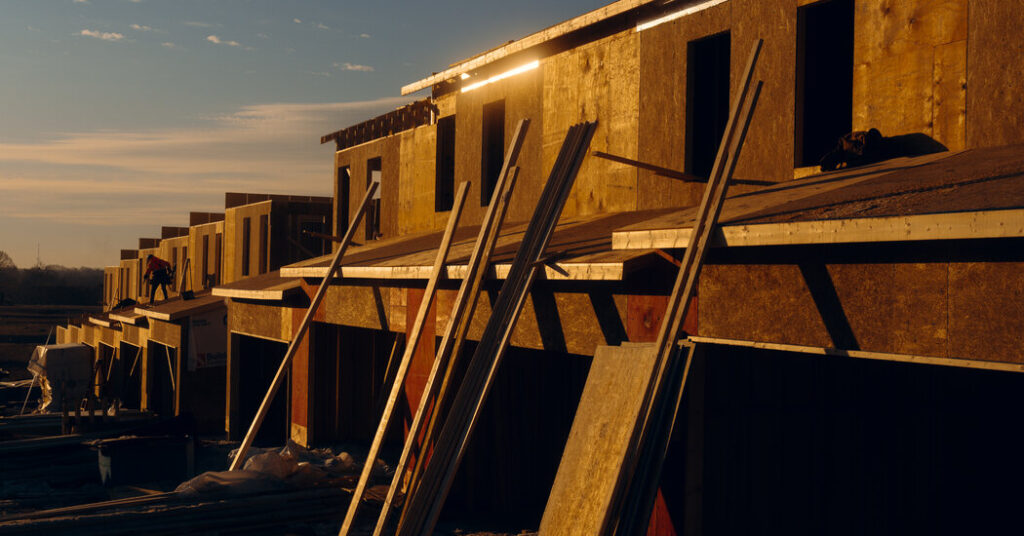
The package, which passed by a vote of 89 to 10, aims to boost the supply of new housing, a critical step toward bringing down housing costs, by removing regulatory barriers, providing incentives and preserving the existing supply. It would also set new limits on the role institutional investors play in the single-family housing market, a top goal of Mr. Trump, who signed an executive order on the issue in January.
The last time Congress passed housing legislation of this scale was in 1990, when it approved a bill that created a national affordable housing strategy and grant programs to fund new construction. The measure approved on Thursday would modernize a key program in that earlier legislation.
The bill, sponsored by Senators Tim Scott, Republican of South Carolina, and Elizabeth Warren, Democrat of Massachusetts — the leaders of the Banking, Housing and Urban Affairs Committee — has generated a rare burst of bipartisanship for an election year.
But while Mr. Trump has indicated his support, he has also cast considerable doubt in recent days on its chances of enactment. He has said he will not sign any legislation until Congress delivers him strict voting restrictions that are stalled in the Senate, leaving Republicans who are divided on the housing bill with little incentive to come to terms and push it through.
Mr. Scott said the central goal of the legislation was to produce more homeowners, noting that the average age of a first-time home buyer is now 40, which he considers too old.
“Let’s create more homeowners at an earlier age,” Mr. Scott said. “The age of affordability is now and the solution to affordability is, in fact, us.”
Polls show that housing affordability is a top concern among voters. Home prices are up around 50 percent since the start of the pandemic, when low interest rates ignited a housing boom. In the aftermath of that rush to buy homes, interest rates spiked, grinding the housing market to a stop, even as prices largely held. Rents also rose dramatically during the same period. While the Trump administration has made attempts to address the crisis with changes that could make it cheaper to buy a home, the legislation focuses on supply, which is widely seen as the root of the problem.
It would expand the definition of manufactured housing so factories could build homes without a steel chassis. Factory-built housing is cheaper and faster to put up than traditional stick-built homes. Other provisions in the bill would update mortgage lending standards and expand access to financing for manufactured housing.
The measure also would expand access to loans to build multifamily housing; expand access to federal grants to be used for new construction; and ease some environmental review processes to speed up building.
The package — a version of a similar bill that passed the House in January and one that passed the Senate last year — now moves to the House, where it faces opposition from members of both parties who are angry about some of the changes made by their colleagues across the Capitol.
“This has not been a bicameral effort on their part,” Representative Mike Flood, Republican of Nebraska and chairman of the Housing and Insurance Subcommittee, said of the Senate in an interview.
House Democrats, too, are frustrated. Representative Maxine Waters of California, the ranking Democrat on the Financial Services Committee, said she wanted the House and Senate to negotiate to resolve their differences over the measure, signaling that it would not have the support to pass the House unless changes were made.
And several right-wing Republicans, following Mr. Trump’s lead, have said they will not support the housing measure or any other Senate-passed legislation until the chamber acts on the voter ID bill, which is being blocked by Democrats and currently has no clear path to enactment.
Beyond the political challenges, the policy disagreements on the housing measure remain profound. The Senate added limits on the creation of a federal digital currency that some House Republicans do not think go far enough. The package also would restrict how private investors can purchase, build and own single-family homes. Under a new proposed rule spearheaded by Senator Raphael Warnock, Democrat of Georgia, investors who own 350 single-family homes would not be able to buy more, although the rules would not apply retroactively.
While the bill would allow investors to build single-family homes exclusively as rentals, it would require builders to sell those homes after seven years, a limit that critics of the provision, including some House Republicans, argue would make it harder for developers to build new rental housing at a time when the country desperately needs new supply. About 7 percent of all single-family construction is built as rentals.
Gone from the bill are several provisions from the original House measure, including one that addressed community banking lending rules and was championed by Representative French Hill of Arkansas, the Republican chairman of the Financial Services Committee.
Carl Hulse contributed reporting.
Ronda Kaysen, a real estate reporter for The Times, writes about the intersection of housing and society.
The post Senate Resoundingly Passes Housing Bill, but Challenges Lie Ahead appeared first on New York Times.