Step 1: Jot down your ideas and share with a partner.
Find a stiff paintbrush or makeup brush with bristles at the base that are stiff, and tips that are soft. Now close your eyes and use the brush to tap against walls, desks, or railings. Can you tell if you hit the object with the rigid part of the brush or the soft tip? Even though your eyes are closed, do the bristles on the brush help you “see?” If so, how?
Now read an article about a recent study on elephant whiskers, and see how this activity might connect to the study.
Step 2: Read a Times article about a recent study.
Read the New York Times article “An Elephant Is Blind Without Its Whiskers,” published on Feb. 12. It begins:
Every elephant has about 1,000 whiskers on its trunk.
They play a crucial role for the animals, which have thick skin and poor eyesight. Elephants cannot regrow these hairs, meaning a lost one creates a permanent sensory blind spot on a trunk, which they use for almost everything in daily life.
And as such an important feature, they are also unique among mammalian facial hairs.
“Elephant whiskers are aliens,” said Andrew Schulz, a mechanical engineer at the Max Planck Institute for Intelligent Systems in Germany.
In a study published Thursday in the journal Science, Dr. Schulz and his colleagues identified the structural features that give elephant whiskers a kind of “built-in” intelligence, providing the sensitivity that the largest mammals on land need to navigate their world.
Step 3: Analyze the study.
1. What was the scientific question that researchers wanted to answer?
2. How did researchers plan and carry out their investigation?
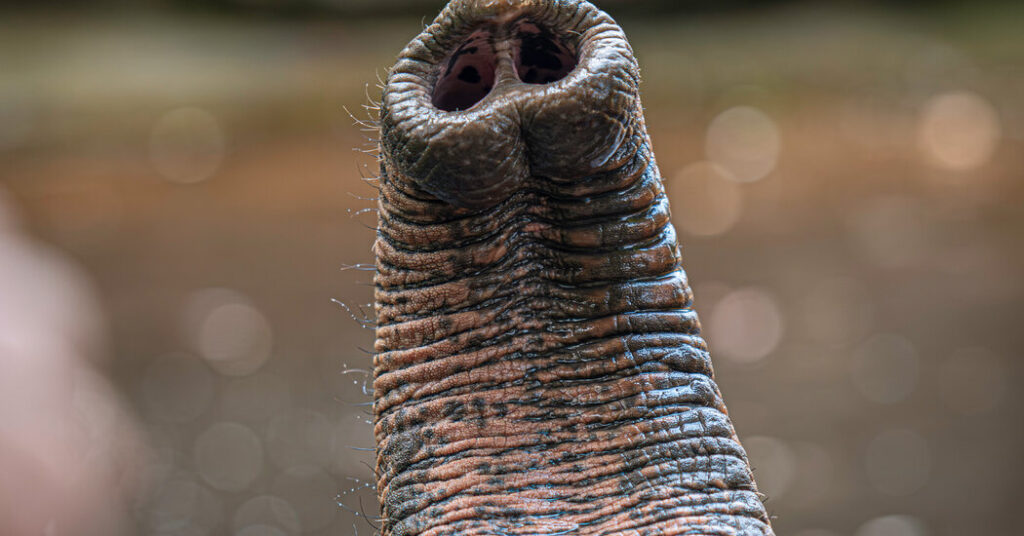
3. What do you notice in the photograph above? What does it show about the study?
4. What new data did the investigation yield? (Data is the factual information collected during observations, experiments or studies.)
5. What explanation did researchers construct using the data they collected and interpreted to answer their original question?
6. What significance does this research have for science, the world or our lives?
Step 4: Work with others to come up with your own scientific investigation.
In this study, researchers tried to better understand how whiskers help elephants see. Collaborate with others to propose another scientific investigation about how an animal uses its senses to “see,” such as to find food, communicate or avoid danger. For example, a scientist might want to investigate how bats use echolocation to navigate and find prey in the dark.
-
What scientific question might you want to answer?
-
Briefly describe how you might design a study using similar techniques mentioned in the article to try to answer that question.
More?
• Science Practice, a new resource aligned with the Science and Engineering Practices for the Next Generation Science Standards, aims to help students better understand how scientists actively gather evidence-based knowledge and solve problems. Learn more about this feature in this introductory post.
• See all the lesson plans in this series.
The post Science Practice | A Study on Elephant Whiskers appeared first on New York Times.