The U.S. military said this week that it had attacked 16 Iranian mine-laying vessels near the Strait of Hormuz. It is unclear whether any mines have been deployed in the strait, but American officials are surely aware that a naval mine — often no larger than a beach ball — can cripple a warship or a tanker.
They have clear evidence from the 1980s, when Iranian mines damaged commercial ships in the Persian Gulf and nearly sank a U.S. Navy frigate.
During the so-called tanker war, the maritime phase of Iran’s conflict with Iraq in the 1980s, both countries tried to cripple the other’s economy by attacking oil tankers and merchant shipping in the Persian Gulf.
Roughly a fifth of the world’s oil tankers pass through the Strait of Hormuz, a narrow waterway that connects the Persian Gulf to the Arabian Sea. Several merchant ships have been attacked in and around the strait since the latest war began on Feb. 28. Iran appeared to claim responsibility for one of the attacks, but the sources of the others were not immediately clear.
Laying mines and disrupting shipping traffic is a key component of Iran’s naval strategy, according to U.S. Navy assessments. Global prices for oil and natural gas typically rise when ships cannot deliver the vast amounts produced in the Gulf, a link that gives Iran leverage in the face of heavy attacks from the United States and Israel.
In the 1980s, the Central Intelligence Agency had assessed that Iran would avoid mining the Strait of Hormuz for fear of striking its own tankers or U.S. Navy vessels, said Stephen Phillips, a naval historian and the author of an upcoming book on the tanker war.
But Iran laid minefields that stretched from the Persian Gulf through the Strait of Hormuz to waters near the port of Fujairah in the United Arab Emirates, as well as the approaches to Bahrain, where the U.S. Navy had a base, Mr. Phillips said.
Kuwait, which was allied with Iraq, eventually asked the United States and the Soviet Union to escort its oil tankers. The U.S. responded by escorting Kuwaiti oil tankers through the Gulf. It didn’t take long for a mine disaster to unfold.
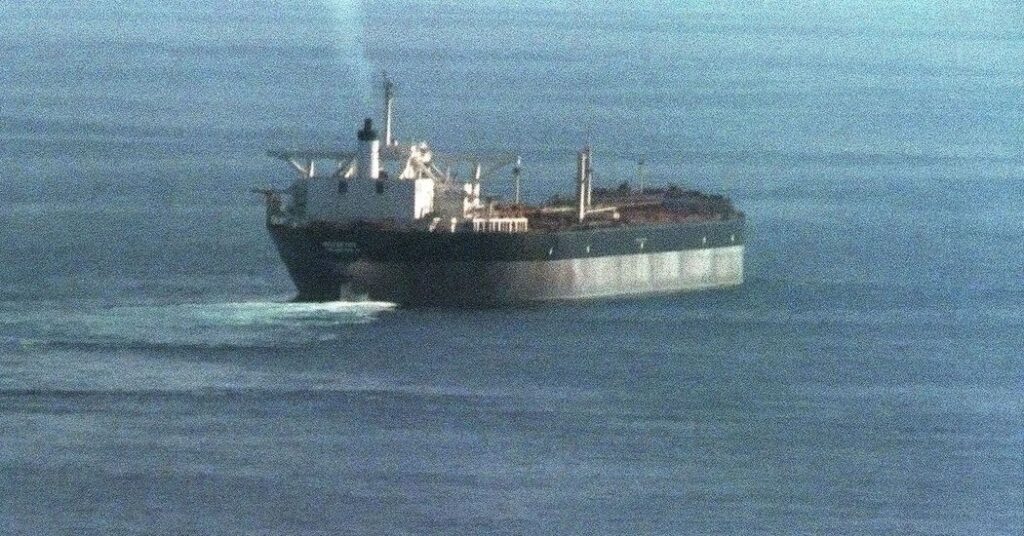
On the very first U.S.-escorted convoy, in July 1987, the supertanker S.S. Bridgeton struck a mine, tearing a hole in the front of the ship’s steel hull, according to the U.S. Naval Institute. Water flooded four of the Bridgeton’s 27 empty containers, Mr. Phillips said. The vessel completed its voyage without casualties and was repaired in time to join a second convoy in November.
The crisis escalated in 1988. In April, the U.S.S. Samuel B. Roberts, a guided-missile frigate nearly sank in the Persian Gulf after striking a mine that blew a hole in its hull, flooding lower decks, igniting fires and injuring several sailors, the U.S. Naval Institute said. Both the Bridgeton and the Roberts hit mines near Farsi Island, which hosted a naval base for Iran’s Islamic Revolutionary Guards Corps.
Iran’s mines had also put its own oil at risk. In August 1987, the U.S.-operated supertanker Texaco Caribbean struck an Iranian mine near Fujairah, forcing it to divert to port and unload the Iranian oil it was carrying.
“This is the challenge when you lay mines — they’re indiscriminate,” Mr. Phillips said.
Mines were also used in the region in the 1990s.
During the Persian Gulf War of 1991, Iraq laid minefields in the waters off Kuwait, which it had occupied. The U.S. launched Operations Desert Storm and Desert Shield to protect Saudi Arabia and drive Iraqi forces from Kuwait. In February 1991, two U.S. Navy ships, the Princeton and the Tripoli, were damaged by mines near Failaka Island, Kuwait, within hours of each other.
After the war, the U.S. Navy deployed minesweepers to clear about 1,200 Iraqi mines, in addition to hundreds of Iranian mines left over from the tanker war.
“As far as we know, we got all of them,” said Mr. Phillips, who served in the U.S. Navy disposing of explosive ordnance. “It’s always possible some were missed.”
Francesca Regalado is a Times reporter covering breaking news.
The post Mines Have Haunted the Persian Gulf for Decades appeared first on New York Times.