Nothing quite resembles a skilled sushi chef deep in the flow of forming piece after piece of nigiri: elbows out, fingers and palms sculpting, eyes in soft focus while the mind inhabits the hands. Individuality shows up in the slightest gestures.
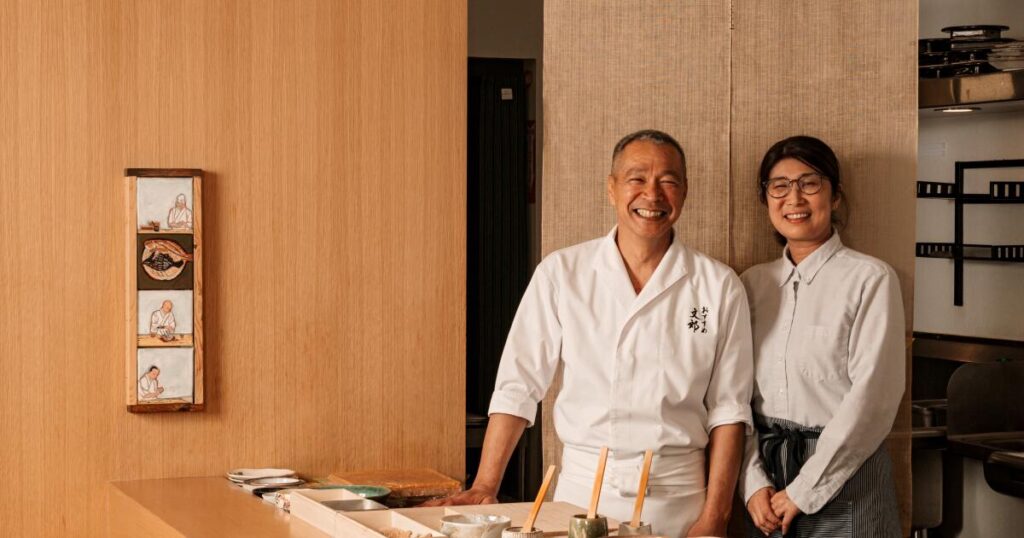
Standing alone behind his seven-seat bar, Fumio Azumi has an endearing habit of cocking his head for an instant when he’s nearly done melding fish and rice. He looks like he’s listening at a door to make sure his child has fallen asleep.
Azumi has been a quietly engaging presence in Los Angeles restaurants for two decades, but Osusume Fumio, the tiny place he opened in Atwater Village four months ago with his wife, Natsuko Aizawa Azumi, is his solo debut behind a sushi counter. Their space is austere, nearly blank, but once you’re sitting in front of Azumi, you feel the intent he brings to his craft. Value, quality, charisma: He achieves a balance full of intent and wisdom.
Osusume Fumio serves omakase, joining territory in L.A. that has never been more crowded or competitive. In our sushi-zealous city, a chef choosing and preparing microseasonal nigiri for half a dozen or so rapt customers in intimate quarters has arguably become our marquee fine-dining medium.
Jesse Silvertown, who has run the Sushi Legend website since 2012 and documents his meals across the globe, tallied a list of the current omakase possibilities in L.A. and Orange County. He counted 119. That’s … a whole lot of hamachi. The mix includes the relatively affordable “trust me” lunches at Sugarfish, which cost between $24 and $60, but at most places the pricing tiers drift into triple digits, up to $400 or $450 per person in our most rarefied temples.
Fumio starts at $120 for lunch and $160 for dinner, focusing primarily on Edomae-style nigiri — time-honored techniques, eschewing the modern flash of caviar or gold leaf — with a few appetizers that change nightly and luxury seafood add-ons available. Midrange, then, by omakase standards, and intentionally so: Azumi understands that, even after working for others for years, he’s building his own audience.
He arrived in the United States from Japan in the 2000s and has climbed through the branches of L.A.’s sushiya family tree. He worked at Studio City institution Asanebo and Mori Sushi in West L.A. shortly before it was sold in 2011. In 2016, he worked at now-closed Sushi of Gari alongside his younger brother, Taketoshi “Take” Azumi, who owns lauded Shin Sushi in Encino.
During the pandemic, the older Azumi met Kwan Gong while working at a wholesale seafood purveyor. The two of them spent their days in arctic conditions, slicing fish bound for supermarket sushi platters and planning the details of an omakase restaurant backed by investors Gong knew. Kogane opened in an Alhambra strip mall in late 2021, the two of them stationed on opposite sides of a serene bar. I remember Fumio there as much for the finesse of his nigiri as for the weathered mirth that crinkled in the corners of his eyes.
His warmth remains, but his presence also has a quieter gravity now that he’s running his own show.
For nearly five years, the Glendale Boulevard storefront the Azumis now occupy was home to Morihiro, Azumi’s former boss and the city’s guiding light for top-tier omakase. “Mori” Onodera relocated his operation in early October to Victor Heights, the small neighborhood bordering Echo Park and Chinatown, adding an a la carte menu and upgrading the beverage program with star bartender Han Suk Cho.
A few weeks later, the Azumis quietly assumed the vacated space. They changed little, keeping the splotchy stained concrete floors and the scruffy brick walls nearly bare to concentrate on the seven-seat sushi bar.
The spareness doesn’t matter, it turns out. For a couple of hours, once Fumio Azumi begins pressing fish and rice into elegantly proportioned nigiri, his orbit feels like the center of the universe. The atmosphere aligns with the philosophy: no ostentation, no grand production. Minimalism magnifies the excellence.
The sequence of nigiri is canonical. He often kicks off with hirame, the flounder offset with an assertive swipe of freshly grated wasabi and a traditional varnish of nikiri (soy sauce mixed with dashi, mirin and sake). His first rounds of shari (sushi rice) are lightly seasoned with white rice vinegar, the heat hovering around body temperature. A second delicate fish such as kasugo (young sea bream) follows, and then the sweet, yielding bounce of hotate (scallop).
Pacific bluefin tuna, specifically from Baja waters, has seen its population rebound over the last decade; it’s the only acceptable region in which to fish the species, according to sustainability guides like the Monterey Bay Aquarium’s Seafood Watch. Azumi usually ages Pacific bluefin somewhere between 16 and 19 days to achieve a velvety density.
To better match silvery varieties in the mackerel family, he switches to shari stained with richer, sharper akazu (red rice vinegar). By this point in the meal Azumi has found his rhythm with any given group of customers. He jokes about being an aging chef on his feet. He asks people where else they like to eat sushi. The choreography and the communion are always a little different: who’s reaching for each piece the moment Azumi sets it down on their geta (the ceramic serving platter in front of each person), and who’s prioritizing photo angles and conversation.
An intermezzo of miso soup made from shrimp stock arrives to reset the palate, and the nigiri progression continues: translucent prawn, kinmedai smoky after a few waves under a blowtorch, uni in its metallic-sweet glory, a tuna handroll (crunch right into this one, no photos, Azumi urges) and the telltale one-two of eel and then tamago (this version thin and spongey) to herald the meal’s conclusion.
Sushi aficionados will gravitate to the supplemental options for cult favorites like shimmery kohada and sticky-buttery nodoguro, and fleeting seasonal delicacies like kawahagi, a winter fish often intensified with a crowning slice of its own liver. My favorite among a handful of auxiliary appetizers: goma tofu, a custardy and piercingly nutty variation made with sesame paste and dolloped with uni. It’s a small but potent way to ease in pre-sushi, and right with a glass of earthy sake that Natsuko can help you select.
In the middle of one dinner, Azumi pulled out a book-sized, off-white oval platter with a crackly glaze. Its design looked familiar to me, and specific. Onodera has been crafting his own tableware for most of his career. Stacks of his plates once filled every spare inch of this restaurant.
“Is that … ?” I asked Azumi, pointing.
He caught the question right away. “Yes,” he grinned. “Mori-san made this. A few of his ceramics were left behind, pushed way back on the top kitchen shelf. We found them when we were cleaning after moving in. He laughed and told us we should keep them.”
Azumi’s pared-to-the-essence solo style has an immediate place in the L.A. sushiverse, but a beautiful inheritance doesn’t hurt either.
The post L.A.’s next must-try sushi bar? Pared-down excellence in storied digs appeared first on Los Angeles Times.