A remote forest in south central Pennsylvania seems to be the perfect place for a body to disappear, shrouded in leaves and covered in moss over time.
For the police who were investigating the skeleton of a woman believed to be in her 20s or 30s, discovered deep in those Pennsylvania woods in the first half of 2025, how long her remains had been there was an important question.
Soil samples and plant material such as roots, seeds and pollen have yielded crime-scene evidence for decades, but moss tends to be overlooked. Yet moss holds clues for investigators who know how to look for them.
To help construct a postmortem timeline, the police called in a forensic botanist. Christopher Hardy, a biology professor at Millersville University in Millersville, Pa., collected and analyzed moss and other plant material that had accumulated on the clothes covering the bones. Based on the amount of moss growth, he was able to estimate that the skeleton had been in the woods for at least a year.
“Plant evidence, including moss, is definitely something that should be utilized a lot more because 90 percent of the biomass on the planet is plant biomass,” Dr. Hardy said. “There’s a lot of evidence just waiting to be collected.”
Organic matter such as plant fragments, roots, leaves and moss can help establish links between a suspect and a crime. At the request of investigators, forensic botanists like Dr. Hardy can collect and analyze plants at crime scenes for possible clues. Too often, though, detectives don’t even consider plant matter as potential evidence. Moss is especially overlooked because there are so few reported cases that have used it.
A group of botanical experts and law enforcement officials is championing moss as a valuable tool and recently wrote two articles for the journal Forensic Sciences Research. The first published in fall 2025, cataloging how moss has been used to help solve criminal cases. The second, published on March 4, detailed the important role that moss played in a Chicago cemetery investigation.
Moss is in the category of tiny, resilient plants called bryophytes, and it can grow practically anywhere. More than 12,000 species of moss can be found around the world in a variety of environments. It has no roots or seeds and can live for decades. Among the most common and recognizable mosses in the United States are sheet moss (Hypnum curvifolium), which grows in a thick carpet; pincushion moss (Leucobryum glaucum), known for growing in rounded mounds; and sphagnum moss (Sphagnum platyphyllum), known for its shaggy appearance.
Particles from the dense, green mats can easily attach to a suspect’s shoes or clothing, grow on human remains and survive in adverse conditions, according to the group’s research. Moss samples can help law enforcement calculate postmortem timelines, track a suspect’s movements and establish key links to help solve crimes including homicides, missing person cases and cemetery desecrations.
Several of the reports’ co-authors were brought together in 2009, to help with an investigation into the disinterment and dumping of human remains at Burr Oak Cemetery outside of Chicago. The case helped inspire them to start raising awareness about using moss as a forensic resource.
Four cemetery employees had been accused of digging up human remains at Burr Oak, a historic 150-acre graveyard, and of discarding them in an unused part of the property so they could resell the burial plots.
Burr Oak is the final resting place of African American icons including the 14-year-old Emmett Till, whose 1955 murder in Mississippi helped spark the civil rights movement, the blues singer Dinah Washington and the heavyweight boxing champion Ezzard Charles. Their graves were not disturbed.
The four employees claimed that the remains that were moved had been unearthed and shifted before they began working at the cemetery.
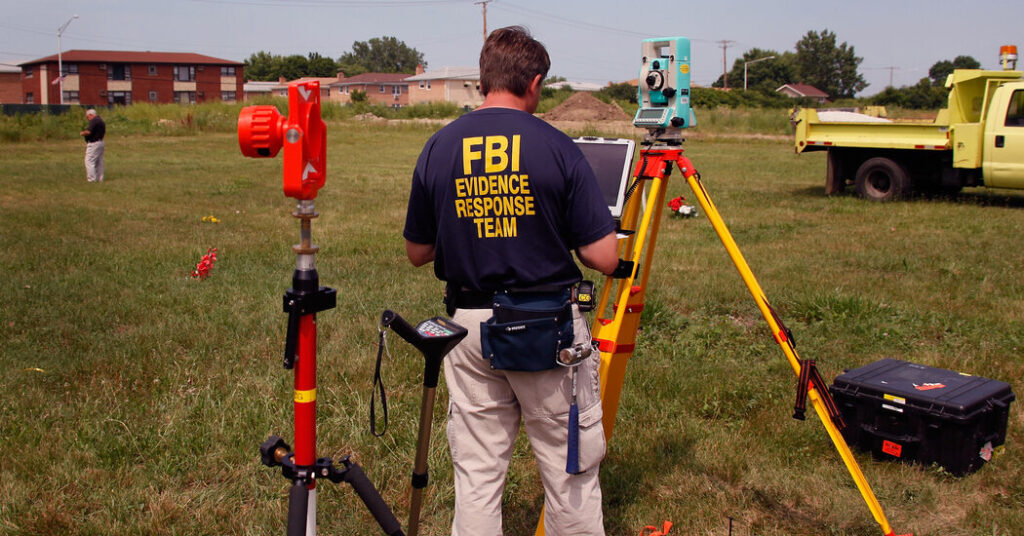
The Cook County police asked Anne L. Grauer, an anthropology professor at Chicago’s Loyola University and a forensic consultant for federal and state law enforcement, to examine the area where about 1,500 bones from at least 29 people had been moved.
She noticed a clump of green moss among the bones that looked out of place. Dr. Grauer told investigators they needed a botany expert who would know “how long moss stays green when it’s not allowed any exposure to sunlight and if we could we find places in the cemetery where this moss grew naturally, which could perhaps help tell us where the skeletal remains came from.”
The Field Museum in Chicago became a resource, given its significant array of mosses. Matt von Konrat, head of the museum’s botanical collections, and his team identified the moss as Fissidens taxifolius, also known as common pocket moss, and found none of it at or near the dump site.
But the moss was growing in areas near the desecrated graves. Based on the moss specimen’s appearance and health, and other factors including light and moisture, investigators determined that the graves had been dug up within the past year, during the suspects’ employment at the cemetery.
Moss was far from the only evidence against the four employees, but it helped establish a timeline and build a case against all four that resulted in their convictions, according to the March research paper. One defendant’s conviction was later overturned because the charges were too vague, according to a court ruling.
Cmdr. Jason Moran of the Cook County Sheriff’s Police Department in Maywood, Ill., said that moss provided an unexpected integral clue, in the absence of witnesses or cameras in the isolated area of the cemetery.
“Moss wasn’t on my radar at the time,” he said. “I was aware of forensic botany but it was kind of obscure.”
Now, when he conducts training or consults on cases with other departments, Commander Moran brings up the possibility of collecting plant-based evidence when applicable.
“We do our part to communicate if moss or botany in general is an option in a case,” he said. “You’re not going to be an expert in forensic botany but you need to be aware of it.”
Dr. von Konrat said he hoped the journal articles educate investigators about the value of moss as a forensic tool and lead to more work between law enforcement and botanists.
For now, those relationships are formed on an ad hoc basis, when the presence of plant matter at a potential crime scene can’t be ignored, as in Dr. Hardy’s case in Pennsylvania. Spreading the word about how moss can be used in certain investigations could strengthen or build ties between law enforcement and botanists.
“We want to connect properly with folks and use this opportunity to see how we might help each other in the future,” Dr. von Konrat said.
The post In Criminal Cases, Moss Is Often Underfoot and Overlooked appeared first on New York Times.