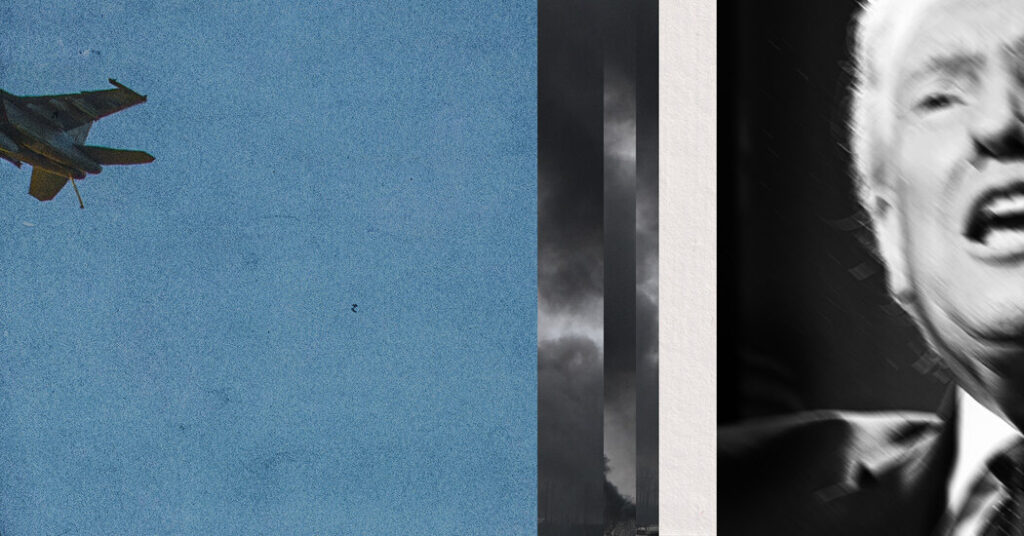
The United States and Israel have been conducting airstrikes on Iran for a week and a half. Stephen Stromberg, an editor in Opinion, on Wednesday convened the Opinion columnists Nicholas Kristof and Bret Stephens and the Opinion contributing writer Megan K. Stack to discuss how the war is developing and how it might end.
The conversation has been edited for clarity.
Stephen Stromberg: How has your view of the war changed over the last week and a half? Nick, why don’t you start?
Nicholas Kristof: I thought attacking Iran was a terrible idea but that there was always some small possibility that it would actually succeed and prompt an uprising. Now that seems more unlikely than ever, partly because President Trump has acted in ways that boost Iranian nationalism — with talk of arming the Kurds, attacks on cultural sites, his failure to apologize for a strike that hit a girls’ school — and arguably help the regime.
I also thought that the war might end quickly, partly because both sides would want it to. Now I think it may drag on, in part because Iran seems intent on re-establishing deterrence, making the West pay a substantial price so that it is less likely to attack again. Paradoxically, Iran may be happier than Trump to lengthen the war.
I’ve also been surprised that the Trump administration seems to be contemplating inserting ground troops, either to try to recover Iran’s highly enriched uranium or to seize Kharg Island, Iran’s oil export hub. Both would risk significant casualties and make an exit even more difficult.
Bret Stephens: I’m flabbergasted by the relentless pessimism I’m seeing in much of the commentariat. We are less than two weeks into a war that will almost surely be over by the end of the month, and already there are predictions that it’s “another Iraq.” American casualties, heartbreaking as they are, have been minor for a conflict of this scale. Iran’s ability to threaten its neighbors diminishes by the day: We’ve seen this in the sharp decline in its ballistic missile and drone attacks. I have to assume that before this war is over, we will find a way to remove Iran’s remaining stores of highly enriched uranium, which greatly enhances global security over the long term. And Iran’s leaders, for all their swagger, now know they are not immune from reprisal, which will make them think a lot more carefully as they plot their retaliation. We may not see regime change now, but this regime is likely to become a zombie state before the next, all-but-inevitable, popular uprising.
Megan K. Stack: As a country, we need to take a beat and look at ourselves. This is an illegal war, lacking congressional or U.N. Security Council backing. Two U.S. acts early in the war were bombing an Iranian ship off Sri Lanka and letting dozens drown, and, it appears, bombing an Iranian girls’ school, killing more than 150 people.
A few things came into focus this past week. One, we’re starting to see some of the destabilization that Trump is inviting, in the oil markets and the standstill in the Strait of Hormuz, in Lebanon, Turkey, the Persian Gulf and on and on. Two, it is now clear that our government cannot articulate why we started this war or what we’re trying to achieve. And, three, so far, the countries gaining are Russia and, to a lesser extent, China.
Stromberg: So, sharply differing takes here. A lot rides on what you think will happen to the Iranian regime and what that means for the world. Bret argues it could turn into a zombie regime, unable to suppress its people for much longer. Nick and Megan, what do you make of the likelihood of such an outcome, and how might its realization shift your thinking about the war’s costs, if at all?
Kristof: Sure, that might happen. And Iran might give up its nuclear program and become a fully democratic state. But I wouldn’t bet on any of that. It’s certainly true that the regime is exceptionally unpopular; I’ve rarely reported from a country where so many ordinary people tell you how much they despise the government. I had thought that after Ayatollah Ali Khamenei died on Feb. 28, there was some possibility of change and reform. But that seems less likely now. The West thought that killing Khamenei would accelerate change. He might have thought that if he were “martyred,” that would help preserve the regime and keep hard-liners in power, and he may have been right.
I’m also skeptical that a zombie regime would be harmless. The Houthis in Yemen are in some sense a zombie group, yet they are still a threat in the Red Sea. As long as Iran has dhows, it can lay mines in the Strait of Hormuz. I worry that even a zombie regime could make a new drive for nuclear weapons. I suspect that Iran’s new leadership may think that one mistake the country made in the past was enriching uranium without actually creating weapons, for that provoked the West without deterring it. There may now be a greater push to actually build the weapon, which would be a catastrophe for proliferation in the region and might be within the capacity even of a zombie regime.
Stephens: A nuclear weapons program requires four things that Iran will now struggle to build up again: first, a great deal of specialized machinery; second, a fair degree of secrecy; third, scientists and technicians willing to participate in the program; and, finally, reasonable hopes of ultimate success. So even if the regime decides to again pursue a nuclear program, which it might, they’ll struggle to do so. I certainly wouldn’t want to be the Iranian physics major stepping into the shoes of one of those deceased Iranian scientists. What’s just as significant is that the Iranian people may have a better chance to topple a regime that, despite the facade of unity, is surely under intense inner strain and as despised as ever.
Stack: A zombie regime, humiliated and crushed? Why do I find myself thinking of Russia’s Soviet Union-to-Vladimir Putin trajectory?
We make a mistake looking at a place such as Iraq or Iran or Russia and assuming that we have a strong fix on the overall politics within the country, what people want, what they are likely to do, what trade-offs they might accept or not. These are complicated dynamics, and Iran is a huge country. I’m skeptical that any of us can accurately predict what Iranians will do in the absence of a strong, centralized government. The risk of Balkanization is real. I don’t know if you heard Trump say that the map of Iran may not look the same when this is all over, but I sure did, and so did Iranians. I’ve been pondering whether that could be an unspoken goal of this war, perhaps on the part of Israel, which might view a fragmented Iran as less menacing than a united one.
Also, it’s a basic doctrine of military strategy that bombing countries produces the inverse of rising up — the “rally round the flag” phenomenon. So I’m beyond skeptical that this is headed anywhere promising.
Stephens: The fate of the regime of Slobodan Milosevic in Serbia, which caused such misery in the Balkans throughout the 1990s, tells a different story of what can happen to a regime that is humiliated and crushed. I don’t much love the current Serbian government, either, but it no longer poses much of a threat to the broader security of its neighborhood, nor is the world worse off now that a country called “Yugoslavia” no longer exists.
Kristof: Let me push back. Milosevic was overthrown because of a student group called Otpor! — and the students were able to organize a campaign against him because the regime wasn’t shooting them. In general, what I’ve seen in my career is that uprisings succeed when troops are no longer willing to massacre protesters. Sadly, Iran’s regime has shown that it is still willing to slaughter demonstrators, so I doubt the Milosevic parallel holds.
Stephens: Let me push back against your pushback! There was this three-month-long U.S.-led bombing campaign against Serb forces over the war in Kosovo — another American military effort not authorized by Congress or the United Nations — that fatally weakened the Milosevic regime before it was brought down by internal opposition. But we probably want to get back to debating Iran. …
Stromberg: Yes, Bret, as much as I love talking about the Balkans when Balkanization is on the mind. Trump said on Wednesday that there is “practically nothing left to target” in Iran. Is the United States accomplishing anything with more bombing?
Kristof: I wish Trump would disingenuously declare victory and end the war and press Israel to cease its strikes, too. That’s pretty much what he did with the Houthis a year ago: He saw that his war on them wasn’t dislodging them and gave up. Trump presented it as a great victory, and so did the Houthis, but at least he ended the bombing campaign after $7 billion wasted.
After 5,500 strikes on Iran, I understand that the United States is running out of bombing targets, and the risk is that then we extend the target list to include the electrical grid and major civilian infrastructure — this might already be happening with attacks on civilian planes and a desalination plant. The war has been a tragic mistake, and nothing would improve it so much as its rapid end.
Stack: Yes, Nick, I agree. As to whether the United States is accomplishing anything with more bombing, I say without snark that it’s impossible to know because we don’t know what Trump is trying to achieve, as the administration’s answers on that point keep changing.
A complication here is that even if the United States decides to pull the plug, it’s not clear what Israel would do. At a minimum, Israel might continue striking Lebanon on its own — to the extent that Israel acts on its own; there is always U.S. backing, even in the absence of direct military involvement.
And no matter how or when this war ends, significant damage and confusion have already been caused in the region’s sense of security. Saudi Arabia might be able to capitalize on this war to continue its push — with more reason now, unfortunately — for a NATO-style defense treaty with the United States and the right to enrich uranium on Saudi soil. On the nuclear question, this war is a terrible illustration of why countries such as Iran or Saudi Arabia might want a nuclear bomb to deter strikes against them.
Stephens: I don’t think we can end the bombing campaign until we’ve either destroyed or secured Iran’s remaining nuclear capabilities, particularly those roughly 200 kilograms of highly enriched uranium believed to be at a site in Isfahan. The United States should also seize Kharg Island in the Persian Gulf, from which Iran exports roughly 90 percent of its oil, as long-term leverage over the regime’s behavior. As for other targets, people such as Adm. Brad Cooper, the CENTCOM commander, is probably in the best position to determine when Iran will no longer be able to threaten us in the Strait of Hormuz and the rest of the region. I’m guessing that might happen in a week or two.
By the way, the surest route to nuclear proliferation in the Mideast was an Iranian weapon. That’s one of the reasons this campaign is so important: to keep Iran from getting one and to lower the temptation the Saudis, and perhaps others, feel to get nukes of their own.
Stack: We should just seize an island from a sovereign country? What gives the United States the right to do that? We started this war even though it’s been acknowledged by intelligence assessments and lawmakers that Iran posed no immediate threat to the United States. And yet we’ve very quickly become cavalier about bombing the country and seizing its territory.
It’s also impossible to discuss nukes without acknowledging the nuclear program that everyone knows Israel has, but which Israel will not publicly acknowledge. If we’re looking at proliferation in the Mideast, that’s the main thing.
Stephens: Perhaps the reason Israel got nuclear weapons in the first place is that its enemies — then Egypt and Syria, now Iran — sought not just to deter or defeat it, but to wipe it off the map. I don’t see Iran’s mullahs or the country’s Islamic Revolutionary Guards Corps having the same scruples as Israel has shown if the tables were turned. As for seizing an island, we’ve seized a lot of them throughout history, though sometimes we’ve given them back, particularly to defeated adversaries that adopt better courses: think of Okinawa or Iwo Jima. Kharg could be Iran’s again if it simply desisted from supporting terrorist groups while breaching the Nonproliferation Treaty in its attempts to get a bomb.
Kristof: The aim of seizing Kharg Island would be to force Iran to capitulate rather than lose its oil revenues. Maybe that would work, but I doubt it, for this regime is ideological and willing to have the country endure suffering indefinitely. How long would we leave U.S. troops on Kharg Island, as they took casualties from periodic drone attacks from the mainland, as Iran harassed shipping in the Strait of Hormuz by dropping mines from dhows, as the Houthis escalated by attacking shipping in the Red Sea, as Iran employed cyberattacks or terrorism to harm Americans and their allies? How long do Americans want to invest blood and treasure in a failed war?
Stromberg: The Times reported Tuesday that Trump discounted the possibility that striking Iran might lead to big economic consequences. But the price of oil is up and remains volatile, even as a group of countries announced Wednesday that they will release 400 million barrels of oil from their reserves. Trump said on Fox News that sailors should “show some guts” and attempt to transit the Strait of Hormuz, but Iran appears to have struck ships that have tried. Whatever you think about how the war’s costs and benefits stack up, what does the last week and a half show about the president’s capability to see through this conflict to a good — or, depending on your view, a less-bad — conclusion?
Kristof: Trump seems to have operated throughout on best-case scenarios, and that makes me doubt his ability to end this conflict wisely. I fear he might take Bret’s advice and either seize Kharg Island or insert Special Forces to try to recover the highly enriched uranium.
Two aspects trouble me the most about Trump’s management of the war. First, he seems really bad at getting advice from those who know the region. For example, Dan Caine, the chairman of the Joint Chiefs of Staff, reportedly warned Trump about all that could go wrong, and the intelligence community reportedly said that an uprising to overthrow the regime was unlikely — yet Trump charged ahead. Second, Trump has blustered about the strike that hit the girls’ school and about raining “death, fire and fury” on Iran, which sounds to me less like military policy and more like a Putin-style plan for a massive war crime.
Stack: I expect that when Trump is done with this war, he will abruptly end U.S. involvement — or at least try to — and claim that any resulting chaos or economic downturn is somebody else’s fault. That’s his nature as a leader. I think he must be looking for a way out already, because anything that affects markets this much will have his attention. And, to be fair, even if he wanted to stabilize the situation, it’s hard to imagine what he could do to put things back together, short of the much-discussed boots on the ground — and even that probably wouldn’t work. I will say, even after five-plus years of living under a Trump presidency, this war has given me a new understanding of his capacity for recklessness.
Stephens: My friend Eliot Cohen recently reminded me of an apt line attributed to Henry Kissinger: “Why are the wrong people doing the right thing?” I, too, have my share of misgivings about this administration and its ability to execute complex tasks in a competent way. On the other hand, I listened to one president after another — Clinton, Bush, Obama, Biden — insist that a nuclear Iran was an unacceptable threat to American interests and global security. But it was Donald Trump who had the nerve to do something about it, even in the teeth of public skepticism and partisan resistance. And for that, as an American and as a Jew, I feel grateful.
Stromberg: Thanks, Bret, for reminding us that there is a possibly apocryphal Kissinger quote for most situations. We’ll see how things look in another week and a half.
Source photographs by Kaveh Kazemi, Roberto Schmidt and U.S. Navy, via Getty Images.
The Times is committed to publishing a diversity of letters to the editor. We’d like to hear what you think about this or any of our articles. Here are some tips. And here’s our email: [email protected].
Follow the New York Times Opinion section on Facebook, Instagram, TikTok, Bluesky, WhatsApp and Threads.
The post ‘I’m Flabbergasted by the Relentless Pessimism’: 3 Opinion Writers on Iran appeared first on New York Times.