James Kirchick is the author of “Secret City: The Hidden History of Gay Washington.”
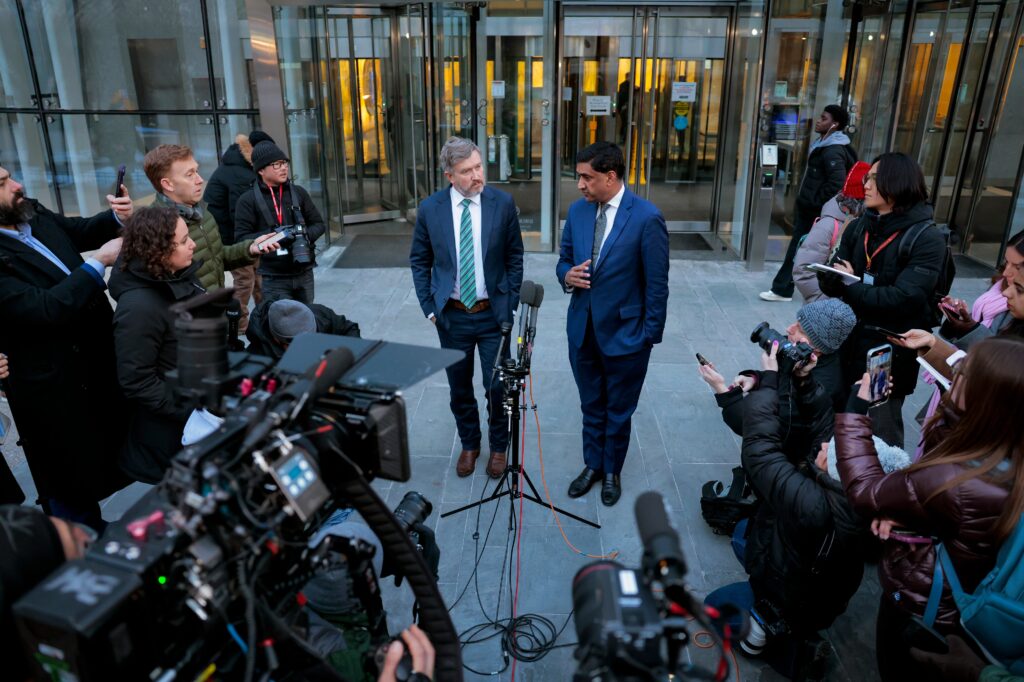
Last month, Reps. Ro Khanna (D-California) and Thomas Massie (R-Kentucky) held a news conference outside the Justice Department. Co-sponsors of the Epstein Files Transparency Act, they had just reviewed a collection of unredacted documents from the FBI’s investigation into the deceased sex offender Jeffrey Epstein and were assailing the government for withholding the names of six men who appeared in a collection of mug-shot-style photographs. “There is no reason in our legislation that allows them to redact the names of those men,” Massie declared. If the department would not release the names, the pair said, they would do it themselves.
The following day on the House floor, Khanna made good on that threat, reading the names of “six, wealthy, powerful men” into the congressional record “to hold the Epstein class accountable.”
It took the Guardian three days to discover that four of the men Khanna named had “no ties to Epstein.” A car mechanic from the nation of Georgia, an information technology specialist, the owner of a home improvement store in Queens and a man Massie later admitted to misidentifying who shares a name with an Italian former member of the European Parliament — none of them are “wealthy” and “powerful.” A more accurate description was provided by Deputy Attorney General Todd Blanche, who referred to them as “completely random.”
Rather than apologize to the public he deceived and to the men he smeared, Khanna blamed the Justice Department. Acknowledging that the innocent men “were just part of a photo line up and are not connected to Epstein’s crimes,” Khanna said that the department nonetheless “failed to protect survivors.” Less than two weeks later, having evidently learned nothing, he claimed that the files showed that Epstein had visited CIA headquarters. A Washington Free Beacon report demonstrated that Khanna was likely referencing a photo of Epstein at a Hermès design studio. (When asked for comment, Khanna acknowledged that “the photograph which had online buzz about being at CIA headquarters was apparently at Hermes.”)
Ever since appointing himself chief congressional inquisitor in the Epstein investigation, Khanna has been deceiving the American people with conspiracy theories. Last summer, the FBI released a memo debunking the two primary components of what independent journalist Michael Tracey, who has done more than anyone to expose the mainstream media’s sensationalist coverage of this story, refers to as the “Epstein mythology.” According to the bureau, there’s no evidence that Epstein possessed a “client list” of people he subjected to sexual blackmail, nor is there any information “that could predicate an investigation against uncharged third parties.” Nothing in the 3.5 million files that the department released in January at the urging of Khanna and others changes that assessment.
Khanna clearly would like people to believe that his ubiquity concerning the Epstein case stems from a sincere interest in human trafficking, a very real problem in which he showed little prior interest. Not once did Khanna tweet about Epstein during Joe Biden’s presidency. He isn’t even a member of the Congressional Human Trafficking Caucus, a nominal affiliation requiring zero commitment.
Khanna has opportunistically commandeered the Epstein spectacle as a vehicle to advance his career. The California Democrat has been laying the groundwork to run for president in 2028 and, as part of that highly dubious undertaking, he has placed himself front and center on all things Epstein. According to New York magazine, Khanna has spent so much time in New Hampshire that he’s referred to as the state’s “fifth delegate” to Congress. “I get texts from him,” one local Democrat said, “and I barely know him.” In the words of New York writer Ben Terris, “being barely known is probably the thing Khanna is best known for.”
Khanna has apparently decided that exploiting the Epstein scandal, facts and propriety be damned, is the way to remedy that obscurity. Some correspondence shared with me from early in his political career provides a window into the mind of a man whose lust for power is unseemly even by Washington standards.
On Jan. 21, 2009, the day after President Barack Obama’s first inauguration, Khanna emailed an aide to Bill Clinton asking the 42nd president to help him get a job working for his wife, Secretary of State Hillary Clinton. “I would be honored to serve Secretary Clinton and the country in the position of Assistant Secretary of State for Business, Energy, and Economic Affairs,” he wrote. “Most importantly, I want to be part of her team, and deeply believe she will be President one day.” Khanna boasted of “working with the AJC and AIPAC” — the American Jewish Committee and the American Israel Public Affairs Committee — “to build ties between the Indo American and pro-Israel communities.” Tom Lantos, the only Holocaust survivor to serve in Congress, whom Khanna challenged in 2004, was “a close mentor.”
After a series of emails and phone calls, the aide forwarded Khanna’s job request to his superior, who himself had clearly been on the receiving end of multiple messages from Khanna. “Guy is killing us,” the superior wrote back. “Not happening.”
Two weeks after the 2014 election — his second failed campaign for Congress — Khanna sent a handwritten letter to Bill Clinton. “You inspired my passion for public service, and I have always believed you are the greatest political leader of our times,” he gushed, praising the 42nd president’s “third way” philosophy and promotion of the “pragmatic center.” Khanna told Clinton that “it would mean a lot to me to have the chance to meet and to have your counsel and mentorship” and pledged, “You will have, of course, my complete and unconditional support in 2016,” a reference to Hillary Clinton’s highly anticipated presidential campaign. Bill Clinton didn’t respond.
Perhaps he should have. The following December, running for Congress again in the district that includes Silicon Valley, Khanna abruptly switched his support from Clinton to Bernie Sanders. In a campaign during which he took money from venture capitalist and left-wing bogeyman Peter Thiel, Khanna, one of the richest members of Congress, discarded his neoliberal centrist costume and changed into that of a progressive populist. Positioning for the left-wing lane in the 2028 Democratic primary, the man who once waxed sentimentally about the importance of the U.S.-Israel relationship, boasted of working closely with AIPAC, and described a Holocaust survivor as his “mentor,” now speaks at a convention where panelists joke about the Oct. 7, 2023, massacre, trolls the pro-Israel group on Twitter, and libels the Jewish State as perpetrating a “genocide.”
Confronted with these radically shifting views, Khanna is dismissive. “By 2016, I was very concerned about economic inequality and supported Medicare for All and a living $15 wage,” he says about abandoning his “complete and unconditional support” for Hillary Clinton’s presidential bid. As for his about-face on Israel, Khanna says that “the Gaza war changed my view. I have been horrified by the Israeli government’s war crimes in Gaza.” Perhaps these sudden reversals of long-held and strongly-expressed beliefs are sincere. Either way, they boosted his career prospects.
It was once easy to dismiss Khanna as just another overly ambitious politician. But his recklessness concerning the Epstein affair — fomenting a moral panic the likes of which this country hasn’t seen since the 1980s child sexual abuse hysteria — crosses a line. Desperate for attention and willing to engage in the lowest forms of demagoguery to achieve it, Khanna once might have been deemed unfit for public office, but these days, there’s no telling how far he could go.
The post How Ro Khanna turned a sex trafficking scandal into a campaign stunt appeared first on Washington Post.