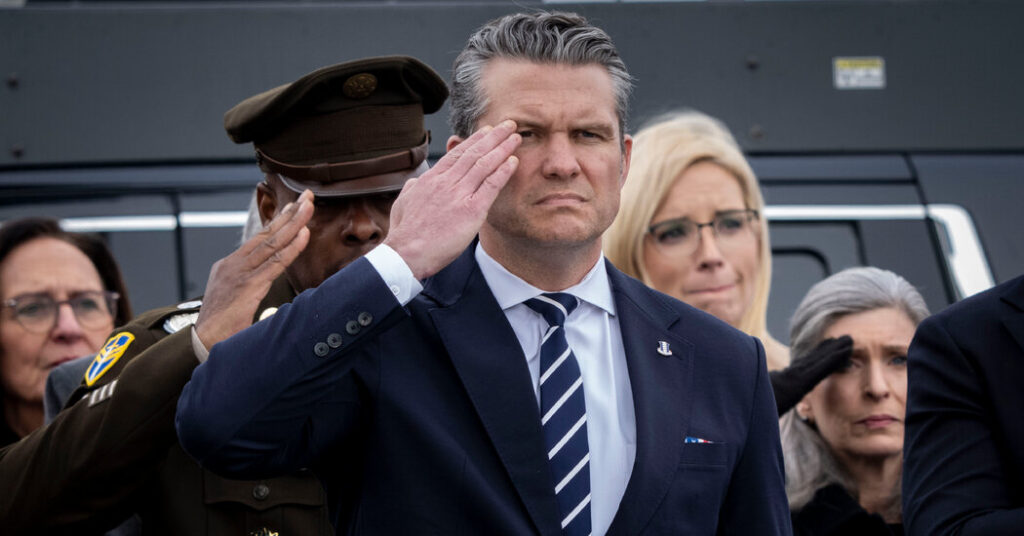
Long before President Trump chose him to lead the U.S. military, Pete Hegseth described the moral calling that had compelled him to volunteer to serve in Iraq.
He was working on Wall Street in the summer of 2005 and had read an article about an insurgent who blew himself up, killing 18 Iraqi children. “To me, that was the face of evil,” Mr. Hegseth told The Princeton Alumni Weekly, adding, “That sent to me a signal that I need to do my part not to let that ideology win in Iraq.”
He deployed to the war-torn city of Samarra a short time later.
Today, Mr. Hegseth describes the mission and moral purpose animating the war in Iran, now in its second week, in starkly different terms. The goal, he said recently, is to unleash “death and destruction from the sky all day long.” Instead of seeking justice, U.S. forces are pursuing vengeance against an implacable foe.
“Their war on Americans has become our retribution,” he vowed.
For decades, presidents and their secretaries of defense have framed American military interventions in altruistic terms. Even though the truth was often more complicated, they cast U.S. troops as liberators bringing democracy and freedom to those living under tyranny and oppression.
Mr. Hegseth has largely dispensed with that talk. His bellicose, at times vengeful, rhetoric reflects his belief that the United States’ lofty goals in Iraq and Afghanistan caused the military to lose focus on its main task, killing the enemy, and led to costly defeats in both wars.
In his view, the U.S. military’s strength is not rooted in its high ideals, humanity or moral purpose, but rather its ability to punish adversaries. Anything that distracts from that singular mission, he has said, is weakness.
“This is not 2003. This is not endless nation building,” Mr. Hegseth said on Tuesday at the Pentagon. “It’s not even close. Our generation of soldiers will not let that happen again.”
Instead, he said, the U.S. military was pursuing Mr. Trump’s war objectives with “brutal efficiency, total air dominance and an unbreakable will.”
A Pentagon spokeswoman said Mr. Hegseth’s remarks “project strength, resolve and confidence” to enemies and allies in “an increasingly dangerous world.”
In 2006, shortly after Mr. Hegseth arrived in Samarra, a powerful explosion shattered the golden dome of one of Iraq’s most revered Shiite shrines in the city. The blast set off months of sectarian fury, plunging the country into a state of civil war.
Mr. Hegseth was part of a small team focused on rebuilding Samarra, where the U.S. military had spent tens of millions of dollars. He pored over spreadsheets detailing the reconstruction contracts and visited many of the sites, some of which were half-finished or empty lots. He concluded that a major chunk of the military’s money was funding the insurgency.
He and his team redirected the remaining funds to the head of the Samarra City Council, who used them to build a security force. The Iraqi leader also provided valuable intelligence on the enemy. To show solidarity, Mr. Hegseth and other soldiers from his team spent the night at the embattled Iraqi leader’s home. The gesture was Mr. Hegseth’s idea, according to a former soldier from his unit.
Those who knew Mr. Hegseth from that period describe him as ambitious, passionate and dedicated to the mission.
“In Iraq, I often met these midlevel officers who were very competent and actually cared despite being thrust into an almost impossible situation not of their making,” recalled Philip Shishkin, a former Wall Street Journal reporter who embedded with Mr. Hegseth’s unit in 2006. “Hegseth fell into that category.”
Upon his return, Mr. Hegseth spoke hopefully of the mission and campaigned to send more troops to Iraq to support Gen. David H. Petraeus’s counterinsurgency strategy, which focused on pushing U.S. troops off big bases and into neighborhoods, where they could focus on protecting Iraqi citizens from insurgent attacks.
Mr. Hegseth wrote in his book “American Crusade” that he initially “mocked” Mr. Trump’s presidential campaign in 2016, put off by his reality TV celebrity and his style. But after Mr. Trump was elected, the two men found common cause in Mr. Hegseth’s campaign to pardon three U.S. troops — two soldiers and a member of the Navy SEALs — who had been accused or convicted of war crimes in Iraq and Afghanistan.
In two of the three instances, the service members were turned in by their own troops — the men they were charged with leading in combat. Mr. Hegseth, then a Fox News host, cast the accused as victims of muddled military thinking and overly restrictive rules of engagement that had prevented troops from killing insurgents and defending themselves. The whistle-blowing soldiers said they were defending their honor and a moral code.
On the day Mr. Trump decided to pardon the three men in late 2019, he called Mr. Hegseth to share the news. Mr. Trump ended the conversation with a compliment that Mr. Hegseth wrote he would “never forget.”
“You’re a warrior, Pete,” Mr. Trump told him, adding an expletive for emphasis.
“It was a hallowed night,” Mr. Hegseth recalled.
As secretary of defense — Mr. Hegseth prefers to be called the “secretary of war” — he vowed to return the military’s focus to killing the enemy. “Maximum lethality, not tepid legality,” he said this year. “Violent effect, not politically correct.”
His diagnosis of the military’s shortcomings is one that often emerges after a lost war. “There’s always someone who thinks that if only we were crueler, if only we’d killed another million Vietnamese, then we would have won this war,” said Phil Klay, a novelist and a Marine Corps veteran of the Iraq war. “If you reduce war to the satisfied feeling you get when you kill the enemy, it makes it a lot simpler and more satisfying.”
Mr. Hegseth’s views also mirror those of Mr. Trump, who has consistently rejected the idea that the United States by virtue of its unique history and superpower status has a special role in the world with regard to spreading democracy or defending freedom.
Mr. Trump’s and Mr. Hegseth’s views are reflected in the name they have given to the Iran mission. In the past, the Pentagon has chosen names that sought to send a message to the American people and the world that the military was fighting for some higher ideal, such as “Operation Enduring Freedom” in Afghanistan or “Operation Unified Protector” in Libya.
For the Iran mission, Mr. Hegseth signed off on “Epic Fury,” a name that connotes retribution and rage.
To the pilots flying missions and sailors firing missiles into Iran, the bellicose rhetoric is, for now, most likely background noise. They are focused on the immediate, and often dangerous, task at hand.
But over the longer term, couching wars in moral terms, such as defending democracy or protecting civilians, gives troops a framework to understand why they are being asked to kill. “Moral language acts as a psychological scaffolding for service members,” said Michael Valdovinos, a former Air Force psychologist and author of the forthcoming book “Moral Injuries.” “When that disappears, it can leave troops carrying the moral burden alone.”
One question is whether a war waged without a clear moral purpose and with mixed support from the American public will weigh heavier on the troops fighting it after the shooting stops.
“Some might say at least they’re being honest about the fact that it’s just sheer brute force,” said Elliot Ackerman, who led Marines in the second battle of Falluja in Iraq and now writes novels and nonfiction works that frequently focus on the moral complexity of war. “But it’s also very dangerous. You’re asking people to die for the ambitions of a president and a moral calculus that’s no greater than might makes right.”
Moral justifications and public support matter to troops taking lives on behalf of their country.
“I can tell you from experience on the back end, it doesn’t feel very good to have participated in a war that everybody thinks was a disaster,” Mr. Ackerman said.
Greg Jaffe covers the Pentagon and the U.S. military for The Times.
The post How Hegseth Came to See Moral Purpose in War as Weakness appeared first on New York Times.