The gunmen who assassinated Haiti’s president, Jovenel Moïse, in July 2021, spoke Spanish and killed him as he lay face up on the floor, a federal jury heard on Wednesday.
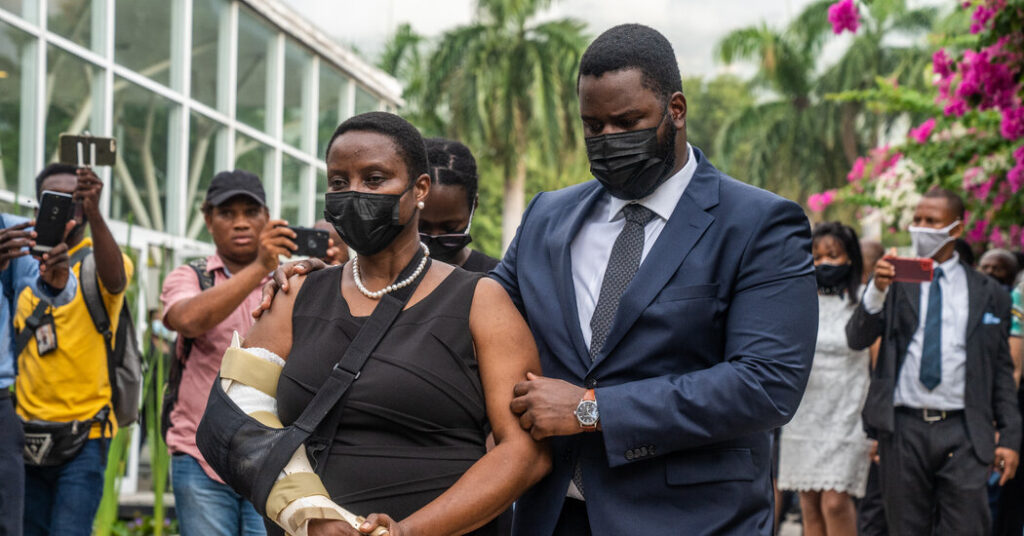
Mr. Moïse’s widow, Martine Moïse, 51, resumed testifying on the second day of the U.S. trial of four men accused of plotting her husband’s murder and hiring a Colombian hit team to carry it out. Ms. Moïse’s testimony is expected to be critical to placing the Colombians at the scene.
Picking up her story at the moment of execution, Ms. Moïse said she had watched, already wounded herself by several gunshots, as one of the gunmen stood over the president and unleashed the final hail of bullets. She saw his body quiver. “He made a sound like an ‘Oh,’” she said.
“Right then I closed my eyes, because I realized no one was coming to my rescue,” she added, speaking in Haitian Creole with the help of an interpreter.
An autopsy found that Mr. Moïse died instantly, struck by 12 bullets.
Ms. Moïse said she didn’t open her eyes again, even as one of the men grabbed her by the leg and flipped her over, then flashed a light across her face, presumably checking if she was still alive.
Blood trickled out of her mouth, she said, from one bullet wound that doctors said almost grazed her lungs.
Apparently satisfied that she was fatally injured, the gunmen fired no more.
The Miami trial centers on the actions of a small, Miami-area security firm, Counter Terrorist Unit Federal Academy, or CTU. The prosecution says the security firm was hoping to overthrow the president to obtain lucrative security contracts from his replacement.
The defendants include the company’s co-owners, a Venezuelan American businessman, Antonio Intriago, and his Colombian partner, Arcangel Pretel Ortiz, as well as their business partner, an Ecuadorean American, Walter Veintemilla, and a Haitian American security officer, James Solages.
The four are accused of hiring a 20-man Colombian hit team to assassinate the president.
Defense lawyers contend their clients are innocent and had hired the Colombians to provide security for what they believed was a legitimate arrest and removal from power of Mr. Moise. They say the security firm was accidentally caught up in a sinister scheme by shadowy Haitian forces who contorted the firm’s legitimate security mission for their own plan to get rid of Mr. Moïse.
During a lengthy interview with The New York Times in 2021, Ms. Moïse said she, like many Haitians, believed there must have been a mastermind behind the attack, someone giving the orders and supplying the money.
On Wednesday, Ms. Moïse told the jury she heard the gunmen speaking Spanish, and referring to one of the crew by the nickname, “Jefe,” Spanish for “boss,” and another as “Pipe,” who prosecutors have identified in court documents as a former Colombian Special Forces officer, Victor Pineda.
Mr. Pineda, who like most of the other men accused of carrying out the killing is in jail and awaiting trial in Haiti, was separately identified as the shooter by one of a fellow defendant during interviews conducted by Colombian military intelligence with captured members of the team in the days after the assassination, according to audio recordings revealed by Caracol Noticias, a Colombian TV station.
The armed men appeared to be rummaging through the president’s belongings and filing cabinet, looking for something, Ms. Moïse said. Several times she heard them say, “That’s not it,” until one exclaimed, “This is it.”
It’s unclear what they were looking for, though one theory the defense lawyers have floated is that they were searching for an executive order the president had reportedly signed appointing a new prime minister, which had yet to be announced.
Jurors were shown a necklace belonging to the former first lady and two watches belonging to the president and his wife, which were later recovered from one of the Colombians detained after the assassination.
Under questioning by a Haitian American prosecutor, Altanese Phenelus, the former first lady was more composed after repeated struggles to contain her grief on her first day of testimony on Tuesday.
On Wednesday, Ms. Moïse described being awoken at 1 a.m. by intense gunfire outside the house that she said lasted about 45 minutes. “I could hear pieces of cement breaking,” as bullets hit the residence in the hills above the capital, Port-au-Prince, she said.
In his final minutes alive, Mr. Moïse made a series of ever more desperate calls to the heads of his security team, and Haiti’s police chief, for urgent help. But they arrived too late.
The president’s 50-man, three-tier security ring had evaporated, some running away, while others had failed to show up for work that day after the conspirators paid out about $80,000 in bribes, according to testimony provided by another participant in the plot who accepted a plea deal.
Under cross-examination, defense lawyers focused on highlighting inconsistencies between what Ms. Moïse said Wednesday and what she told F.B.I. investigators in the days after the assassination as she was recovering in hospital.
David Howard, one of the defense lawyers, questioned her memory of the 45 minutes of gunfire outside the house before the attackers entered, reminding her that she told the F.B.I. it had lasted only five or six minutes.
Prosecutors later had Ms. Moïse say that she was in significant pain and taking painkillers after surgery when the F.B.I. interviewed her.
Ms. Moïse looked down as she described the traumatic moments before her husband was killed, watching his agonized face through the gap under the bed they had tried to hide beneath.
“I saw his face disfigured, as someone who is telling himself, ‘OK, it’s over,’” she recalled.
She said she lifted her head and raised a finger “so he could see that I was still alive.”
Next she heard one of the gunmen issue a description of a man they were looking for: “someone who was slim, Black and tall.”
Then, she said, “they just went ahead and shot the president.”
Moments later, a photograph of the dead president was sent to the phone of one of the Colombian team waiting outside the residence, phone records show.
After the gunmen left, Ms. Moïse said, she dragged herself on the floor to her husband’s side.
“I looked at him and I saw his eye was out,” she said, sobbing. “I cried to God, ‘Why is it I am still alive.’”
The post Haitian President’s Widow Recalls Killers Spoke Spanish and Used Nicknames appeared first on New York Times.