Conservative leaders flew across the globe and over the Andes to one of the world’s southernmost capitals this week for the inauguration of Chile’s right-wing president, José Antonio Kast.
They arrived in Santiago from Washington, Budapest, Madrid and even farther, for an event that turned a routine transfer of power into a celebration of a movement that is gaining momentum across the hemisphere.
“There is something in the air,” Kevin Roberts, the president of the Heritage Foundation, an influential conservative Washington research institute, said in an interview on Tuesday in Santiago, the Chilean capital, where he had also traveled for the inauguration.
“This is an ascendant movement right now,” he added. “And it’s very exciting.”
The inauguration of Mr. Kast, a Catholic and a father of nine who has spent most of his political career railing against abortion and more recently crime and illegal immigration, follows a string of conservative electoral wins across Latin America in the past year.
Mr. Kast joins a growing roster of leaders in the hemisphere aligned with President Trump, who has put a greater focus on Latin America and is leaning on his ideological allies to help take on drug cartels and purge Chinese influence from the region.
“What we see today looked like a dream only a few years ago,” said Jorge Martín Frias, a Spanish lawmaker in the European Parliament and a member of Spain’s far-right Vox party. He spoke at a conference called “Patriotism and Freedom,” which right-wing research groups from across the world had organized at a Santiago hotel.
Mr. Frias noted the recent election victories by President Javier Milei of Argentina, President Nasry Asfura of Honduras and President Santiago Peña of Paraguay — all conservatives.
“There are reasons for happiness, no doubt,” Mr. Frias added.
Still, Latin America’s three most populous countries — Mexico, Colombia and Brazil — are governed by left-wing leaders, though Colombia and Brazil face highly unpredictable elections this year. In Peru, a right-wing candidate is leading the polls ahead of a general election next month.
Experts say the success of right-wing leaders is driven by a surge in anti-incumbent sentiment and growing concerns over crime and security, issues that conservative candidates have successfully capitalized on.
While the Trump administration looks on enthusiastically at this trend, it remains unclear whether countries will be willing to work with the United States on security, or move away from China, which has become a dominant trading partner.
“Amid all the celebration among conservatives, there are two big questions,” said Benjamin N. Gedan, director of the Latin America program at the Stimson Center, a research organization in Washington. “How long will this last and in the meantime will it generate meaningful cooperation?”
That skepticism had not been invited to Mr. Kast’s inauguration.
“I hope this right-wing wave also reaches Brazil,” said Flavio Bolsonaro, a son of former right-wing Brazilian President Jair Bolsonaro, who was also in Santiago.
Flavio Bolsonaro plans to challenge Brazil’s leftist president, Luiz Inácio Lula da Silva, in his country’s general election in October. Mr. Bolsonaro is taking the place of his father, who is serving a 27-year prison term for plotting a coup to cling to power after losing the last election in 2022.
Trump Administration: Live Updates
Updated
- The Senate resoundingly passed a major housing bill, but challenges lie ahead.
- The Trump administration has sued California over tailpipe emissions limits.
- A statue of Trump and Epstein re-enacting the ‘Titanic’ pose appears on the National Mall.
Mr. Lula decided at the last minute not to attend Mr. Kast’s inauguration, sending his foreign minister instead. A spokesman for Mr. Lula cited a scheduling conflict, but a person close to the Brazilian presidency said Mr. Kast’s invitation to Flavio Bolsonaro played a role in his decision to cancel the visit. The person asked not to be identified because he was speaking about a sensitive issue.
Mr. Lula “declined to come here because he knew that Flávio Bolsonaro would also be present,” Mr. Bolsonaro said, referring to himself in the third person.
Attendees at the inauguration included U.S. Deputy Secretary of State Christopher Landau; the presidents of Argentina, Bolivia and Ecuador; and Maria Corina Machado, the leader of Venezuela’s main opposition. A large group of anti-abortion and conservative activists from around the world were also on hand.
“This goes beyond a presidential inauguration,” said Jesús Magaña, a Colombian anti-abortion activist. “It’s a change of rhythm in the region.”
After discussing the damage inflicted by “wokism” and praising Mr. Trump over pisco sours and canapés at the patriotism conference in Santiago, attendees traveled to the coastal Chilean city of Valparaíso on Wednesday for the official inauguration ceremony in the country’s Congress.
There, Chile’s outgoing leftist president, Gabriel Boric, handed off the presidential sash to Mr. Kast.
Mr. Boric, a former student leader who was elected on the tails of a social movement demanding economic equality, more rights for women and Indigenous people, left congress in his usual relaxed look, without a tie, driving his own car accompanied by his daughter, whom he has brought to work before, and unmarried partner.
Some of his young ministers stood in the crowd as their successors were announced, including Antonia Orellana, a feminist who pushed abortion legislation in congress and was replaced as women’s minister by an evangelical anti-abortion campaigner.
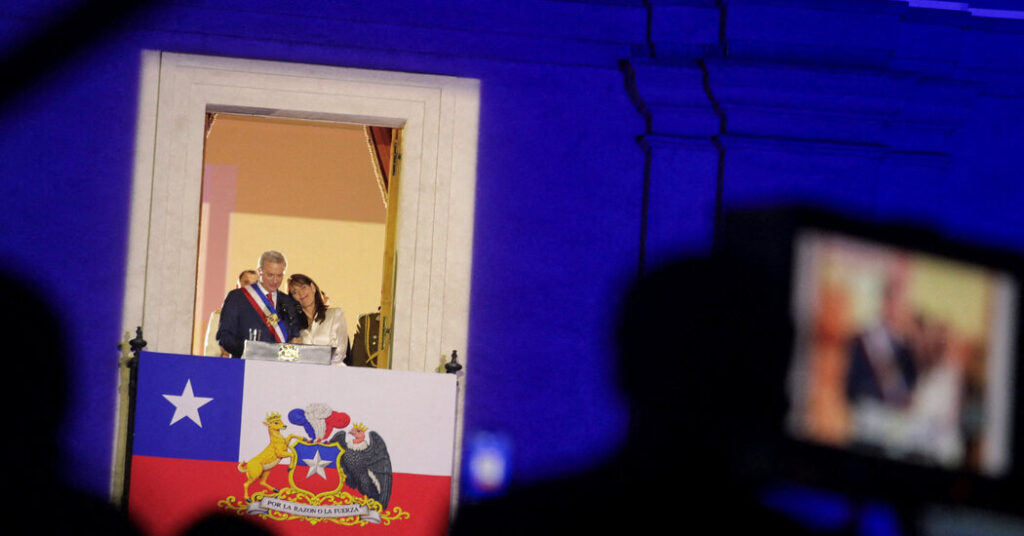
“We are going to take back our country,” Mr. Kast told the crowd on Wednesday night from a balcony of the presidential palace in Santiago, as supporters were handed red “Make Chile Great Again” baseball caps sponsored by Passapoga, a local strip club.
“We are going to take back our streets,’’ Mr. Kast said. “We are going to take back our institutions. We are going to take back hope.”
There are many questions about how Mr. Kast will govern.
He has recently avoided referring to some of his most divisive positions, like his opposition to abortion. His agenda includes cuts to taxes and public spending, and a crackdown on crime and illegal migration. At his inauguration, he mentioned crime but not abortion.
Mr. Kast last week attended a summit in Miami, where Mr. Trump welcomed conservative leaders from the region to discuss fighting drug trafficking.
He also faces the difficult task of navigating close economic ties with China just as the United States is seeking to roll back China’s presence in the region.
Chinese state-owned firms control more than half of Chile’s electrical grid, and China is Chile’s main trading partner and the top buyer of its copper. It is unclear whether Mr. Kast will be willing to curtail China’s role in Chile, a challenge that other allies of President Trump across the region, including Mr. Milei of Argentina, also face.
Mr. Roberts of the Heritage Foundation was optimistic.
“There’s excitement about the United States being in its backyard again,” he said. “I anticipate that we will be down here a lot.’’
Ana Ionova contributed reporting from Rio de Janeiro, Brazil, and John Bartlett from Santiago, Chile.
Emma Bubola is a Times reporter covering Argentina. She is based in Buenos Aires.
The post Conservative Euphoria Hits Chile as Right Surges in Latin America appeared first on New York Times.